Deforestation: Grade 9 Understanding for IGCSE Biology 4.18B

Deforestation

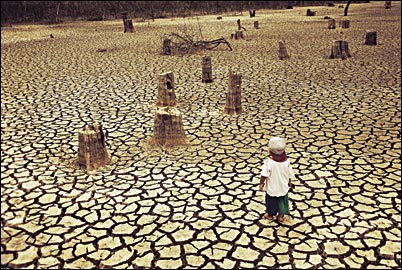
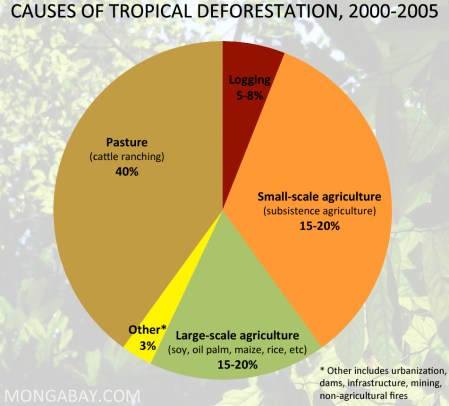
Deforestation means the cutting down of mature forest and woodland for non-forestry purposes.  No new trees are planted and so the total area of forest decreases.  Humans have cut down forests for many reasons and have built their economies on exploiting natural resources.  Forests today are cleared to provide wood for logging, to provide land for building homes, for subsistence farmers as well as for commercial growing of crops and cattle farming.
causes-of-tropical-deforestation

Deforestation happens all the world.  (It is worth noting that the only reason there are no European countries on the list below is because all our forests were cleared very effectively some time ago….)
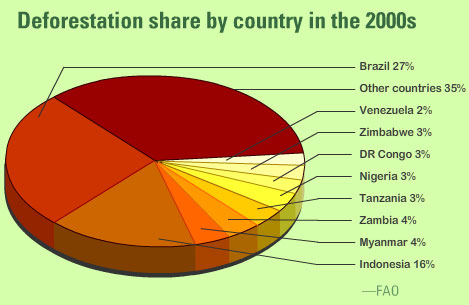
deforestation-by-country

What are the biological consequences of deforestation?

Wherever deforestation occurs, the biological consequences are the same:

  1. Atmospheric Gases
  2. Soil Erosion
  3. Disturbance to the Water Cycle
  4. Loss of Biodiversity (inexplicably omitted by the people who wrote the specification

Growing trees have a net uptake of carbon dioxide and a net loss of oxygen due to photosynthesis.  Carbon dioxide is a gas that acts as a pollutant in our atmosphere because it is a greenhouse gas.  Carbon dioxide concentrations have been rising over the past century and this is leading to permanent and potentially damaging alterations to the earth’s climate system – a process called climate change.  Oxygen is the gas that almost all organisms require for their respiration.
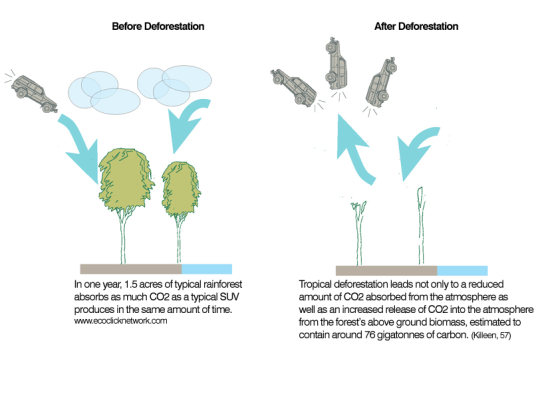
before-and-after-deforestation

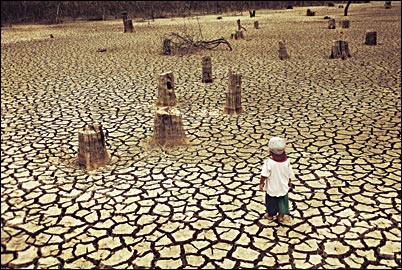
In many tropical regions, forests protect the sometimes violent tropical storms from hitting the ground. When forest cover is removed, rainfall hits the soil much harder and this can lead to loss of topsoil in a process called soil erosion.  As the water runs through the soil, it will dissolve minerals as it goes, thus leaving the soil that is left denuded of essential minerals for plant growth.  This leaching of minerals makes it difficult to use the land cleared for agriculture and so more forest is cleared.

Deforestation also disrupts the water cycle.  Trees move large volumes of water a year from the soil into the atmosphere in a process called transpiration.  So when trees are lost, less water evaporates from the soil, more water is lost in run-off and so rainfall can be reduced.
deforestation

The diagram below shows a before and after explanation of how the water cycle is disrupted. (Evapotranspiration is a term for the total water evaporated from a piece of land, combining evaporation directly from the ground and transpiration lost from plants)
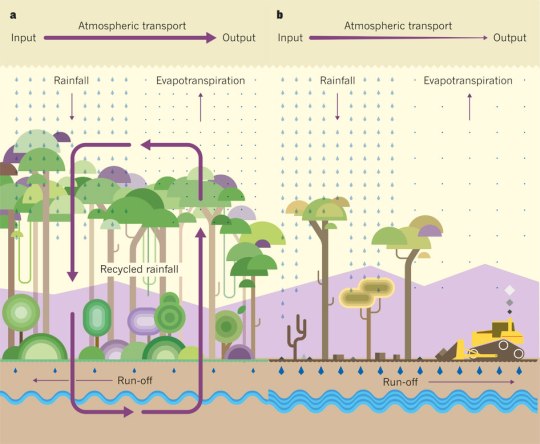
nature11485-f1.2

There is a final problem with deforestation although the examiners have omitted it from the specification for some inexplicable reason.  Forests provide a habitat for a wide variety of animal and plant species.  So when forests are lost, species become extinct.  This loss of biodiversity is a final terrible consequence of deforestation.  80% of known species live in tropical rainforest so the fact that in the last 50 years, over half of this area has been cleared is a major concern.  The rate of loss of rainforest is around 140,000 square kilometres a year although in some parts of the world, the rate of loss is slowing.

Deforestation is a complex issue and a GCSE revision blog like this is not the place to go into the interesting political and cultural details. I would direct you to the WWF site for more information and indeed some ideas as to what we can do to help.

http://wwf.panda.org/about_our_earth/deforestation/


Differences between Sexual and Asexual Reproduction: Grade 9 Understanding for IGCSE Biology 3.1 3.2

All organisms have the potential to reproduce.  Reproduction is one of the 7 characteristics of life (8 if you study EdExcel IGCSE Biology…..) and of course it means the ability to produce new individuals.  But over the 4 billion or so years life has been around on the planet, evolution has developed a myriad ways of producing new individuals.  So as biologists are simple folk (well all the ones I work with are….), it makes sense to group different reproductive strategies together to make it easier to understand.

The major distinction between different ways of reproducing is to divide them into asexual and sexual reproduction.  This works fairly well, although it seems to be a subject many GCSE students don’t understand too well.  So here goes….

The first big idea to dispel is that the number of parents involved determines whether reproduction is sexual or asexual.  Too often I am told that asexual involves one parent, sexual two.  But although this works in most cases, sexual reproduction can happen with only one parent, for example in flowering plants that self-pollinate.  So we need a different way of deciding whether reproduction is sexual or asexual.

And in fact a clear distinction does exist and it is to do with genetics.  If the offspring produced are genetically identical to the parent (i.e. a clone) then it is an asexual form of reproduction.  If the offspring produced are genetically different to the parents, then it is sexual.

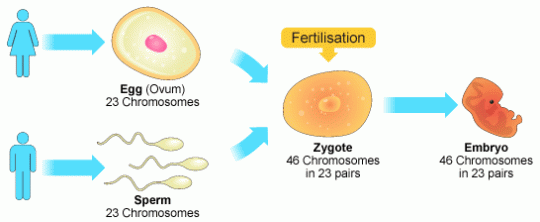
Often sexual reproduction involves the process of fertilisation.  This allows two parents to each contribute half their genetic material to their offspring thus generating individuals with new and unique genetic make ups.   These specialised cells that contain half the genetic material are called gametes and as you all know, they are made by a special type of cell division called meiosis.  Meiosis is vital for sexual reproduction as it produces cells that are haploid (one member of each pair of chromosomes) and all genetically unique.

28e8093a6c73a669578e4ece04543452e0cb08cf

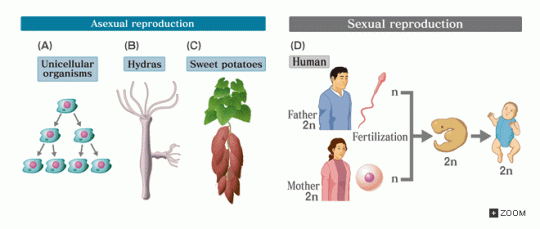
So this diagram shows two humans each producing gametes by meiosis.  The parents on the left will have 23 pairs of chromosomes and so each haploid gamete will have 23 individual chromosomes.  Fertilisation restores the diploid number.  Mitosis is then used to turn this single cell, the zygote into a multicellular embryo and then indeed into a new individual.  (You will remember mitosis is a type of cell division that always produces genetically identical daughter cells)

fig12_1

The examples of asexual reproduction on the left all involve only this second type of cell division, mitosis.  There are no gametes, no fertilisation and hence no genetic variation.  The simplest type of asexual reproduction is shown as (A) and this is called binary fission.  A single-celled organism can divide in two to produce two genetically identical daughter cells.  Hydra (B) are a simple type of animal and they reproduce by budding.  A new individual just grows off the side and when it is big enough, it drops off….. And many plants can reproduce asexually using a technique called vegetative propagation.  The sweet potato plant in (C) can produce several offspring plants from each potato but as they are all clones of each other, this is definitely asexual reproduction.

Students do get confused with this topic so please ask me a question using the comment feature below the post.  Keep revising hard!

Use of Quadrats: Grade 9 Understanding for IGCSE Biology 4.2 4.4B

This is going to be a dull post so I shall get my apologies in early…. Please do not read this if you are hoping to be inspired by the beauty of science nor if you want to learn about cutting edge technologies.  If you are struggling with insomnia or have a strange interest in square-shaped pieces of metal, this post might be suitable for you.

A quadrat is just a small square used in environmental biology to estimate populations of plants or to sample within an ecosystem.

1099-01_prd1347

This quadrat is 50cm by 50cm and divided into 25 smaller squares, just to make it slightly less dull….

There are two uses of quadrats.  The first is to make estimates of population, the second to investigate the distribution of organisms in an ecosystem.  Your school probably has playing fields and on the playing fields there will be plants such as dandelions.  But how many dandelions live on your playing field?  Well if you were feeling desperate, you might distract yourself by attempting to find this out.  You could cover every square inch of the field and keep an accurate tally count of the dandelion plants you find.  But this would take a long time and even plant ecologists have better things to do with their time.   So a quadrat can be used to randomly sample the field to save you the bother of counting every single plant.

How to use quadrats in random sampling?

Each quadrat has an area of 0.25m2 (50cm by 50cm).  So let’s imagine you randomly place your quadrat 10 times on the playing field and count the dandelion plants in it each time.   You get the following results:

1,1,3,4,0,3,0,1,0,2

This gives an average of 1.5 dandelions per quadrat.  If this is a representative sample of the total population, you can now estimate the total population of dandelion plants in the field.  You will need to know the total area of the field – let’s pretend it is 200m2.

So each quadrat contains an average of 1.5 dandelions.  How many quadrats in total represent the whole playing field?  You would need 800 quadrats to cover the whole field, so our estimate for the total population of dandelions is 1.5 x 800 = 1200 dandelions.

How do you get random samples?

The only way to sample randomly is to use truly random numbers to represent coordinates in the field.  Shutting your eyes and spinning round until you are disorientated before hurling the quadrat or perhaps alternatively dropping the quadrat from a great height both sound like random procedures but they are not….

Random numbers can be obtained from tables or from a website such as random.org

PB_fieldwork-using-your-school-playing-field-1

Sampling with a quadrat can only be done if the organisms you are trying to count do not move around, so basically it works for plants and barnacles.

Right I am feeling sleepy just writing about quadrats so am off for a lie down.

Digestion of Lipids: Grade 9 Understanding for IGCSE Biology 2.29 2.30 2.31

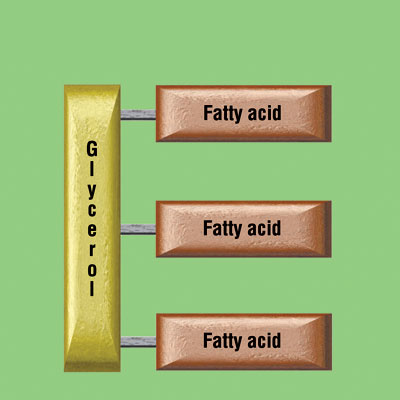
A balanced diet will contain many different fats and oils.  The commonest type of molecule in these lipids is called a triglyceride.  They are made from a small molecule of glycerol attached to three fatty acids.

86940Simplified_00000059575

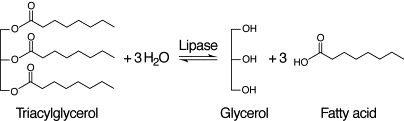
These triglycerides are too large to be absorbed in the small intestine (ileum) and so need to be broken down into their constituent parts.  In the digestive system there are enzymes called lipases that can catalyse the digestion of lipids into fatty acids and glycerol.

gr1

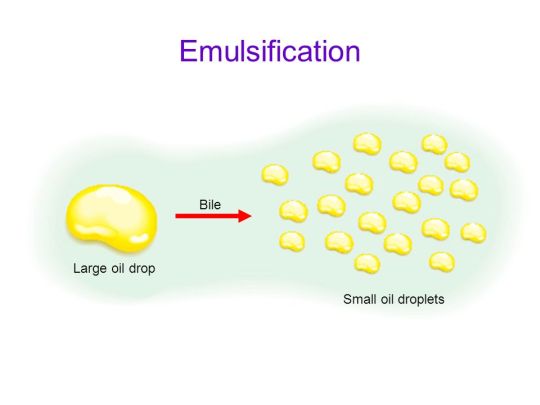
Most digestion of lipids happens in the duodenum.  The pancreas produces a lipase enzyme that mixes with the food in the duodenum.  Although bile does not contain any digestive enzymes, it does have bile salts that play an important role in the digestion of lipids.  Bile salts cause large fat droplets in the duodenum to change into many smaller lipid droplets – a process called emulsification. (Read my post on bile if you want more details here….)

slide_32

Fatty acids and glycerol molecules are small enough to cross the epithelium in the villus in the ileum.  This absorption of fatty acids and glycerol is slightly different to the other products of digestion as they do not pass immediately into the blood.  They are assembled immediately into structures called chylomicrons and these move into the single, blind-ended tube in the villus called a lacteal.  The lacteals merge together into lymph vessels that eventually empty into the blood in the neck.  (Please read my post on absorption in the small intestine to read more about this)

Digestion of Proteins: Grade 9 Understanding for IGCSE Biology 2.29

Proteins are large insoluble molecules made up of many hundreds of amino acids joined together in a long chain.  So in order to obtain these molecules from our diet, the large protein must be digested (broken down) into the smaller amino acid subunits.  Amino acids can be absorbed into the blood stream in the ileum, part of the small intestine.

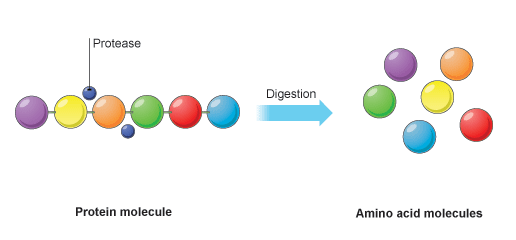
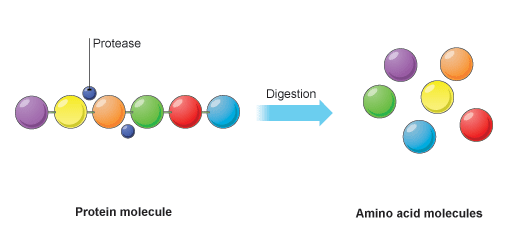
The family of enzymes that can catalyst the digestion of proteins are called proteases.

eb34a2a670077be85de3000b88ed2da8cd2d55fb

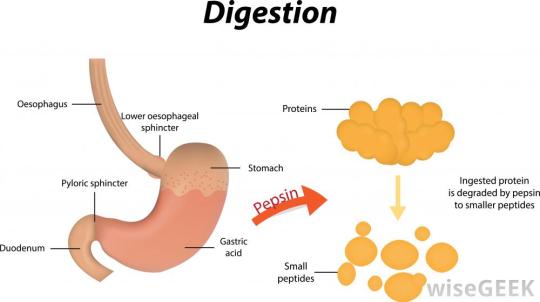
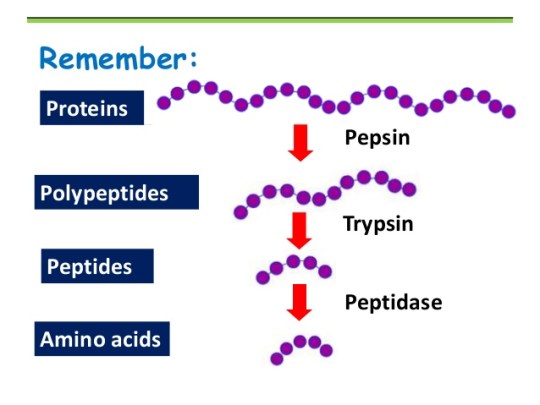
Protein digestion happens in a two-stage process.  In the first stage the large protein molecules are broken down into smaller proteins (often called polypeptides) by a protease enzyme.  Pepsin is one such protease and acts in the stomach.

digestion-diagram-with-pepsin-note

Remember that the food in the stomach is mixed with hydrochloric acid.  This results in a very acidic liquid in the stomach (chyme).  Pepsin works in the stomach and so rather unusually for a digestive enzyme, it has an optimum pH of pH 1.5 – pH2.

The second protease enzyme that you should know about is trypsin.  Trypsin is made in the pancreas and so enters the duodenum soon after the stomach contents pass the pyloric sphincter (see diagram above).  The acidic chyme that enters the duodenum is rapidly neutralised by hydrogencarbonate ions (an alkali) secreted in the bile and in pancreatic juice.  Trypsin has an optimum pH of around pH 7.5.

digestion-68-638

As shown in the diagram above, there is a final stage to protein digestion.  The actions of pepsin in the stomach and trypsin the duodenum result in small protein fragments called peptides.  Many peptides are still too large to be absorbed into the blood in the ileum and so need digesting further into their constituent amino acids.  Peptidase enzymes are embedded in the epithelial cell membranes in the small intestine and this final reaction completes the digestion of proteins.

Amino acids are absorbed by active transport into the blood capillaries in the villi in the small intestine.

Starch Digestion: Grade 9 Understanding for IGCSE Biology 2.29

You must remember that “Digestion” has a specific meaning in Biology.  It is the term used for the process that involves the chemical breakdown of large, insoluble food molecules into smaller, simpler molecules that can be absorbed into the blood.  Many of the molecules in food are polymers – that is macromolecules made from long chains of repeating subunits.  Examples of dietary macromolecules include proteins, polysaccharides and fats.  These molecules are too large to be able to pass into the blood in the villi of the small intestine and so the body has evolved to chemically break them down into their constituent monomers or building blocks.  Digestion is the process in the alimentary canal that achieves this.

Digestion reactions are also known as hydrolysis reactions because a molecule of water is required in the reaction to break the covalent bond holding the monomers together.  These reactions are all catalysed (sped up) by specific molecules called digestive enzymes.

Why do different food types need different digestive enzymes to speed up their breakdown in the digestive system?

(If you are unsure, you need to revise the way enzymes work to catalyse reactions by a “lock and key” theory?)

Digestion of Carbohydrates

Many simple carbohydrates (e.g. glucose) do not need digesting.  This is because they are already small enough to be absorbed into the blood directly in the ileum (small intestine). But larger disaccharide sugars (e.g. maltose and sucrose) do need to be broken down, as do all polysaccharides (e.g starch).

The family of enzymes that break down carbohydrates are called carbohydrases.

93c2ed0cd53f5a0c0b1dc706885c32245a34e001

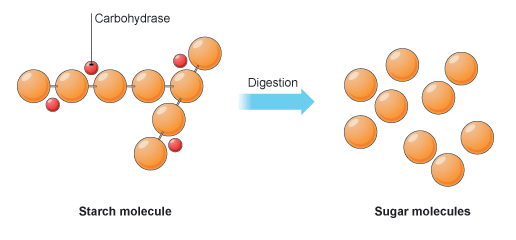
Starch is a large polysaccharide made up of many hundreds of glucose residues linked together.  It is way too big to be able to cross the epithelial lining of the small intestine and so needs to be digested.  This happens in a two-stage process.  Firstly there is an enzyme amylase that can catalyse the following reaction:

starch + water ——-> maltose

Amylase is made in the salivary glands and so works in the mouth.  But the main region for the digestion of starch is in the duodenum.  This is because amylase is also made in the pancreas.

Maltose is a disaccharide molecule made of two glucose residues joined together.  Maltose itself requires digesting to its constituent glucose molecules in order to be absorbed.  So the second stage in the digestion of starch involves a second enzyme, maltase that is found embedded into the epithelial lining of the ileum.  Maltase catalyses the breakdown of a molecule of maltose into two molecules of glucose which can be absorbed into the blood.

maltose + water ——> glucose

4502875


Bile: A* Grade 9 Understanding for IGCSE Biology 2.30 2.31

The liver is the largest internal organ and plays over 500 different roles in the body.   Many functions are to do with the processing of various chemicals such as carbohydrates, amino acids and lipids.  The liver also removes alcohol and other drugs from the bloodstream:  this is why alcoholics often suffer from liver disease.

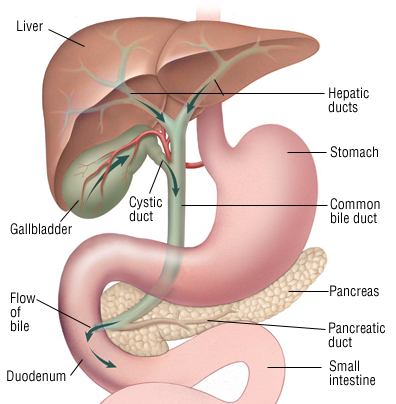
But one function of the liver that you need to understand in detail concerns its role in the digestive system.  The liver cells produce a green liquid called bile which is stored in a sac underneath the liver called the gall bladder.  Bile can pass from the gall bladder down the bile duct and as shown in the diagram below, it then mixes with the contents of the duodenum (small intestine) soon after the acidic chyme leaves the stomach.

image

What is in bile?

Bile contains a mixture of chemicals.  It has an alkaline substance (hydrogencarbonate ions) which helps to neutralise the chyme as it leaves the stomach.  Remember the pH of the stomach contents is around pH1-2 and in the duodenum, there is a pH of around pH7.5.  The difference in pH is due to the alkali present in bile and pancreatic juice.  Bile also contains excretory molecules called bile pigments.  These are waste molecules from the liver that have been made from the breakdown of haemoglobin.  And finally there are the bile salts.  These play an important role in the digestion of lipids in the duodenum.

How do bile salts improve digestion of lipids in the duodenum?

The duodenum is where many digestive reactions happen in the body.  This is because the pancreatic juice contains many enzymes, all of which catalyse a specific digestive reaction.  One such enzyme is lipase and this enzyme catalyses the following reaction:

lipids + water ——> glycerol and fatty acids

gr1

Fatty acids and glycerol are small enough molecules to be absorbed into the villi in the ileum.  They pass into the lacteal in the centre of each villus to be carried around the body in the lymphatic system.

But the problem is that in the duodenum, the lipid molecules will exist as large droplets.  Large droplets of fat/oil will have a reduced surface area for lipase to bind to and so the rate of digestion of the lipid would be slow.  But bile salts interact with the lipid droplet causing a few large droplets to be broken down into dozens of tiny droplets.  This is called emulsification and while it does not chemically alter the lipid, it does make it easier for lipase to break it down.  Lipase and bile salts together break down lipids much faster than lipase alone.slide_32

Final key point:  there are no digestive enzymes in bile.  But in spite of this, bile plays a crucial role in the digestion of lipid droplets in the duodenum.

Small Intestine: Grade 9 Understanding for IGCSE Biology 2.32

The first part of the small intestine, called the duodenum is principally involved in digestion.  Large insoluble food molecules such as proteins, lipids and starch are chemically broken down into smaller molecules in reactions catalysed by digestive enzymes.

This post will look at the longer regions of the small intestine, the jejunum and ileum.  There are some digestive reactions that happen here but the main function of these parts of the intestine is the absorption of the smaller products of digestion into the body.

smintestine_parts


You should understand already which molecules are produced as products of digestion:  glucose from the digestion of carbohydrates, amino acids from the breakdown of proteins and fatty acids and glycerol from the digestion of triglyceride lipids. (see my post on digestion) These then are the molecules that diffuse from the intestine into the body in the small intestine.

How is the structure of the small intestine adapted for absorption?

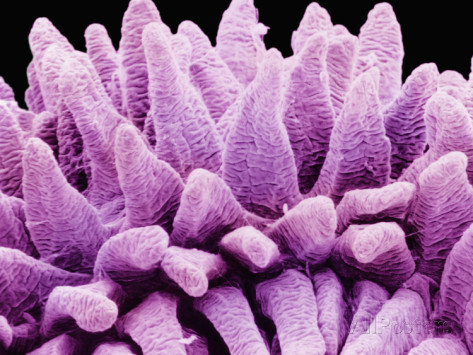
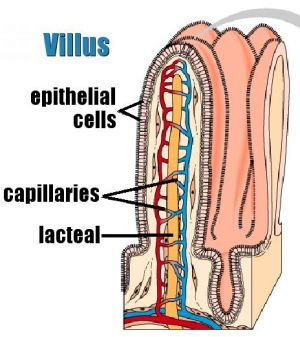
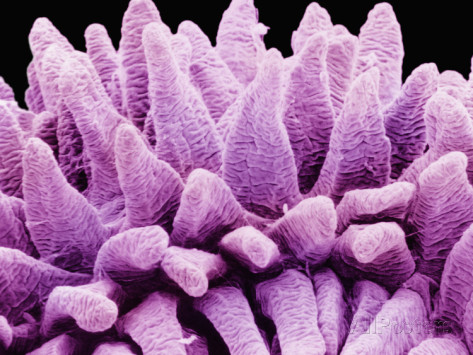
The main idea here is that the lining of these parts of the small intestine has a very large surface area.  The intestine is long, the wall is ridged and the lining (called the epithelium) has many thousands of tiny projections called villi.  Each villus is 1-3mm long but the effect is to increase the surface area for absorption by many hundreds of times.

villus  kessel-shih-the-finger-like-villi-in-the-mammal-small-intestine-mucosa-greatly-increase-the-surface-area

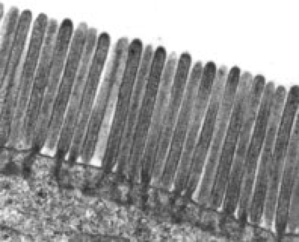
These epithelial cells have a cell membrane which is folded into many thousands of tiny structures called microvilli.  Microvilli (or a brush border) can only be seem with an electron microscope and act to increase the surface area still further.

microvilli21340815507988

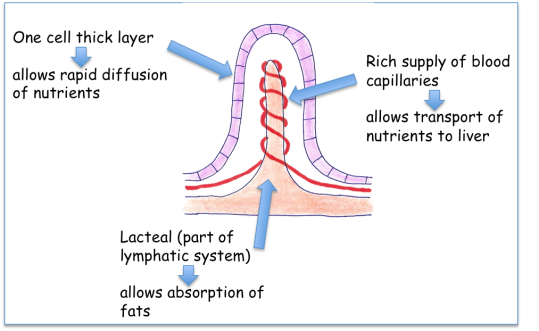
The cells that line the villus are called epithelial cells and are found in a layer that is just one cell thick.  This reduces the distance the products of digestion have to move across to be absorbed.

Each villus contains a dense network of blood capillaries.  This means that glucose and amino acids can easily diffuse into the blood and then be taken away from the small intestine to the liver in the hepatic portal vein.  There is also a blind-ended single tube called a lacteal in each villus.  This tube forms part of the lymphatic system and is used to transport fatty acids and glycerol away from the small intestine.

VillusLabelled

What’s the point of graphs? Help for IGCSE Biology

A student contacted me to ask “what’s the point of graphs?”  I hope this short post may help.

A graph is just a way to visually represent the data you have collected in an experiment so it is easier to see any patterns.  Some people can see trends and patterns just in a column of numbers, but I need a graph to show me exactly what is going on.

There are a few essential things when plotting a graph in an exam question.  The examiners use the acronym SLAAP for allocating marks so students should be fully aware what these mark points stand for….

S stands for Scale:  choose a linear scale on the two axes that means your graph uses up as much of the space given on the page – this mark will not be given if a tiny graph is plotted in the bottom left corner of the page.

L stands for Line:  when plotting experimental data in Biology, it can never be wrong to join each point to the next with a straight line.  This “dot to dot” plotting does not allow you to read off the graph to find intermediate values, but does best show the trend in results.  But read the question carefully – the examiner may want you to plot a “line of best fit” or a freehand curve through the points.  If they don’t explicitly mention it, get a ruler and join dot to dot with straight lines.

A stands for Axes:  have you plotted the axes the correct way round?  This often foxes students as they don’t see why it is so important.  But there is a correct way of plotting a graph.  The thing that you have measured in your experiment (the dependent variable) always goes on the y axis.  The thing that you have altered in your experiment (the independent variable) always goes on the x axis.

A stands for Axes (again):  this mark is for labelling your axes correctly.  Everyone puts the numbers on the axes but often students leave out units and so lose the mark.  Remember to always add the units to every axis you plot!

P stands for Points:  this mark is for correctly plotting the points on the axes you have drawn – now what could be simpler than that!

A well plotted graph that would score 5/5 on an iGCSE question.  They have measure the speed of a car starting from rest for 6 seconds – perhaps it’s not a car but a rocket…. 40m/s after 6s sounds like impressive acceleration to me!

2000px-ScientificGraphSpeedVsTime.svg

Finally a comment about the difference between precision and accuracy when analysing experimental data.  In an ideal world you want your data to be precise and accurate but understanding the difference between the two can be really important….

I think that Precision is to do with how data is measured.  Precise data is clustered closely together.  If you measured the time it takes for a reliable experiment to happen with a sundial, the data would be very imprecise.  The same experiment, measured with a stopwatch would generate precise data.  If asked how to improve the precision of an experiment, the first thing to look at is how is the dependent variable being measured?

 Accuracy is how close your measured value is to the “true” value.  If you are trying to kick a football into a goal and you always hit the left hand post, you are not accurate but you are precise!  Accuracy can often be improved in an experiment by controlling other variables better.

precision_accuracy