Cell Division part I: Grade 9 Understanding for IGCSE 3.15, 3.28, 3.29

At the beginning of March each year, I get my Y11 classes to draw up a list of topics they want to go through again in revision. Cell Division is always there and it is not difficult to see why.  Mitosis doesn’t make any sense unless you understand the concept of homologous pairs of chromosomes and I think you already know that very few iGCSE students do…… (Please see the various posts and videos on the blog on this topic before attempting to understand mitosis)

But there is actually very little to fear in the topic of cell division. If your teacher has told you about the various stages of mitosis that’s fine but you will not be asked to recall them in the exam, at least not if you are studying EdExcel iGCSE.  So in this post I am going to try to focus on the key bits of understanding you need rather than bombarding you with unnecessary details.

1 Chromosomes come in pairs

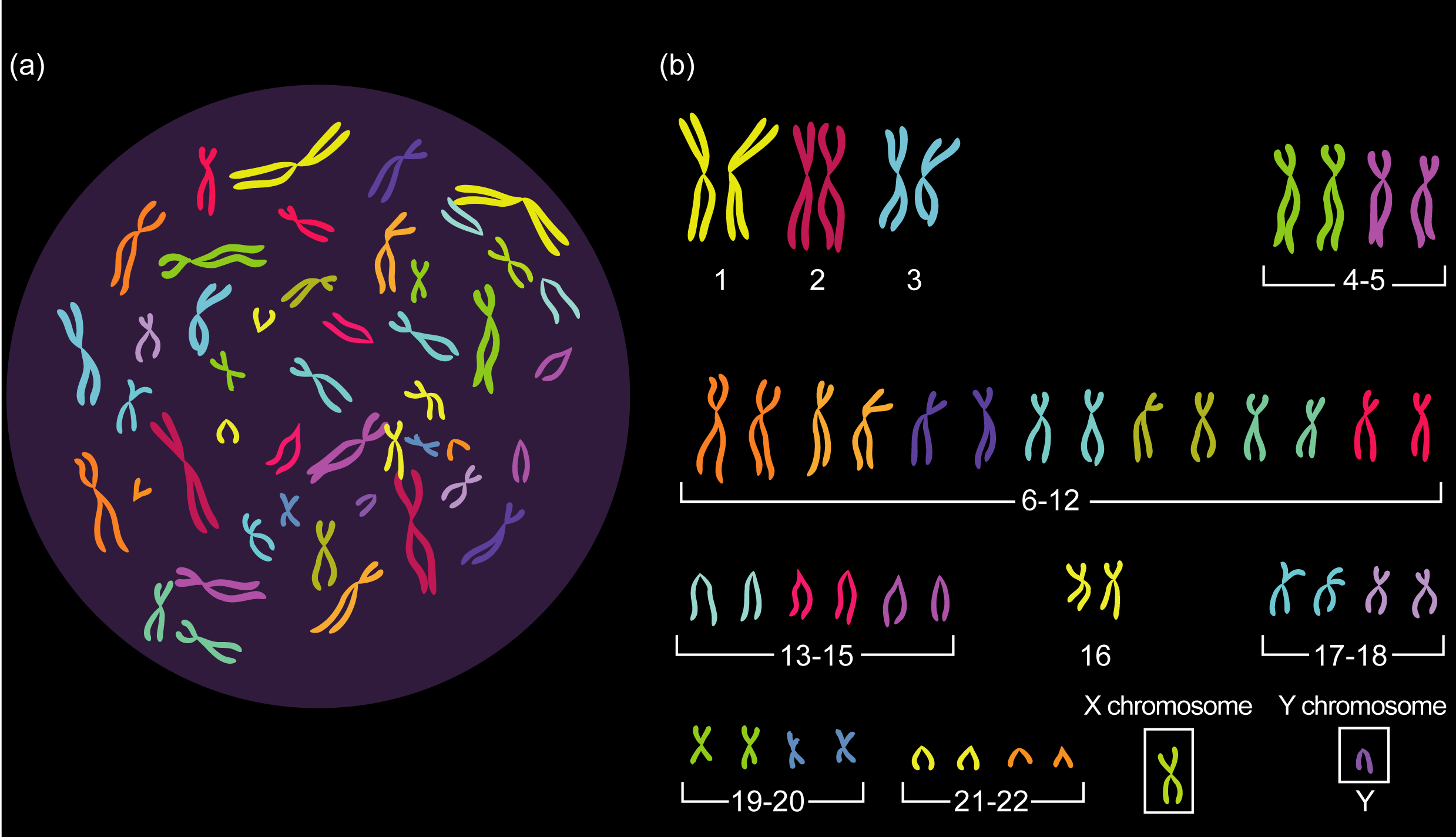
This is the main idea you need before you start.  In almost all sexually-reproducing organisms the cells are DIPLOID.  This means that however many different sized chromosomes they have, in each cell there will be pairs of chromosomes (called homologous pairs)

So human cells contain 23 pairs of chromosomes (46 in total)
chromosomes

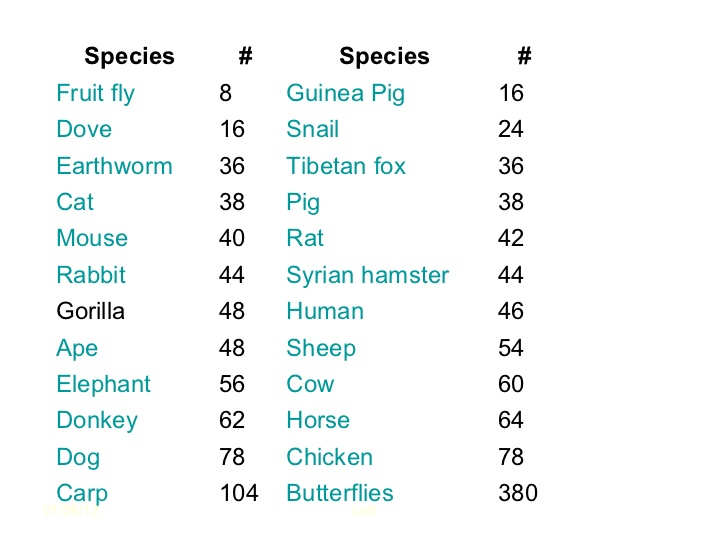
Remember that the number 46 only applies to humans.  Other species have very different numbers of chromosomes in each cell (see table below)
meiosis-ii-16-728

So doves have 8 pairs of chromosomes, dogs have 39 pairs of chromosomes, rats 21 pairs of chromosomes.  The important point is not how many pairs each organism has but that they all have chromosomes that come in pairs!

The chromosomes any individual possesses is determined at the moment of fertilisation.  Sperm and Egg cells (gametes) do not have pairs of chromosomes.  They are the only cells in the body that are not diploid.  Gametes only have one member of each pair of chromosomes.  Cells which only have one member of each pair of chromosomes are called HAPLOID cells.

So every cell in the body is diploid and genetically identical apart from the gametes which are haploid.

2 Organisms that reproduce sexually need two different types of cell division

biology-unit-4-cell-division-types-of-reproduction-3-638

The fertilised egg (zygote) is a diploid cell.  It has pairs of chromosomes that originate one from each parent via the gametes.  Every cell division in growth and development of the embryo and foetus until birth, every cell division in growth and repair after birth always produces two genetically identical and diploid cells from the one original cell.  This cell division that produces genetically identical diploid cells is called Mitosis.

Gametes (sperm and egg cells) need to be made by a different process.  If gametes were diploid then there would be a doubling of the chromosome number every generation and that clearly wouldn’t do.  So a different way of dividing the nucleus has evolved.  It doesn’t produce genetically identical diploid cells but produces gametes that are haploid and genetically unique.  This process is called Meiosis and is only used in the production of gametes.

3 Mitosis is involved in growth, repair, asexual reproduction and cloning

Any process in the body in which the outcome required is the production of genetically identical diploid cells will use mitosis.  (It is not too complicated an idea to see that if you don’t need to make gametes and fuse them together in fertilisation, you can just copy cells by mitosis over and over again.  All the daughter cells will be exact copies of each other and diploid.

Now I know this post is not going to satisfy everyone. I know some of you will want to read about the cell cycle, prophase, metaphase, centrioles, spindle fibres and the condensation of chromosomes, chromatids being pulled apart etc. etc.) And just for you, I will write a post later today on the details of Mitosis….. But please remember that if you are using the blog to revise for exams, none of this second post is necessary and none of it will be tested in the Edexcel iGCSE paper.  If you are doing revision, focus on the key understanding ideas discussed above.  And as always, please leave a reply below to ask questions, comment or leave feedback – all comments welcome!
Female Reproductive System: Grade 9 Understanding for IGCSE Biology 3.8

The human male and female reproductive systems are made from the same embryonic cells and are perhaps more similar in structure and function than is first apparent.  There are two ovaries protected within the pelvic cavity.  The ovary is the site of egg cell production.  The egg cell is the female gamete and is haploid – it has only one chromosome from each homologous pair.  The ovaries are also endocrine organs that produce the female sex hormones oestrogen and progesterone.

[Indeed differences between the gametes is the essential difference between male and female organisms.  Females are always individuals who produce a small number of large, often immobile gametes.  You can easily remember this: female – few, fixed, fat.  Males are organisms that produce large numbers of small, motile games. Male – many, mini, motile.]

X2604-O-20A

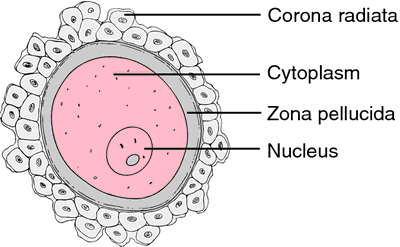
This diagram shows the human egg cell after it has been released from the ovary into the Fallopian tubes (or oviduct). The egg cell is coloured pink in the diagram above (if you are being picky it is not really an egg but a cell called a secondary oocyte but I won’t stress over this now…)  The egg cell is surrounded by a thick jelly-like layer called the zona pellucida and then by a whole cluster of mother’s cells from her ovary – the corona radiata.  The big idea to remember is that the egg cell is very large compared to sperm cells:  it is one of the largest cells in humans with a diameter of about 500 micrometers.

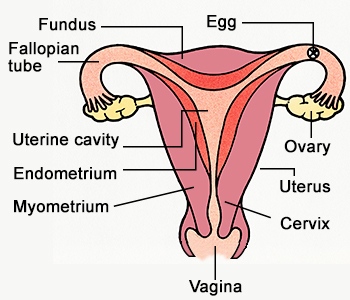
The Fallopian tubes carry the egg down towards the uterus.  The lining of the Fallopian tubes is covered in a ciliated epithelium.  The cilia waft to generate a current that helps move the egg down towards the uterus.  Sperm cells have to swim against this current to reach the egg in the tubes.  The Fallopian tube is the usual site for fertilisation to occur.

labeled-female-reproductive-system-diagram

Once fertilisation has occurred, the newly formed zygote divides over and over again by mitosis to form a ball of cells called an embryo.  The embryo continues its journey down the Fallopian tube until it reaches the uterus.  The uterus (womb) is a muscular organ with a thickened and blood-rich lining called the endometrium.  Implantation occurs when the embryo attaches to the endometrium and over time, a placenta forms.  The embryo develops into a foetus and remains in the uterus for 9 months.

The cervix is a narrow opening between the uterus and the vagina.  It holds the developing foetus in the uterus during pregnancy but dilates (widens) at birth to form part of the birth canal.  The vagina is the organ into which sperm are deposited from the man’s penis during sexual intercourse.  The lining of the vagina is acidic to protect against bacterial pathogens and the sperm cells released into the vagina quickly start to swim away from the acidity in grooves in the lining.  These grooves lead to the cervix and hence into the uterus.

female_reproductive_table

Last few IGCSE Biology blog posts on their way…

I am very close to having a comprehensive coverage of the EdExcel iGCSE Biology specification on my site.  These are the last few topics I need to address:

  • Female Reproductive system
  • Mineral Ions in Plants
  • Human diet
  • The Digestive System in Mammals
  • Small Intestine
  • Comparison between Sexual and Asexual reproduction
  • Cell Division
  • Use of Quadrats
  • Air pollution and Climate Change
  • Deforestation
  • Microorganisms and Food Production
  • Growing Crop plants
  • Fish farming
  • Cloning in Plants
  • Cloning in Animals

I hope that I can write the last few posts between now and Christmas.  Then I can focus again on the common areas of confusion and poor understanding in the run up to iGCSE papers in summer 2016.

Male Reproductive Systems: Grade 9 Understanding for IGCSE Biology 3.8

I am slightly wary about writing about the male and female reproductive systems.  Not because I get embarrassed with this topic (5 terms of human dissection at medical school removed any squeamishness about body parts….)  But rather that I worry that the school’s internet filters might start blocking my website if the wrong words appear.  But you don’t know until you try, so here goes…..

Male Reproductive System

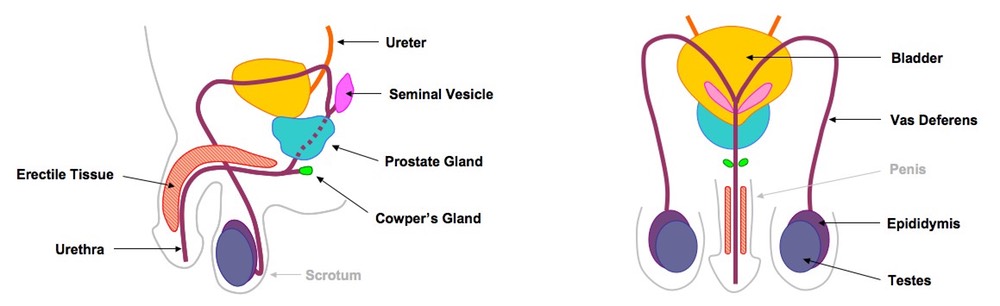
I will start with the male reproductive system as males are simpler than females in many, many ways… The male reproductive system has three functions:

  • to produce the male gametes, sperm cells, at a prodigious rate
  • to make the male sex hormone testosterone
  • to act as a delivery system to ensure sperm cells are carried into the female reproductive tract in conditions that will allow them to fertilise an egg

male_reproductive_organs_med

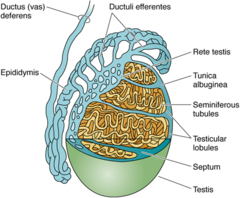
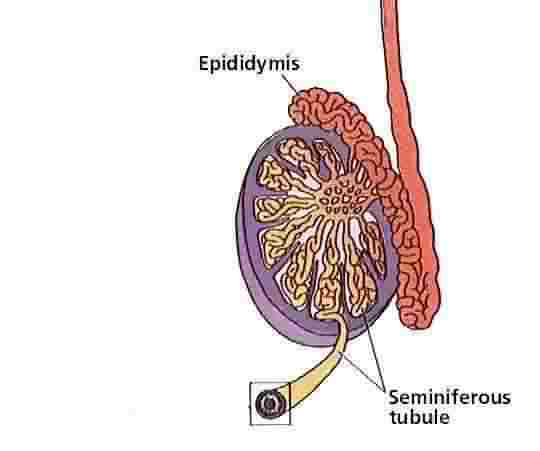
The first two functions listed above happen in the testis.  There are cells in the testis that secrete the hormone testosterone into the blood from puberty onwards.  Testosterone switches on secondary sexual characteristics in the male (body hair growth, muscle development, change in pitch of voice etc.) after puberty.  The main part of the testis is made up of very long coiled tubules called seminiferous tubules in which the sperm cells are made.

fTdncmfmBWuUzelsDXJVcA_m 02c_testis

Humans have over a hundred meters of seminiferous tubules in total in both testes and this allows sperm cells to made at a very fast rate.  Even though it takes around 75 days to make an individual sperm cell, the testes make them at a rate of around 85 million sperm cells per day.  The epididymis is found next to the testis in the scrotum and is a coiled tube in which sperm cells continue to develop and mature.  Sperm are stored here too in readiness for ejaculation.

Everyone knows that in humans the testes are found outside the body cavity in order to keep them cool.  Sperm production happens at a maximal rate 3 degrees below core body temperature and having testes outside the body keeps them at this temperature.

The vas deferens is a tube lined with smooth muscle that carries sperm cells away from the testis for ejaculation.  As you can see it loops around the back of the bladder, before joining up with the urethra just below the bladder.  The urethra is the tube that carries urine away from the bladder but can also carry semen once the vas deferens has joined with it.

There are three accessory glands in the male system (prostate gland, seminal vesicle and the Cowpersglands)  These glands produce the fluid that when mixed with the sperm cells is called semen.  Semen contains a sugar fructose to provide energy for the sperm cells to swim.  It is slightly alkaline to neutralise the acidity in the vagina and also contains mucus to make the fluid easy to move along the tubes.

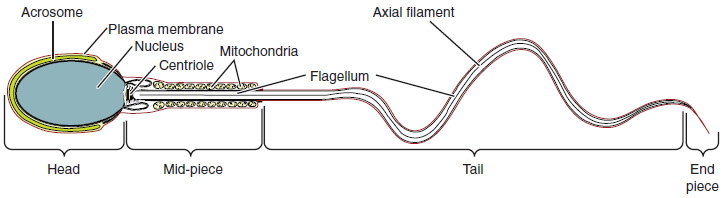
The sperm cells only acquire the ability to swim when in the epididymis and only become totally mature and able to fertilise the egg right next to the egg cell in the female tract.

Figure_28_01_05

The penis is an organ that contains erectile tissue that can fill with blood to allow the penis to fit into the female vagina for ejaculation.

Alveoli and Gas Exchange: Grade 9 Understanding for IGCSE Biology 2.46 2.48

The primary function of the lungs is to allow gas exchange to occur.  Oxygen gas can diffuse into the blood from the air in the lungs.  Oxygen of course is needed for the process of aerobic respiration that is happening in every cell all the time.  Aerobic respiration produces carbon dioxide as a waste product.  Carbon dioxide diffuses out the blood in the lungs into the air in the lungs.  Hence the name gas exchange – one gas (oxygen) diffuses in, another (carbon dioxide) diffuses out.469521_1311326813_large

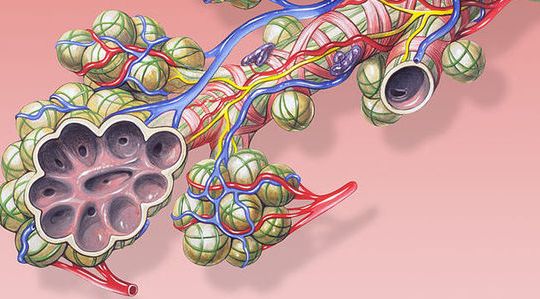
This diagram above shows the bronchial tree – the branching network of tubes that carry air into the lungs.  The trachea at the top branches into the right and left bronchi, then each in turn branch into smaller bronchi and finally into the smallest tubes called bronchioles.  Bronchioles carry air into a cluster of tiny airsacs called alveoli (not ravioli as AZB told his F division today…)

Diffusion is the passive movement of molecules of a liquid or gas from a high concentration to a low concentration.  So the first question is what ensures that there is an appropriate concentration gradient for each gas to diffuse?

4.2

In order to understand this, you have to remember that the blood going to the lungs is deoxygenated.  The right ventricle pumps deoxygenated blood to the lungs in the pulmonary arteries.  The tiny alveoli are then covered with capillaries and these join together to form the pulmonary veins.   The pulmonary veins carry the oxygenated blood back to the left atrium of the heart.  So the blood coming to the lungs will have a low oxygen concentration but a high carbon dioxide concentration.

How are the structure of alveoli adapted for efficient gas exchange?

  1. The alveoli in total provide a large surface area for the diffusion of oxygen and carbon dioxide.  The total surface area of the alveoli in humans is approximately 90 m2 – the equivalent of two tennis courts…..
  2. The walls of the alveoli are very thin.  The alveolus is lined with a single layer of cells, and of course the capillaries are also only one cell thick. So the distance for the diffusion of oxygen and carbon dioxide is very small (hence the rate of diffusion is very fast)
  3. The alveoli have a rich blood supply.  Alveoli are lined by many capillaries.
  4. The surface of the alveolus is moist.  Gas exchange surfaces are always moist as oxygen and carbon dioxide will diffuse more rapidly if they are dissolved in water.
  5. Alveoli also contain a cell that secretes surfactant.  This molecule reduces the surface tension in the film of water that lines the alveolus, allowing air to move in and out more smoothly.

biobook_animalmovement_graphik_38

Chromosomes: Grade 9 Understanding for IGCSE Biology 3.15 3.32

I hope everyone reading this blog knows the definition of a gene.  It is one of the few things in the iGCSE course that it is worth learning by heart.

A gene is a sequence of a DNA molecule that codes for a single protein“.

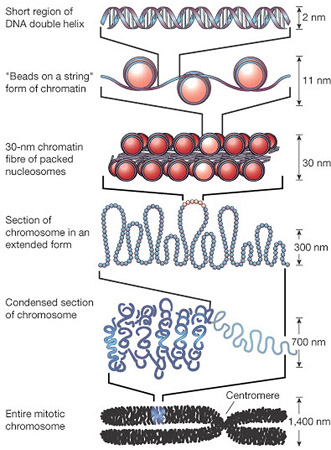
In human cells, every nucleus contains about 23,000 genes.  Remember there is about 1.5m of DNA inside each nucleus.  For most of the life-cycle of the cell, this DNA is in a tangled web called chromatin.  Chromatin is DNA molecules loosely associated with some scaffolding proteins.  The scaffolding proteins are shown in the second level down of this excellent diagram as “beads on a string”.

chromatin

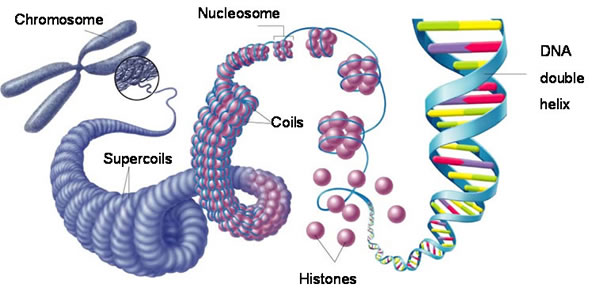
But this tangled web of DNA in chromatin poses a problem for the nucleus.  For the cell to divide by mitosis, it is essential that the nucleus replicates into two identical nuclei, one for each new cell.  The DNA molecules in the nucleus will make a copy of themselves by semi-conservative replication but how then can you ensure that each daughter nucleus gets exactly one copy of each DNA molecule if they are all tangled up….?  This is where chromosomes come in!

00 Eukaryotic Chromosomes

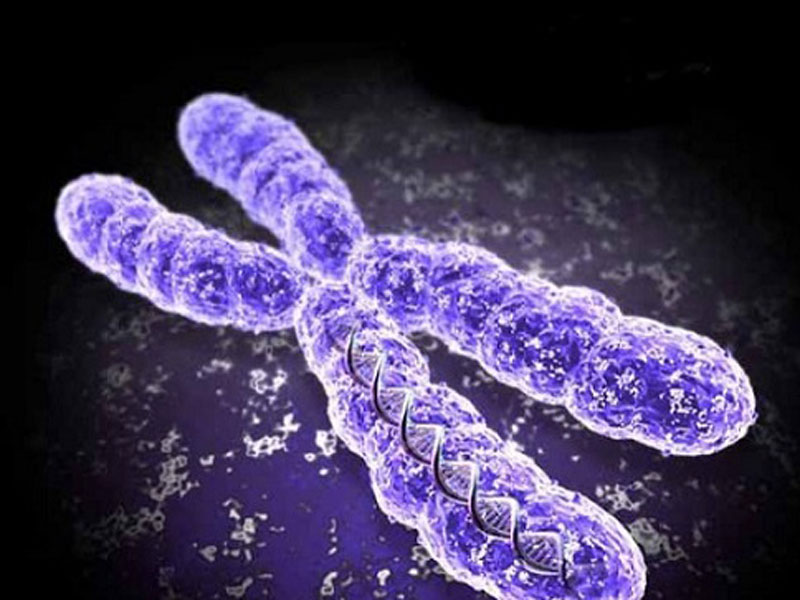
Each chromosome is a physical structure formed by supercoiling of the DNA round the scaffold proteins.  The DNA coils, then folds back on itself, then coils again until each DNA molecule is so tightly coiled up that a visible chromosome appears in the nucleus.  Chromosomes only become visible just before mitosis starts as for the rest of the time, the DNA is much more loosely coiled and so cannot be seen.

Chromosomes

This also explains why each chromosome always looks X shaped.  When chromosomes become visible the DNA has already replicated, so one chromosome is now made of two identical sister chromatids joined at a region called the centromere.

mitosis2_1

So the picture on the left shows a chromosome made as a single structure comprising one DNA molecule wrapped around the scaffold proteins.  Then DNA replication occurs (in the S phase of the cell cycle) and now each chromosome is made of two identical chromatids joined at the centromere.  Then the two chromatids are separated in mitosis and the chromosome returns to the structure it had at the start.

How many chromosomes are there in human cells?

The key idea here is that chromosomes are found in pairs in all body cells apart from gametes,  These pairs of chromosomes  (called homologous pairs) have exactly the same genes in the same locations on the chromosome.  They are inherited one from each parent so one member of each pair will come from your father, one from your mother.

Different species have different numbers of pairs of chromosomes.  For humans you should know that we have 23 pairs of chromosomes in the nucleus of every body cell (making a total of 46).  Cells with chromosomes found in pairs are called diploid cells.  Every cell in the body is diploid apart from the gametes.  Gametes only have one member of each homologous pair and are called haploid cells.

Which of the following cells are diploid, which are haploid?

  1. Zygote
  2. Skin cell
  3. Sperm cell
  4. Liver cell
  5. Pollen grain
  6. Egg cell

If you are not sure, ask me by leaving a comment below….

23-chrom

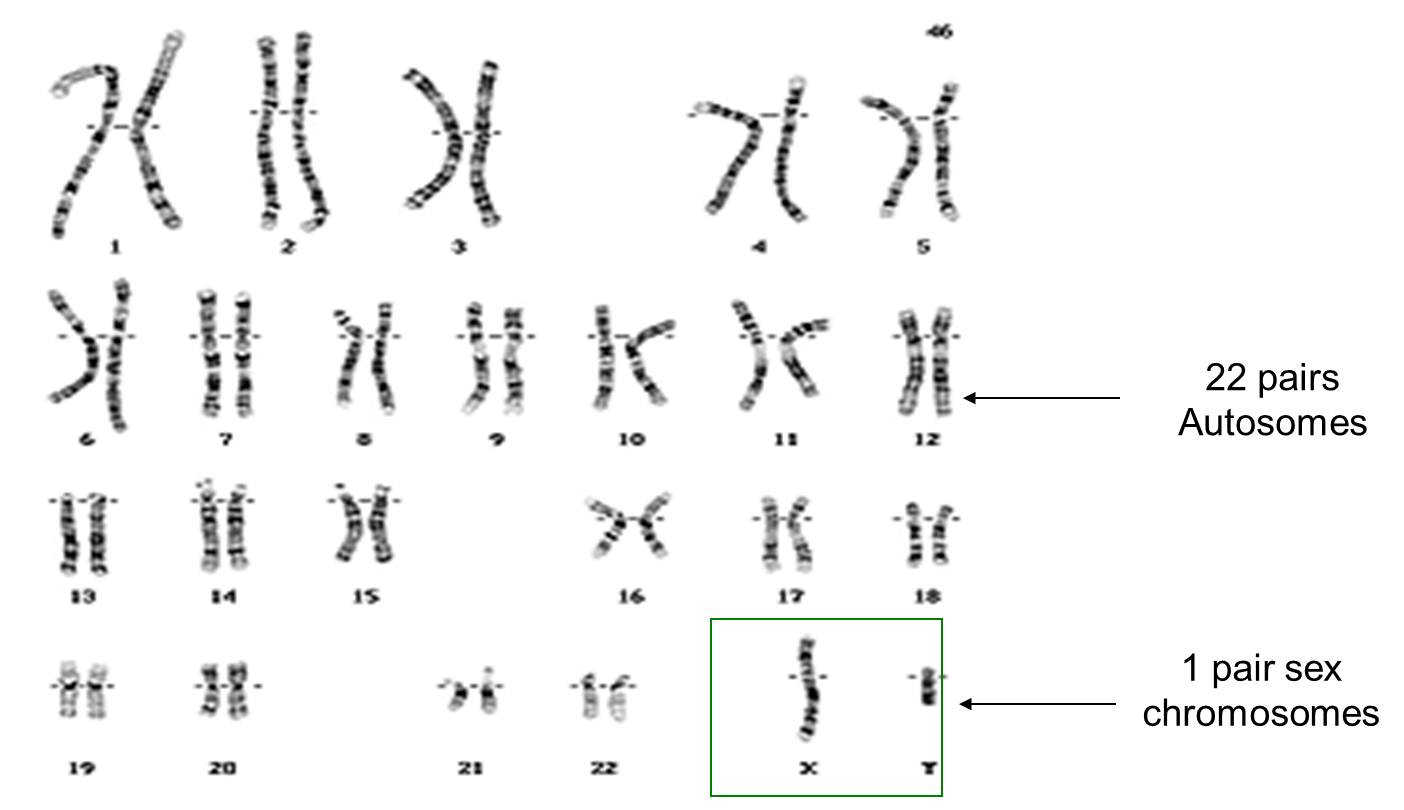
Finally for this post, chromosomes determine the sex of a human.  You can see in the picture above that the 23 pairs of chromosomes can be divided into pairs 1 to 22 – these are called autosomes and play no role in determining your sex.  But the 23rd pair of chromosomes are called the sex chromosomes.  Males have one large X chromosome and one tiny Y chromosome as their 23rd pair whereas females have two large X chromosomes.

Gametes are haploid so only have one member of each pair.  So when a man makes sperm cells (by meiosis) 50% of his sperm cells will contain his X chromosome, 50% his Y chromosome.  A woman’s egg cell will always contain one X chromosome. (Why is this?) So I hope you can see that at the moment of fertilisation, the babies sex is determined depending on whether it is a Y-containing sperm cell that happens to fertilise the egg or an X-chromosome containing sperm…  If the former, the baby is male, if the latter female.

chromosomes

I might explain this more fully in a post some other time….

Final thing for this post.  If you have got to the end of this and understand everything in the text above, you are in a tiny minority of school students. Well done!  This is a tricky topic and if you really understand chromosomes, you stand a chance of understanding cell division and genetics.

Respiration: Grade 9 Understanding for IGCSE Biology 2.34 2.36 2.37 2.38

I can’t believe that it is over year since I started posting about iGCSE Biology misconceptions and yet I have never written about Respiration.  If there is one topic that students misunderstand more than any other (apart perhaps from genetics), this must be it….  So I am going to try to explain in a straightforward way what respiration is and why it is so important for life.

Life requires energy.  Living cells are constantly doing things that use up energy: pumping molecules across their cell membranes, moving organelles around the cell, cell division, nerve cells sending electrical impulses around the body, muscle fibres contracting etc. etc.  In every case, this energy comes from a metabolic process called Respiration.  It is a series of chemical reactions, catalysed by enzymes and in some way, it happens in all cells.

So let’s start with a good definition.  [Examiners are simple souls and often start questions with the classic “What is Respiration?”]

Respiration is a series of chemical reactions that happens inside cells in which food molecules (for example glucose) are oxidised to release energy for the cell.

My definition has to be a little vague because although glucose is found in all the equations for respiration, other food molecules can certainly be respired.  And oxygen is only used in aerobic respiration.  Many organisms can only respire without oxygen (anaerobic respiration) and some, such as humans can switch between aerobic and anaerobic depending on the conditions.

f-d-58fb95c61caa798de5a938e01f65970733c8f3fe943a17282b88533e+IMAGE_THUMB_POSTCARD+IMAGE_THUMB_POSTCARD.1

Aerobic Respiration happens for the most part in tiny organelles in the cytoplasm called Mitochondria.  The diagram above shows the structure of a mitochondrion (I wouldn’t worry about learning it but perhaps you should be able to recognise the characteristically folded inner membrane?)

What are the differences between aerobic and anaerobic respiration in humans?

Well we have mentioned two already and there are others…..:

  • Aerobic respiration requires oxygen, anaerobic does not.
  • Aerobic respiration takes place in mitochondria, anaerobic only occurs in the cytoplasm.
  • Aerobic respiration produces much more energy per glucose molecule than anaerobic – it is a more complete oxidation of the glucose, so much more energy is released.
  • Anaerobic respiration produces lactic acid as a waste product (in humans) whereas in aerobic, carbon dioxide and water are the products

The summary equations for the processes are different as well.

Aerobic respiration:

word equation                       Glucose + Oxygen ——> Carbon Dioxide + Water

balanced chemical equation            C6H12O6 + 6O2  ——> 6CO2 + 6H20

Anaerobic respiration in humans:

Glucose —–> Lactic Acid

Anaerobic respiration in Yeast (a single celled fungus):

Glucose —–> Ethanol and Carbon Dioxide

A couple of final points to note:

Anaerobic respiration in muscle cells does not produce carbon dioxide as a waste product (see the equation above…) Lactic acid is the only waste product.  But lactic acid will accumulate in muscles and stop the muscle functioning properly so after a period of intense activity, lactic acid needs to be removed.  How does this happen?

Lactic acid moves from the muscle in the blood and is transported to the liver.  In the liver, the lactic acid is metabolised in an aerobic pathway that uses oxygen.  This is why sprinters will always be breathing fast after the race, even when they are standing still.  Their body needs extra oxygen to oxidise the lactic acid they have produced during the race.  This extra oxygen is termed an oxygen debt and is the oxygen needed in the liver to fully oxidise lactic acid to carbon dioxide and water.

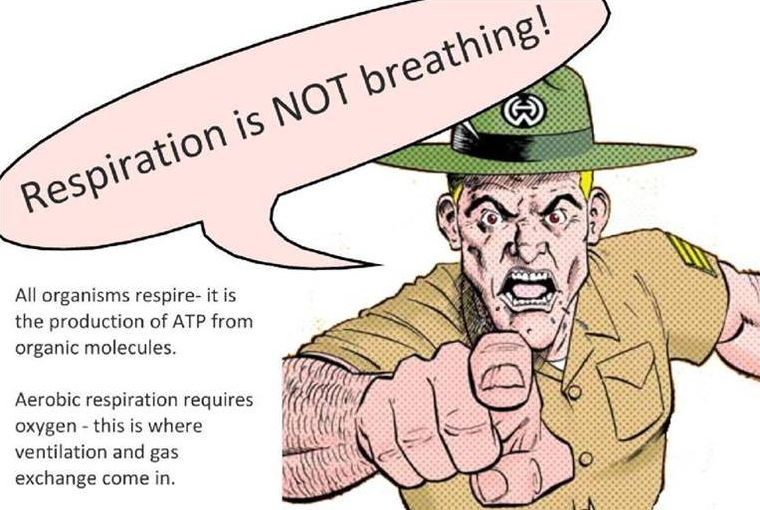
Finally, respiration is not the same as breathing.  Our American cousins sometimes muddle these processes up but in this one case, the British way is much better….  Use the term ventilation for breathing – moving air in and out of the lungs – and reserve respiration for the chemical reactions that happen inside the cells to release energy.

breathing

Please leave a comment below if you find this post helpful or ask me about anything that isn’t clear….

Characteristics of Life: Grade 9 Understanding for IGCSE Biology 1.1

main-qimg-ae9b489263e7f46e0f34f0f3bd41c1e2

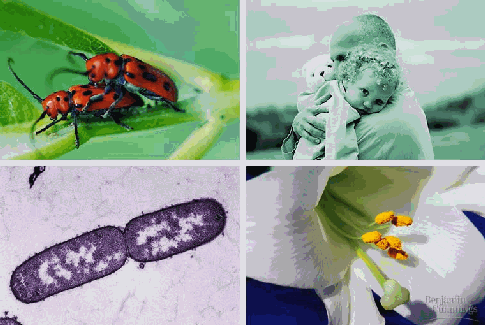
The iGCSE specification says that all living organisms share the following basic characteristics and then lists 8 bullet points.  This seems unnecessarily unhelpful because every student in the whole word learns MRS GREN for the 7 characteristics of life…

Make sure you understand the exact meaning of each of the following terms:

  • Movement
  • Respiration
  • Sensitivity
  • Growth
  • Reproduction
  • Excretion
  • Nutrition

Not all organisms Move from place to place of course and lots of things move that are not alive.  So that doesn’t make me think that this is a good way to start the whole study of Biology.  It is true that all living things, without exception, Respire.  “Respiration is a series of chemical reactions that happens inside cells in which food molecules are oxidised to release energy for the cell” – good definition that….   Sensitivity means the ability to detect and respond to changes in the environment.  Mammals do this through their nervous and hormonal systems, plants through plant growth substances such as auxin.  Growth either involves a cell getting larger or in multicellular organisms, the two processes of cell division and cell specialisation.  All living things have the potential to Reproduce, to create new individuals of their species.  Excretion is the removal of waste molecules (e.g. carbon dioxide, urea) that have been made inside cells.  Nutrition means either obtaining food molecules by eating another organism or if you are a plant, and I guess none of you are,  by making your own food molecules through photosynthesis.

The people who wrote the specification have added “they control their internal conditions” to the list.  This is actually a better characteristic of life than many above as it is a universal feature of all life.  The term for this process is Homeostasis – the ability to regulate and control the internal environment.

It is a shame that two of the best ways to decide whether something is alive have been left off the list.  All living things on earth are made of cells.  Some organisms are unicellular (Paramecium for example) but many are made of many cells.  And all living organisms have the molecule DNA as their genetic material.  If you get a question on this in the exam, it’s probably better to talk about the 8 characteristics of life the examiner likes… That’s exams for you!