
Tagged: revision
Xylem transport – Grade 9 Understanding for IGCSE Biology 2.54, 2.55B, 2.56B
The topic of plant transport can appear quite complicated but you will see from your past paper booklets that the questions examiners tend to set on it are much more straightforward.
The key piece of understanding is to realise that there are two transport systems in plants, learn their names and what they transport.
- Xylem vessels move water and mineral ions from the roots to the leaves.
- Phloem sieve tubes move sugars, notably sucrose, and amino acids around the plant. Both of these molecules are made in photosynthesis in the leaves and so can be transported from the leaves to the areas in the plant where they are needed.
Water is needed for photosynthesis of course in the leaves (remember that rain water cannot enter leaves directly because of the waxy cuticle on the surface of the leaf). All the water that is used in photosynthesis is absorbed in the roots from the soil and moved up the plant in the xylem vessels. Minerals such as nitrate, phosphate and magnesium ions are also required in the leaves for making amino acids, DNA and chlorophyll respectively. These minerals are moved up the plant along with the water in the xylem.
How does water enter the roots from the soil?
Water molecules can only enter root hair cells (and indeed can only cross any cell membrane) by one mechanism and that is OSMOSIS. If you understand the mechanism of osmosis that is great but don’t worry too much about it at this stage. You need to know that osmosis is a net movement of water from a dilute solution to a more concentrated solution across a partially permeable membrane.
How do mineral ions enter the roots from the soil?
Minerals are pumped into the root hair cells from the soil using ACTIVE TRANSPORT. This a process that uses energy from respiration in the cell to move ions against their concentration gradient (so from a lower concentration in the soil to a higher concentration inside the cell cytoplasm.)
What do we know about xylem vessels?
The cells that water and minerals are transported in are called xylem vessels. They have some interesting specialisations for this function. They are dead cells that are empty with no cytoplasm or nucleus. The end walls of these cells break down to provide a continuous unbroken column of water all the way up the plant. The cell walls of xylem vessels are thick and strengthened and waterproofed with a chemical called lignin.
What causes the water to move up the xylem?
Clearly it will take energy from somewhere to move water against gravity all the way up a plant from the roots to the leaves. The key question here is what provides the energy for this movement? There is no pumping of water up the plant and indeed the plant spends no energy at all on water movement. The answer is that it is the heat energy from the sun that evaporates water in the leaves that provides the energy for water movement. When you combine this with the fact that water molecules are “sticky” – they are attracted to their neighbours by a type of weak bond called a hydrogen bond – you can see that the water evaporating into the air spaces in the leaf can pull water molecules up the continuous column of water found in the xylem. The proper adjective for this stickiness is cohesive and you should know the name for the evaporation of water in the leaves (Transpiration)

A Simple Reflex Arc: Grade 9 Understanding for IGCSE Biology 2.90
GCSE Biology students often find the reflex arc a difficult topic in the section on human coordination and response. This is because it is the only type of response they learn about and doesn’t really fit into a sensible flow of ideas on the various types of behaviours organisms can show. But it is not too complicated, at least if you restrict yourself to ideas that might be tested in the iGCSE exam.
Prior Knowledge (you need to understand these things before you can appreciate a reflex arc)
- basic structure of a neurone/nerve cell
- three different kinds of neurones – sensory, motor and relay – and where they are found in the body
- nerve impulses are electrical events that travel at up to 100ms-1 along nerve cells but cross synapses much more slowly by diffusion of a chemical called a neurotransmitter
Reflex responses
Most human behaviours are complex and involve millions of neurones interacting in the brain. Our ability to link stimuli (changes in the environment) with an appropriate response can develop over time, can be modified by past experience and can produce different outcomes depending on the circumstances. For example if you see a fast moving spherical object moving towards your head, you might head it (football), catch it (cricket), hit it (cricket again), duck out of the way (cricket again) or eat it (flying Malteser)
A simple reflex response is much more straightforward: the same stimulus always produces the same response. It does not need to be learned but is innate (you are born with it) and in humans, reflex responses tend to be involved in protecting the body from harm or maintaining posture. The example we look at is called a withdrawal reflex to a painful stimulus e.g. touching a hot plate on a cooker.
The response to this is that you contract muscles in your arm to move your hand away from the hot plate. The key idea is that you will do this before you feel the heat or burn the skin. The sequence of events is
- touch the hot plate (pain receptors stimulated in the skin)
- move your arm away (reflex arc)
- feel the pain (brain receives the nerve impulses and a conscious sensation of pain is felt
The reason that you move your arm away before you feel anything is that your brain is not involved in this response. This produces a rapid, involuntary reaction called a reflex response. The reason the response is so rapid is that at most three neurones are involved in linking the painful stimulus to the response. The arrangement of these three neurones is called a reflex arc.
 The cell that detects the stimulus is called a sensory neurone. One end of this cell is a pain receptor in the skin and the other end of this individual cell is found in the spinal cord (see diagram above) Neurones can be very long cells! The sensory neurone forms a synapse (junction) with a relay neurone found entirely in the grey matter in the centre of the spinal cord and this in turn synapses with a motor neurone. The cell body of the motor neurone is on the spinal cord and the other end of this individual cell is a synapse with a skeletal muscle in the arm.
Synapses are the things that slow nerve impulses down and as this whole pathway only includes two synapses (sensory-relay and relay-motor) the response will be as fast as possible. The response is involuntary as the brain is not involved.
In humans, we can modify most reflex responses using the conscious parts of our brain. As the sensory neurone synapses with the relay neurone in the diagram, it will also synapse with other neurones carrying nerve impulses up to the brain. This is why touching a hot plate will hurt (the feeling of pain is in the brain). There will also be neurones from the brain that can modify the synapse between the relay and motor neurone. If I told you that I would pay anyone who can touch a hot plate for 2 seconds $10,000 (although of course I don’t have $10,000) many of you would be able to force yourself not to pull your arm away from the hotplate when you touch it. You could overcome the reflex response with signals from your brain which would know how much fun you could have with $10,000.
Zollar leaderboard for bD1.4
There are just a couple of days left for the boys of bD1:4 to accumulate “Zollars” for the star prize of a lunch at Zero 3 next week. Just to remind you, I will buy lunch (whatever you want) for the boy in my division with the most zollars at the start of our first Biology lesson of the new term.
If you haven’t yet signed up to Zondle, please do so as my revision games should be useful. It is free, you don’t need to add your real name (although please choose an id that I can tell who you are…..) and get playing. Use the class code I emailed you so you can see exactly what I want you to do. You get zollars for playing games but also for the scores you get and you can play each game as many times as you like.
Just for your information, there are 11 boys with zollars already on the board and four players with over a 1000 zollars to their name……
New Cloning revision game on Zondle
http://www.zondle.com/cdl.aspx?qp=310717&a=934
Cloning is one of the harder topics to understand. Work through the topic making revision notes using the textbook and then have a go at the Zondle quiz – link above.
Good luck!
Easter holiday iGCSE revision: the final stages
I hope that many of the Y11 students reading this will have made good use of the time in the holidays to get ahead with their revision. If you can “hit the ground running” when you return to school next week, that makes it so much easier for you to benefit fully from the revision classes to come. (If this doesn’t apply to you, skip the next paragraph and continue on in the post.)
Your aim when school starts next week is to keep up the good work habits, the organisation and the high personal motivation levels you have shown this holiday. Remember that you can never do as much as you can with schoolwork: there is always another past paper to work through, another time to go over your revision notes, another summary poster to make. The important thing is to use the time you do spend working wisely and gain the most you can from the experience. Sheikh Mohammed is a man I greatly admire for what he has achieved both in racing and as a leader: his epithet is that “in the race for excellence, there is no finishing line”. There is more to do, you will almost certainly benefit by doing a little more, and you can do it! Keep going…….
If you haven’t managed to achieve what you wanted in the past three weeks, don’t panic. You won’t be alone. There is still time for you to make a big difference to your chances in summer exams. I think your best bet is to now team up with a mate or two for revision. (These comments apply to students in the boarding school where I work but the idea is transferable) Ask a friend who you know has good work habits if you can pair up with him for the first week of school for revision. When he or she works, you work. Ideally you work alongside each other (the housemaster’s dining room is often a good venue free of distractions) Don’t copy exactly what they are doing as they may be at a different stage in the revision process to you, but just work with them, never alone.
You will all have more conflicting demands on your time when the term starts again. Don’t worry about this at all. Keep doing your sport, your music, your social activities with mates. All are vital to success. You will probably be set homework by teachers in these first few weeks: that’s fine too. Complete each task as conscientiously as you can even if you think you could be better doing something else. The key thing is to keep the positive energy, the focus and the high performance levels going. Don’t allow yourself to ever slip into old habits (at least not until the end of June) Momentum is key: if you don’t yet have it, build it quick. If you do have it, keep going. Keep working with the same focus, the same intensity and enjoy the feeling of making progress. Just think how much better you understand topics compared to a few weeks ago!
Final idea in this post is this. Keep looking after yourself and your mates. Eat healthily, get to bed early, keep your room tidy and clean and help others to do the same. Work is not something you do alone. You and your friends are “all in it together” so look after others and to some extent they will look out for you. Exams are important but so are many other things in life – friendship, health, family to name just three – so don’t neglect these things even when the pressures start to build.
If anyone reading this wants any help with anything to do with revision, schoolwork etc. please get in touch. Catch me in my schoolroom if you can or get in touch via Twitter or comments on my blog.
Carbon Cycle – Grade 9 Understanding for IGCSE Biology 4.10

The Carbon cycle should really be much simpler to understand than the Nitrogen cycle I posted about yesterday. This is because the processes involved in moving carbon atoms from one compartment to the next in an ecosystem are more straightforward. There are four processes mentioned in the specification and you need to make sure you understand each.
- Photosynthesis: only happens in producers, takes CO2 from the air to produce complex molecules (carbohydrates/proteins/fats) that can be passed up food chain.
- Respiration: happens in all organisms (producers, consumers, decomposers) and turns carbohydrates into carbon dioxide
- Combustion: fossil fuels and plants can be burnt for fuel releasing carbon dioxide into the atmosphere
- Decomposition: two types of decomposition – in aerobic conditions decomposer organisms (bacteria/fungi) convert complex molecules in faeces/dead organisms into carbon dioxide: in anaerobic conditions, dead organisms can be turned into fossil fuels.
If you want to draw a carbon cycle from scratch to check you understand it, follow the procedure below.
1) Draw the following boxes showing where carbon atoms are found in an ecosystem – CO2 in air, carbon compounds in plants, carbon compounds in animals, fossil fuels and limestone, detritus in soil
2) Draw arrows linking the boxes with the following labels: photosynthesis, respiration, feeding, combustion, death and decay, death and no decay
That’s about as complicated as it gets.
Warning: Do not under any circumstances draw an arrow from the detritus in the soil directly to plants. Plants do not absorb any carbon containing molecules from the soil into their roots. Honestly, please believe me they don’t however much you want them to…. It would make the cycle more straightforward but they don’t – sorry. The only carbon-containing molecule plants absorb from their environment is CO2 and that as you all know is absorbed from the air in leaves in the process of photosynthesis.
Zondle quiz on carbon cycle to follow in due course: keep working hard! (I am jealous of those of you in Portugal at the moment although weather has been fine today in Northants!)
Nitrogen cycle for IGCSE Biology: Grade 9 Understanding 4.11B
I will make a blog post on each of the three “cycles” you need to know about for iGCSE. By far the most complicated is the Nitrogen cycle, so we might as well start there….
The first bit of understanding you need to is be clear the difference between how energy moves through an ecosystem and how matter (i.e. atoms) are exchanged between organisms and their environment. Energy in the ecosystems moves in a linear flow: there is no recycling of energy. The energy comes in at one end (in the producers through the process of photosynthesis) and is ultimately all lost as heat to the environment through the process of respiration. There is no possible way energy can be recycled. The “circle of life” that students like so much from Disney certainly does not apply here…. People find this idea very difficult to appreciate. All the time students will tell me that the energy in dead plants and animals goes into the soil and is then absorbed through the roots of plants: “it’s the circle of life sir” they earnestly tell me. And in the words of the late, great Amy Winehouse, I say “NO,NO,NO”…
Matter on the other hand is recycled through the ecosystem. The individual atoms that make up your body (H,O,C,N,S etc.etc,) have all been in other organisms and indeed will be again in the future. You took them in through your food and use these atoms to build the molecules that make up your cells. But ultimately all these atoms will leave your body either through metabolic processes or when you die and are decomposed. You could draw up a cycle for any of the atoms that are found in living things but your specification only requires you to understand two. How are carbon atoms cycled – the Carbon cycle – and how are nitrogen atoms cycled – the Nitrogen cycle. (You will also look at the Water cycle as well…..)

Things to understand about the Nitrogen Cycle:
1) Which molecules in living things contain nitrogen atoms?
Well the answer is fairly simple. Proteins are polymers of amino acids. Amino acids all contain an -NH2 group (amine group) and so Nitrogen is found in proteins. The bases in DNA (Adenine, Cytosine, Guanine and Thymine) are described as nitrogenous bases and so they contain nitrogen too.
2) Where are nitrogen atoms found in the ecosystem other than in the molecules of living organisms?
This is more complicated. Nitrogen gas makes up 78% of the atmosphere so clearly there is a lot of nitrogen in the air. In the soil, there will be urea from the urine of animals and urea contains nitrogen. There are also a range of ions found in the soil that contain nitrogen: the two most important are ammonium NH4+ and nitrate, NO3-. (I don’t know how to do subscript and superscript in WordPress and so you will have to excuse the rather ugly molecular formulae)
3) How do nitrogen atoms move from the abiotic (non-living) parts of the ecosystem and into the organisms?
There is only one way nitrogen atoms can move from the abiotic environment and into the organisms in an ecosystem. This is via plants that can absorb nitrate ions from the soil in their roots. This is a slight simplification but it will do at the moment. Look at the diagram above and find the arrow that shows assimilation of nitrates from the soil into plants.
4) How many different kinds of soil bacteria are involved in cycling nitrogen?
You need to know about four different kinds of bacterial that live in the soil that play a role in recycling nitrogen. Use the diagram above and your notes to describe the role each of these organisms play in the cycling of nitrogen atoms in the ecosystem.
- Decomposers (Putrefying Bacteria)
- Nitrifying Bacteria
- Nitrogen-Fixing Bacteria
- Denitrifying Bacteria
I am off to have my supper: another post about these bacteria will appear here later tonight or tomorrow. Please don’t read it until you have tried to write down a paragraph on each of the four types of bacteria in the bullet point list above.
Experimental Design questions IGCSE Biology
I have been posting comments about the questions that appear year after year on iGCSE Biology papers. Questions like the one below are found in every past paper we have. I call these the “Design an experiment to” questions for obvious reasons…..
“Rivers are sometimes polluted by warm water from power station outflows. This is known as thermal pollution and can affect the growth of plants. Design an experiment to investigate the effect of water temperature on the growth of plants. 6 marks. November 2010”
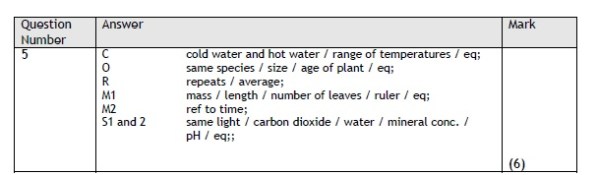
As you all know, the mark scheme for this kind of design an experiment question is based around the acronym CORMS.
C – how do you change the independent variable?
The independent variable is the thing you are going to change to see its effect. In this experiment it is the temperature of the water. So how are we going to change it? Well it might appear obvious but you need aquatic plants living in water baths at a range of temperatures, say 10,20,30,40,50,60 degrees. Try to make your independent variable continuous if it is possible – the range of temperatures above is much better than just one set of plants in hot water, another in cold water.
O – what organisms (or other biological material) will you use?
To get this mark you will need to say something about the plants you will use in your investigation. For the experiment to produce reliable results, there are many features of the plants that will need to be kept the same in each water bath. Same species, same age of plants, same starting size, same surface area of leaves etc. There are other factors too about the plants that need to be controlled. Can you think of any others?
R – reliability
In order to produce reliable results you will need to set up multiple repeats of each experiment so anomalous readings disappear as you average your results. How would you do this? Well in the example above, I would set up 5 identical water baths at each temperature. We are investigating six different temperatures so we will need 30 water baths. Don’t worry about this. For research as vital as this fascinating experiment, no expense should be spared……
M – how are you going to measure the dependent variable?
There are often two possible marks for this and you will see M1 and M2 on the mark schemes. The key idea is often the same however (there’s a shock) The first mark is for identifying what you will measure about the plants to measure growth. There are lots of alternatives depending on what kind of plant you are using. I am picturing a small floating algae growing in my water baths so I would measure the mass of the plants. (Dry mass would be better but this would lead to destructive sampling – plants won’t grow further if you dehydrate them completely in an oven before weighing them……) You could measure the height of the stem of a plant, or the total surface area of water covered. It doesn’t really matter which thing you choose as long as it is a sensible measure of growth. What will M2 be awarded for? Well it is essential you leave all 30 waterbaths for exactly the same length of time between measurements. How frequently will you measure the growth of your plants? Every hour would be too often, so perhaps every day would be sensible. So a statement that says “use a mass balance to measure the total mass of the plants in each water bath every day for a period of 10 days” will be certain to get both M marks…
S – what factors do you need to standardise to make the experiment a fair test?
You will have mentioned some of these “fair test” factors in the mark point O above. Now it is time to show that you understand what factors other than the temperature of the water will effect the growth of your plants. Growth of plants is done by photosynthesis so I would be aiming to show you understand the other factors that will effect rates of photosynthesis: i.e. light intensity. light wavelength and carbon dioxide concentration. All three should be kept constant and I would say how: same lamp at the same distance from the water baths, carbon dioxide in water controlled by dissolving same mass of sodium hydrogencarbonate in the water. There are often two S marks but by stating all three important control variables this should guarantee we get both.
Now I have written this post without looking at the mark scheme. “Promise…. Honestly Sir I wouldn’t cheat myself like that…..” But here it is and look we would have got full marks. Full Marks = A* #result
Motivational advice for D block Biologists

I know some of you are working hard at the moment. How do I know? Well I can see that you are reading these blog posts, are playing the revision games on Zondle and producing good scores…..
Revision is a great example of a self-perpetuating process. The hardest thing is to get started but once you are in a routine, I hope the rhythm of revision will see you through to the end.
It is good to have an end-product to show for your work. This is why revision notes or flash cards are such a good idea. You can see them on your desk every day, you can see how they are growing or being used and this can motivate you to keep going! Have a go at working through some of the past paper questions in the booklet. Mark your answers using the provided mark schemes. Can you show evidence to yourself that you are making progress?
Revision can feel like a slog and in some ways it is….. There is no getting round that. But if you can make it fun, you are much more likely to keep going and all the effort will be worth it in the end.
You have a long summer holiday ahead of you. I can just about remember what that particular summer was like for me in 1987. (I know it’s hard to believe but I am so old I didn’t even do GCSEs but their predecessor O levels) I remember dancing to New Order, U2 releasing Joshua Tree and a lot of parties with some very special people. It will be the same for you I’m sure so work hard now so you can enjoy it with not a drop of guilt……
Zondle – does this help your revision?
I have posted a few games on Zondle with questions on the various topics I have written about in the past few weeks. I don’t know if you can search for my material on Zondle but my username is PMG_Biology. (Boys in my D division received an email with a class code so they can sign up and see all my material – thanks to the four boys who have signed up so far). I know that two of you have played some of these games and I can see the scores you got on my tests. The feedback I also get is which questions you have not scored well on which could be useful in giving me feedback about your learning.
If you think these revision games are useful, please can you comment below or tweet me with your thoughts? I can easily add more material to this site, but won’t do so unless the games are proving useful. Over to you…….
 PMG Biology