Comments and Suggestions welcome…..

Dear Readers,

Please feel free to send me any comments/suggestions/improvements so I can make this blog better and more useful to the GCSE students who read it…..  I will be writing some new posts in the Christmas holidays to complete the current IGCSE specification, and perhaps then to address the new material included for examination in 2019….?

But please tell me if there are particular topics you would like me to expand on…. If you don’t understand it fully, then lots of other readers won’t either!

And keep working hard – no short cuts in Biology GCSE…..

Please click the “Leave a Comment” link below this post to pass on any feedback.

Fish Farming: Grade 9 Understanding for IGCSE Biology 5.9B

5.9B explain the methods which are used to farm large numbers of fish to provide a source of protein, including maintenance of water quality, control of intraspecific and interspecific predation, control of disease, removal of waste products, quality and frequency of feeding and the use of selective breeding.
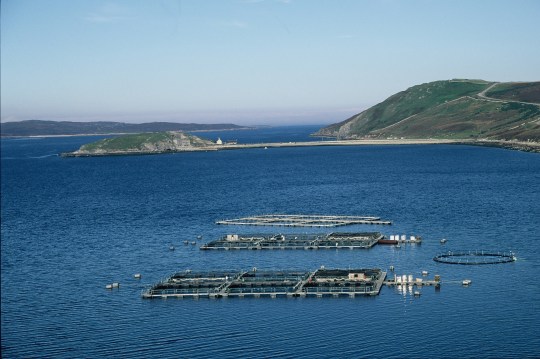
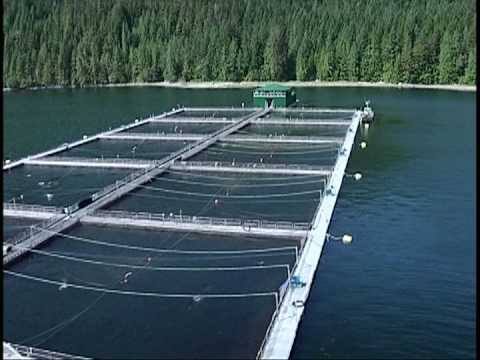
fish-farm-l-eribollBefore we start it is worth me being completely clear – I hate the topic of fish farming.  I am not saying it isn’t important, just that when you read the specification point above, it hardly lifts your spirits does it?  Perhaps this is why I have waited until the evening before the 2016 paper 2 exam before writing about it on the blog.

Background understanding needed:

Humans have overfished all the world’s oceans over the past 20-30 years.  This means that fishermen have become so successful at collecting fish from the oceans due to advances in trawling technology and echolocation, that fish populations have crashed.  It is a truly sobering thought that almost every studied fish species in the ocean has only 10% of the numbers that we know were present 50 years ago.  90% of all fish have been removed by fishing.

http://www.theguardian.com/environment/2011/feb/18/end-line-film-fish

Fish provide the  major source of dietary protein for a large proportion of the world’s population.  When you combine this with the fact that fish are becoming so scarce in the ocean, it is getting harder and harder to catch them, it is clear we have a potential problem on our hands.  Farming fish rather than catching wild fish might (stress might) provide a possible solution…..

Fish Farming

Farming fish is really as dull as it sounds.  Large floating cages are anchored often in estuary waters and small fish are added.  They are fed regularly (with fish food made from other less tasty fish that humans are extracting from the ocean), predators are kept out by the clever use of nets and fine mesh cage, antibiotics and other chemicals added to control lice and bacterial pathogens and after a few months, the fish can be harvested.
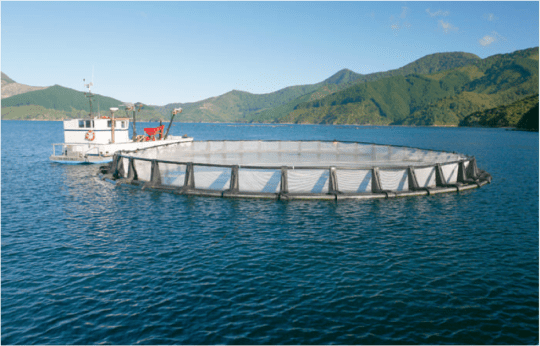
Salmon-Farming

Maintenance of Water Quality

If the fish farm is in a tidal part of an estuary, then the tide will twice a day replace the water in the cage with fresh seawater containing high concentrations of oxygen for respiration in the fish.

Control of Intraspecific and Interspecific Predation

Intraspecific predation means predation within a species.  This means the fish will eat each other…. This is prevented by only having fish of the same age in any particular cage.  There won’t be any bigger fish to eat the smaller ones.  Interspecific predation means other species eating your precious fish.  This is prevented by keeping predators out of the cage using a mesh size that doesn’t let predatory fish and seals in plus covering your cage with netting to deter sea birds.

Control of Disease

The density of fish living in the cage will be much higher than would ever occur in the wild.  This means the conditions are perfect for fish parasites such as lice to spread.  This is controlled by adding toxic chemicals to the water.  Bacterial pathogens too can be a problem in which case antibiotics would be added to the fish food.

Removal of Waste Products

(See tidal solution above)

Quality and frequency of feeding

The farmed fish need to be fed a diet that is rich in protein for growth.  Obviously the frequency of feeding is important:  too often and food will not all be eaten and will leak out into surrounding waters, too rarely and the fish will grow too slowly.

Use of Selective Breeding

The characteristics a fish farmer wants in his fish are very different from those that might be selected for in a wild population.  For this reason, selective breeding might have to be used to produce fish that have the desired characteristics.  These might include an ability to grow rapidly when fed on a cheap diet of fish pellets and to produce tasty and attractive meat, a resistance to lice and other parasites, a willingness to grow even when swimming opportunities are rather limited, a friendly disposition so thousands can live happily crammed into a single cage etc.

I have written this post in a bit of a rush the night before the exam.  So there may be things I have left out, but at least I have given you something to read to help you sleep the night before the exam!  Good luck.

 

Last minute panic

Clearly there is a lot of last minute cramming going on before IGCSE Biology paper 2 tomorrow….

Screen Shot 2016-06-09 at 21.40.19

That is absolutely fine but please remember you also need a good night’s sleep so your head is clear.  Knowledge is only a part of the skills required tomorrow in the exam and at least as big a part will be played by your ability to read the question, to think clearly, to recall good answers and to show your understanding clearly on the page.  All of these will benefit if you get a good night’s sleep tonight!

Take your time to read the question carefully and before you start writing any response, take a moment to think “what are the key scientific terms I need to use to show my understanding?”  So many marks are lost by waffling on without actually stating the key idea!


IGCSE Biology paper 2 – predictions

I am always very wary of trying to “second guess” IGCSE examiners and predict what questions might come up as it can be a risky business.  But as all the Y11 students out there start a well-earned half term, I thought I would put up a short post with some suggestions as to areas of the specification that have not yet been tested.

Important Disclaimer:  Remember that the examiners can set questions on the entire specification in paper 2 (including all the bullet points in bold).  It seems more likely to me that the questions will be on areas of the specification not yet tested in paper 1 but you cannot guarantee it.  So please make sure you revise the entire specification and are as prepared as you can for any questions that might come up.

Topics not yet assessed on 2016 paper 1

  • Viruses 1.2
  • Enzymes and Biological Molecules 2.5, 2.6, 2.7, 2.8, 2.9, 2.10. 2.11
  • Movement across Membranes (Diffusion and Osmosis) 2.12, 2.13, 2.14, 2.15, 2.16
  • Photosynthesis 2.17, 2.18, 2.19. 2.20. 2.21, 2.22
  • Breathing 2.44, 2.45, 2.46, 2.47, 2.48
  • Respiration 2.32, 2.33, 2.34, 2.35, 2.36
  • Kidney and Excretion 2.68, 2.69, 2.70, 2.71, 2.72, 2.73, 2.74, 2.75, 2.76
  • Plant Responses 2.80, 2.81, 2.82
  • Reproduction in Plants 3.1, 3.2, 3.3, 3.4, 3.5, 3.6, 3.7
  • Water/Carbon/Nitrogen Cycles 4.8, 4.9, 4.10
  • Food Production (crops) 5.1, 5.2, 5.3, 5.4
  • Food Production (microorganisms) 5.5, 5.6, 5.7, 5.8
  • Fish Farming 5.9
  • Genetic Modification 5.12, 5.13, 5.14, 5.15, 5.16

Remember that there are posts on almost all these topics on the blog so use the search function on the Home page and just type in the syllabus code.

Finally, keep working hard. It is easy to get too comfortable about your exams now that many have already been sat.  A little bit of fear is still a good thing, so remember that 33% of your GCSE marks are still up for grabs and this paper 2 will make all the difference in determining your final grade.  No short cuts now, keep being organised, methodical and diligent.  The summer holiday will give you plenty of opportunities to socialise, have fun and relax so try to keep the momentum up in this coming week.  Good luck!

Any questions, please ask by leaving a comment on this blog post.

Air Pollution part 2: Grade 9 Understanding for IGCSE Biology 4.12

It’s a cold February day in half term as I write this and I have already lit my log-burner in the living room downstairs.  When this was fitted a year or two ago, I was told it is now a legal requirement in the UK to also fit a detector for one atmospheric pollutant that can be produced as a waste product of combustion of biofuels.  This post is about that pollutant, carbon monoxide.

Carbon Monoxide

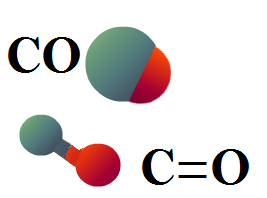
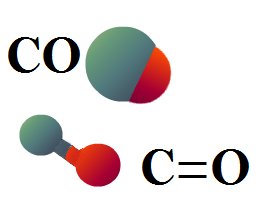
Carbon monoxide is a colourless, odourless gas.  It is produced whenever carbon-based fuels (coal, gas, wood, charcoal) burn in an atmosphere with a restricted oxygen supply.  The structure of a molecule of carbon monoxide is very simple:  it is a carbon atom covalently bonded to a single oxygen atom.

molecular-orbital-theory

(My log burner has a control where you restrict air getting into the stove so that your massively expensive logs burn a little more slowly – hence the need for the CO detector)  Carbon Monoxide poisoning results in 200 hospital admissions per year in the UK and around 40 deaths.

Why is carbon monoxide such a deadly gas?

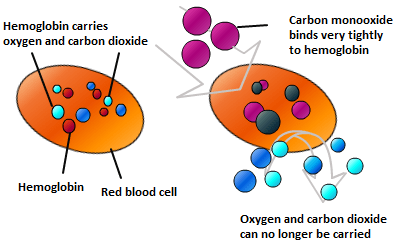
The symptoms of carbon monoxide poisoning are similar to flu.  Tiredness, vomiting, headache, stomach pain….  They are caused because when carbon monoxide is breathed in, it will diffuse into the blood in the alveoli of the lungs.  Carbon monoxide binds to haemoglobin, the protein found in red blood cells that transports oxygen.  It binds about 70 times as effectively to haemoglobin, forming a stable compound called carboxyhaemoglobin.  So it prevents haemoglobin molecules from transporting oxygen (and indeed carbon dioxide) around the body.

carboxyheamoglobin

I hope that post is useful when you come to revise this section.  It also links in of course to the topic on blood and indeed the health consequences of cigarette smoking.  I’m sure I have posts on these topics as well to read if you are interested…..  I’m off now to get my chimney swept and to check the batteries in my Carbon Monoxide detector.

Air Pollution part 1: Grade 9 understanding for IGCSE Biology 4.12

The extended topic on “Human Influences on the environment” is one that is well worth revising thoroughly.  I haven’t done any analysis of past papers (life is too short) but my hunch is that questions on these topics have been over-represented in the past few years.   This first blog post on air pollution is just going to summarise the consequences of pollution of the atmosphere by one gas – sulphur dioxide. I apologise but I cannot bring myself to spell it sulfur dioxide as it is in the specification – old man syndrome I’m afraid…..

Sulphur Dioxide

99% of the sulphur dioxide in the air comes from human sources.  It is an acidic gas that acts as a pollutant in two ways.  Firstly direct on human lungs and airways where it is an irritant and can cause wheezing, tightness in the chest and lead to lung disease.  This can be a particular problem for people already suffering with asthma and other diseases of the lung.  Sulphur dioxide (along with various oxides of nitrogen) is also a major contributor to the environmental problem of acid rain.

Sulphur dioxide is produced when any fossil fuel containing sulphur is burned.  The biggest contributor of this pollutant gas (~70% of the total emissions) is the industrial combustion of coal and natural gas for electricity production.  ~20% of total emission comes from other industrial processes and the remainder from burning petrol and other domestic fossil fuels.

07a

The major environmental problem with sulphur dioxide is acid rain.

p0013033-acid-rain

Sulphur dioxide and various nitrogen oxides are released from coal-fired power stations when coal is burned.  These gases can react in the atmosphere under the influence of radiation from the sun and then dissolve in water to form sulphuric and nitric acids.  These then cause the rainfall to be excessively acidic and this often occurs long distances from where the pollutants were released.

NB All rainfall is slightly acidic due to carbon dioxide in the atmosphere forming carbonic acid.  Acid rain is therefore defined as rainfall (or other precipitation such as snow or hail) with a pH of less than pH5.6.

acid-rain

What are the consequences of acid rain?

As shown in the picture above, there are several biological impacts of acid rain.

Acid rain can cause coniferous trees (e.g. pine trees) to lose their needles (leaves).  This will kill the tree as it cannot photosynthesise and so has led to deforestation in certain parts of the world.

Acid rain leaches minerals (e.g calcium and potassium )from the soil more effectively than normal rain.  This leaves the soil very low in certain essential minerals and so makes it harder for plants to grow.

The minerals leached can then themselves become pollutants in fresh water.  Aluminium ions in fresh water can cause fish to overproduce mucus in their gills.  This will kill adult fish as they cannot get enough oxygen into their blood.  Fish eggs will not survive in acidic water and many small invertebrates are also killed directly by the acidity.  So freshwater ecosystems can collapse.