
Immunity: Grade 9 Understanding for Biology IGCSE 2.63B

The most complicated topic in the human transport topic is certainly immunisation.  In a previous post, I said you should be able to answer the following two questions:

Why is it that the first time your body encounters measles virus, you suffer from the disease measles?  Why will someone who has had measles as a baby (or been immunised against it) never contract the disease measles even though the virus might get into their body many subsequent times?

I thought in this post I should attempt to expand a little so as to provide answers to these two important questions. This understanding is quite complex for IGCSE but you cannot really see how immunity works unless you can work through each stage in the process.

Let’s pretend you are a new born baby and you get measles virus particles into your bloodstream from contact with an infected person.  Remember viruses are not living organisms as they are not made of cells and have no metabolism.  All they are is a tiny particle made of DNA (genetic material) surrounded by a protein coat.

Look up a picture showing the structure of a virus particle in Google.  This one comes from science learn.org.nz

Virus generalised structure

The “spikes” on the surface of the virus particle are proteins that are essential to allow the virus to get inside a host cell.  But they can also act as antigens allowing the immune system to recognise the virus as a foreign object and so mount an immune response to it.

In the body there are hundreds of billions of white blood cells called B lymphocytes.  Each B lymphocyte is able to divide by mitosis over and over again to form a clone of cells called plasma cells.  These plasma cells secrete a type of protein called an antibody which has a shape specific to the shape of the antigen such that it can bind to the antigen and neutralise it.  (Can you think of another example in the specification where the shape of a protein is essential to its function?)

Now here is the first key piece of information needed in understanding immunity. Each B lymphocyte is only able to produce an antibody molecule with one particular shape.  So the reason you need hundreds of billions of lymphocytes is to be able to produce antibodies that have the correct shape to combat hundreds of billions of possible shaped antigens on a lifetime of pathogen exposure.

Go back to your newborn baby exposed to measles virus.  There might be only a handful of B lymphocytes in the babies’ body that just happen to be able to produce a shape of antibody specific to antigens on the surface of the measles virus.  Before any antibodies can be produced, the “correct” B lymphocyte has to come into contact with measles virus particles and be activated.  It then has to divide many times by mitosis to form a clone of plasma cells and the plasma cells have to differentiate and start producing antibodies.  This whole process is called the primary response (first exposure hence primary) and it may take up to 8 days before any antibodies start appearing in the babies’ blood.  What are the measles virus particles doing all this while?  Well they are infecting host cells, damaging them and causing disease.  This is why the baby will suffer from the disease measles.

The second key piece of information for immunity is this:  when the B lymphocyte that has been activated divides by mitosis to form a clone, not all the cells produced form antibody-producing plasma cells.  About 25% of the clone just remain as lymphocytes and are called memory cells.  This is because they are long-lived cells that account for immunological memory.

Let’s pretend the baby gets better from measles due to the antibodies produced in the primary response.  What happens if years later, the child goes to school and meets measles virus again for a second time?  You all know that the child won’t get the disease measles this time.  This is because the immune response is different second time round – the secondary response.  The secondary response to antigen is quicker (no 8 day delay), larger (more antibodies made) and lasts for longer.  This is because in a secondary response there are not just a handful of B lymphocytes in the body capable of making antibodies to combat measles virus.  There are now millions of memory cells left over from the primary response that can all immediately “leap into life” and start making antibodies.  These antibodies will be produced so quickly and in such large numbers that the virus particles will be eliminated before they have time to cause harm and disease.   No harm caused to host cells therefore no disease measles this time round!

Finally, you know that you can have immunity to measles without having had the disease.  This is because everyone in the UK sitting GCSE exams this summer will have been immunised against measles virus as a baby.  You were injected with antigens from the surface of measles virus particles when you were a baby.  These antigens by themselves could not give you measles (why not?) but they did cause a primary response to occur and memory cells to measles antigens be formed.  So now if you do encounter measles virus, your body will mount a secondary response and you won’t get the disease.  #result

Common misconception:

When answering questions on this topic in exams, candidates often think that it is the antibodies produced in the primary response that are left over to stop you getting measles later in life. Look at a graph showing primary and secondary responses to antigen such as the one below.
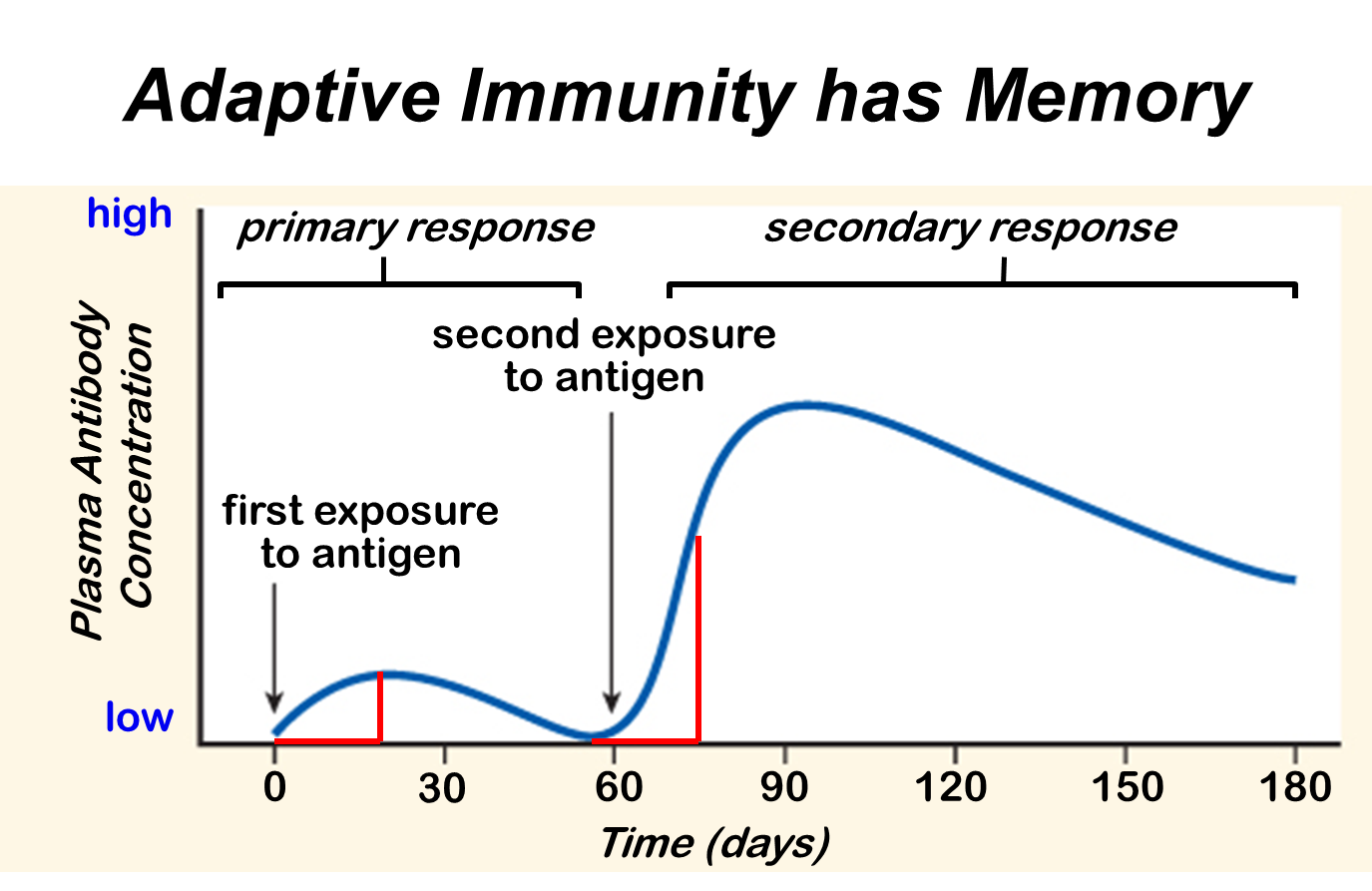
This graph shows how antibody concentration in the blood changes in the primary and secondary immune response.

This graph shows how antibody concentration in the blood changes in the primary and secondary immune response.

Antibodies are proteins and you can see they have a half-life in the blood of a few weeks.  (The liver breaks down proteins in the blood as one of its many functions)  So all the antibodies from a primary response will have been removed within a few months of the first exposure. Immunity can last a lifetime and this is because memory cells can survive as long as you do.  Unlike antibodies they can hang around in your blood and lymph nodes for the rest of your life.  If you live to be a hundred, you still won’t catch measles more than once.

This is a tricky topic so do please comment on this post if you have any questions.  Work hard at revision – it will be worth it in the end…..  (At least with Biology revision, it is fascinating stuff isn’t it?)



Human Transport IGCSE – a few pointers for Grade 9 Understanding 2.59, 2.63B, 2.69

I have had a request from a student to write about the level of details needed in the section of the specification on human transport.  Here are the relevant bullet points from the specification, together with a very brief outline of the kinds of details to learn:

  • Blood composition  55% plasma, 45% cells (red blood cells, white blood cells and platelets)
  • Plasma functions – transport of dissolved carbon dioxide, dissolved glucose, urea, salts etc.and transport of heat around body
  • Red Blood cells – no nucleus, each cell packed full of 250,000 molecules of haemoglobin, biconcave disc shape to squeeze through narrow capillaries
  • Phagocytes/Lymphocytes – two types of white blood cell, phagocytes engulf foreign organisms in blood by phagocytosis, lymphocytes do many functions in defending the body against disease but many produce antibodies
  • Vaccination with reference to memory cells and primary v secondary response (see below)
  • Functions of clotting and role of platelets (prevent infection, stop blood loss – platelets play central role in clotting as they produce chemicals that are needed for clotting cascade
  • Structure and function of the heart (learn names of chambers, blood vessels, names of four sets of valves and what they do)
  • Role of adrenaline in changing heart rate during exercise (speeds it up to maximise cardiac output to muscles)
  • Structure and functions of arteries/veins/capillaries (simple bookwork)
  • General plan of circulation including heart, lungs, liver and kidneys (see below)

The two sections that are perhaps hardest to interpret are the ones on vaccination and the general plan of the circulation.

1) Key terms in vaccination to understand:

  • Antigen
  • Antibody
  • Lymphocyte
  • Clonal Selection theory
  • Memory cells
  • Effector cells (plasma cells)
  • Primary response
  • Secondary response

At the end of the process, you should be able to provide a clear concise answer to the following question?

Why is it that the first time your body encounters measles virus, you suffer from the disease measles?  Why will someone who has had measles as a baby (or been immunised against it) never contract the disease measles even though the virus might get into their body many subsequent times?

2) The blood vessels involved in the four organs mentioned are described below.

Heart – receives blood from the coronary arteries which branch off the aorta before it has even left the heart:  Why doesn’t the cardiac muscle in the heart just get the oxygen and nutrients it needs from the blood in the chambers?

Lungs – pulmonary artery takes blood from right ventricle to the lungs, pulmonary vein return oxygenated blood to the heart and empty it into the left atrium.  What is unique about the composition of the blood in the pulmonary artery?

Liver – has a most unusual blood supply.  There is  a hepatic artery that branches off the aorta and brings oxygenated blood to the liver.  Blood also goes to the liver in the hepatic portal vein which brings blood from the small intestine.  Blood in the hepatic portal vein will contain lots of dissolved glucose and amino acids, both of which are processed in the liver.  Deoxygenated blood leaves the liver in the hepatic vein.  Find a diagram to show the arrangement of these three blood vessels.

Kidney – straightforward blood supply in that there is a renal artery and a renal vein.  (important idea is that the renal artery is much much bigger than you would expect from the size of the organs:  25% of the cardiac output of blood flows through the kidneys on each circuit)  Why do you think this is?

I hope this helps – more to follow when I get home from my holidays tomorrow afternoon…..


How to score full marks on IGCSE Genetics questions? 3.23 3.25

This will be my final blog entry from Dubai.  I will be flying home tomorrow with spirits refreshed by this amazing country and the positive and dynamic people I have met.

There will be a Mendelian genetics question in one of the two EdExcel IGCSE Biology papers.  Examiners are people who like to stick to tried and tested formulae with setting questions and it’s always worked in the past, so why change now…?

You should welcome the genetics question when it appears for two reasons:

  • If you understand what is going on and
  • if you are prepared to set the answer out correctly (see below)

you can almost guarantee that you will score all the marks!  And that’s what we want as full marks = top grade

The understanding you need for these questions is actually quite detailed and beyond what I can explain in this post.  Check your understanding by answering the following questions:

  1. What is the difference in meaning between a gene and an allele?
  2. Why does the genotype of a person, plant, fruit fly or rabbit contain two alleles for each gene?
  3. What is different about the genotype of a gamete compared with every other cell in the body?  Why are gametes different?
  4. How would you explain what is meant by a recessive allele?
  5. If two alleles are codominant, what does this mean?  Give me a specific example in which this pattern of inheritance is found.

Good, I am assuming you have answered these questions fully using important terms like diploid, homologous chromosomes, phenotype, heterozygous correctly……

In which case, all that remains is to remind you how to set out a genetic diagram.  I am not usually a proponent of slavishly following protocols but in producing a genetic diagram in an exam, you certainly should.  There are usually five marks available for a question like this and only one of the marks is for getting the right answer.  20% = E grade and that is not what we want.

  • Start with the phenotype of the parents – write mother and father’s phenotype down in full
  • Then underneath the phenotype, write the genotype of the parents.  (The letters to use for the two alleles will be given in the question and always use the letters suggested, don’t make up your own.  Slavish following of protocol remember)
  • The next bit is the first tricky bit.  Write the alleles present in the gametes.  Remember gametes are formed by meiosis and so only contain one member of each homologous pair of chromosomes – they will only have one allele from each pair in each cell.  Draw circles around each gamete to show the examiner you understand they are individual cells.
  • Draw a fertilisation table (called a Punnett square after Reginald Punnett – who says you don’t learn anything useful at GCSE?)
  • Write out the offspring genotypes from the table
  • Write out the offspring phenotypes underneath your list of offspring genotypes showing how they match up.

Answer the question.  If asked for a probability, express it as a fraction or percentage.  Those of you who follow the horses are sometimes tempted to write the probability as odds, but “3-1 the dwarf rabbit, 3-1 on the field” is not a good answer in your Biology exam…

If you do this you will always get all the marks.

Please remember:

The ratio of 3:1 is only found in the offspring of two heterozygous parents.  Sometimes students seem to think that all genetic crosses produce offspring in this ratio. This doesn’t make any sense if you think about it for a moment but in an exam, thinking for a moment is not always easy.

If you look at phenotypes in a population, the dominant phenotype is not always more common that the recessive phenotype.  This is something people find really difficult to get their head around.  Think of the disease polydactyly in which suffers have an extra digit (e.g. Anne Boleyn)  Polydactyly js caused by a dominant allele but I bet in your class at school, people with 5 digits on each hand are more common than those with 6.  (A joke about schools in the Fens north of Cambridge has been removed in the interests of good taste)

As fertilisation is random, offspring will never exactly fit the expected Mendelian ratio.  If you are given a cross in which peas produce offspring and 495 are smooth and 505 are wrinkled, you do not have to work out some complicated theory to explain this ratio.  It will be a 1:1 ratio with the small differences due to random fertilisation

Good luck and keep working hard!  Comments welcome as always – it does show me that someone is reading this stuff…….


Evolution for IGCSE Biology: Grade 9 Understanding 3.38 3.39

There are a few topics which you can pretty much guarantee will be tested somewhere in the two iGCSE Biology papers.  There will be a genetics problem to solve (see later post) and in almost every year there is a question about the process of natural selection.  These questions tend to be based around either the evolution of antibiotic-resistant strains of bacteria or an animal example based around some adaptation.

Questions on evolution are usually worth four or five marks and I would suggest you always answer them with bullet points.  Mark schemes for these questions are often similar and once you have revised the topic, some time spent with past questions and mark schemes would be time well spent.

Imagine you are set a question about cheetah and high speed running.  (Everyone knows cheetah can run for short distances at up to 70 mph:  so can the gazelle of course – that’s a coincidence isn’t it?)  How did modern-day cheetah evolve to run so fast?

Key ideas to include in your answer:

1) Variation in cheetah population:  in any population of cheetah at any point in their evolutionary history, some cheetah will just happen to be able to run a little faster than others.  This continuous variation could be due to environmental factors (diet, access to gyms etc.) or it could be due to the combinations of genes they happen to have inherited from their parents, or more likely to a bit of both.  Environmental causes of variation are not inherited of course but the genetic ones can be and that’s the key to natural selection.

2) Competition:  variation by itself cannot lead to natural selection.  If all cheetah survived to breed however slowly they ran, then high-speed cheetah would never have evolved.  In my example, cheetah are competing with other cheetah for access to prey species.  Gazelle run pretty quick too (I wonder why?) so cheetah who are slower than average will get less food.  Conversely if you are a cheetah who just happens due to random genetic variation to be a little quicker than your neighbours, you will get more food, be more healthy and more likely to survive to adulthood.

3) If your particular combination of genes makes you more likely to survive, then you are more likely to breed and pass these genes onto future generations of cheetah.  This process is called Natural Selection and it results in certain alleles becoming more frequent in a population over time.  In this example, the alleles that produce aerodynamic, long-limbed and muscle-bound cheetah become more frequent over time while alleles building lethargic, over-weight and peaceful cheetah tend not to be passed on as well to future generations.

4) This produces a gradual change in the population over time.  Selection is a cumulative process:  small changes from one generation to the next can add up to big changes over thousands of generations.

NB  This answer does not contain the word mutation and this is quite deliberate on my part.  You want to make absolutely clear in your answer that at no point in the history of cheetah, did two slow-running cheetah parents give birth to a “mutant” cheetah with Usain Bolt like qualities.  Mutation is a random change in the DNA of an organism and much of the genetic variation described above comes not from new mutations appearing but from the shuffling up of alleles into new combinations in meiosis.  These new combinations of alleles can produce new phenotypes and these are the features on which selection can act.

But……  If you are writing about the evolution of antibiotic resistance in bacteria, this can be due to a single mutation.  One altered gene can produce an enzyme that will breakdown antibiotic molecules or pump them out of a bacterial cell, so in this example it would be correct to talk about a random mutation occurring in the bacterial population.  The key thing here is that these mutations have been occurring randomly for billions of years in bacteria.  The mutation is totally independent of the use of antibiotics.  All that has happened differently in the past 50 years is that for most of evolutionary history these random mutations would have been harmful to the survival chances of the bacterium unfortunate enough to acquire them.  Now in an environment particularly in hospitals flush with antibiotics, these once harmful mutations can give the bacteria a massive selective advantage.  Hence the evolution of strains of bacteria in hospitals resistant to a variety of different antibiotics e.g. MRSA and C. difficile

This is an essential topic to get your head around for the exam.  Please comment on the blog post if you have any questions or contact me via Twitter.

Good luck!

Thoughts from Dubai – an #EdTech future beckons

I am half way through my week in Dubai – two books completed of the five I brought out – and more calories already consumed than required for the entire five day stay.  I hope you will forgive a blog entry with a few thoughts….

Spending time in a totally new city like this does make me think about civilisations and my future working life.  I am writing these words sitting overlooking the Arabian Gulf in beautiful gardens, air temperature approximately 30 degrees.  My wifi from the hotel extends down to the beach and so I can work away here, topping up my sunburn and intermittently responding to emails from boys I teach and writing blog posts that a handful of people worldwide are reading.  I am playing with Firefly which is my school’s VLE (virtual learning environment) and thinking how best to organise our departmental site.  It does make one wonder whether as IT and #edtech improves exponentially I couldn’t spend more of my working life in a place like this.  Slough has plenty to recommend it of course but it is hard not to think that in some ways, the quality of life might be better with British winters spent over here.  Independent learning is a catchphrase much in use in my establishment at least so can I make a suggestion?

Why don’t we follow the model of continental football leagues and have a midyear winter break?  Not a Christmas holiday but a period of 4 weeks (let’s call it February) when the school in the UK closes, everyone goes home and boys work independently using #EdTech.  This flippant proposal has massive benefits – the school saves on heating and lighting bills, the boys get to develop more independence in their learning habits and I spend 4 weeks working out here every winter which would do wonders for my quality of life as well as my golf handicap.  I would set tasks for students to complete, not run of the mill stuff, but extended pieces of work developing collaborative and research skills, with online tests to give students feedback.   I would be available for contact six hours a day and could offer help/suggestions as to how to make progress in the various group and individual tasks set.  Students would blog at the end of each day about the learning they have achieved that day to which I could offer feedback and support.  I can see this proposal would pose difficulties for the Field Game program – how to get every round of Second Junior Sine completed so that someone wins the cup? – but apart from this, what’s not to like?  This four week midyear break would also allow boys to build up work experience (where relevant) or work on community projects away from school.  The learning they would gain from this would be immense, not restricted classroom learning but true, life-changing learning of the kind that too rarely happens in the frenetic and stressed world of the modern school.

My other thought here has been about the impermanence of civilisation.  Dubai’s growth makes me think about what I see as the massive complacency in the UK.  I wonder if this was similar to how the Romans felt sitting in their villas, surrounded by wonderful architecture in what seemed to them a thriving state.   Everywhere in Dubai you see people working hard against the odds.  To construct a city and civilisation like this in the desert in such a short space of time shows the ambition of these people and their leaders.  Although we might not have Goths and Visigoths at the gates, it is not hard to see the challenge this growing state poses to our Western civilisation.  Gause’s Law of Competitive Exclusion says that two species cannot occupy the same niche in an ecosystem, one will always drive the other to extinction by out-competing them for resources and perhaps a similar law applies to civilisation?  Gillam’s Law – it has a ring to it, you can’t deny.  Dubai is occupying the same niche as other large cities in the West – a business and trade hub with a growing economy and wealth creation to the fore – and from where I am sitting it is hard to believe that any Western city is in a stronger position to win in this particular competition.  Are we prepared to work as hard as the immigrant population I see here?

There, two big thoughts for one day and it’s not even lunchtime.  Remember Gillam’s Law, you heard it here first.

Eutrophication – the least glamorous topic in IGCSE Biology 4.16 4.17

This is a topic it is easy to overlook in your revision:  water pollution by sewage is hardly glamorous and when you combine it with the limited excitement of learning about fertilisers, you don’t have to be a genius to see why many students leave it out. But examiners seem to like eutrophication so it is worth making sure you are going to score full marks on any question they set.

Starting point in your understanding for this topic should be that what limits plant growth in many circumstances, and often in aquatic ecosystems, is the availability to the plant of nitrate ions.  A nitrate ion (NO3-) is essential for the plant to make amino acids, and hence proteins and also DNA.  Cells need more DNA and proteins to divide and grow so farmers spray extra nitrate ions onto their fields in fertilisers.

Nitrate ions are very soluble in water so if it rains, they can easily dissolve as the rain water passes through the soil a process known as “leaching”.  These nitrate ions can thus end up in freshwater, for example streams and ponds where they have exactly the same effect as in the soil – they cause excessive plant growth.  The plants in freshwater are often types of algae and if you have far too much nitrate in the water, this can cause an algal bloom.  This excessive growth of plants is called eutrophication (or more properly hypertrophication)

Now the eutrophication story then proceeds like this….

If there is an algal bloom, this can eventually cover the surface of a pond so that light doesn’t penetrate to the multicellular plants that live on the bottom, the beautifully named “bottom-dwellers”.  No light for these plants means they can’t photosynthesise and so they die.  In the water there will be aerobic bacteria that act as decomposers and so if there is loads of dead material in the water, the populations of these bacterial decomposers will rapidly rise to break down the detritus.  These bacteria remove dissolved oxygen efficiently from the water as their numbers go up (remember they are aerobic bacteria), so water quality rapidly falls.  The lowering oxygen concentration in the water will itself cause animals from small invertebrates to larger fish to die and so a vicious circle is set up: less oxygen = more dead organisms = more decomposers = less oxygen.

The consequences for a pond in these conditions are very damaging.  The complex ecosystem involving producers, consumers, food chains and so on is replaced by one with algae, decomposing bacteria and a few organisms that can survive in anaerobic conditions.

Anything that increases the numbers of decomposers in a freshwater ecosystem can cause eutrophication and the consequences described.  The commonest cause is agricultural run off from fertilisers (nitrates/phosphates etc.) but untreated sewage can cause similar consequences. The decomposers need to break down the sewage, releasing nitrate ions into the water that cause eutrophication.  The murkiness of the water can also kill bottom-dwellers directly and set the whole cycle off.

Eutrophication is a sequential process and often examiners use this question to test your ability to organise your answer properly.  I would always answer a four or five marker on this topic with bullet points rather than a paragraph of text.  Why do you think this is?

Now make a summary diagram to show eutrophication and answer a few IGCSE questions from the booklet.

Work hard!


Revision tips – a few topics that should be compulsory

Students often choose to revise topics that either they know they find interesting or perhaps ones that they already understand.  Working on the idea that you will have 10 hours at most to revise the whole IGCSE specification this holiday, this should be avoided if at all possible.  Use the “traffic lights” checklists in the revision booklets to target your revision within a particular topic.

Topics that boys often avoid revising (are some of these just a little dull?) but which examiners seem to like to test are given below:

  • Deforestation and link with climate change
  • Cycles in Ecology (Carbon, Nitrogen and Water)
  • Natural Selection (you can almost guarantee there will be a question on this)
  • Genetic Engineering (pay close attention to the syllabus points about specific examples and ethical objections)
  • Variety of Living Organisms (Classification) – there are loads of specific details about the Five Kingdoms with specific examples:  go through this section of the specification really carefully!
  • Food – balanced diet idea and the specific vitamins mentioned in the specification
  • Air pollution – sulphur dioxide (acid rain) and carbon monoxide
  • Fermenters – how to grow bacteria and the specific conditions needed
  • Fish Farming – remember someone in the exam board loves fish farming!  Make sure you understand the specific details of how the fish farm is set up and the potential problems:  this tiny part of the syllabus has been over-represented massively in the past few years:  please take care to ensure you don’t get caught out by another fish farming question…..

The basic message in this post is this:  your course is not IGCSE Human Biology so make sure you don’t just revise for this!

Keep working hard and tweet me with any questions or make a comment on this blog post.

PMG


Eton win two Rackets finals at Queens

Image

If yesterday the honours were shared between Eton and St Paul’s the same was not true at Queens today. The Eton College rackets players won both their finals and so completed a remarkable week at the Queens Club.

In the Second Pairs final this morning the Eton pair of George Loup and Ed Rowell were matched against the Harrow 2nd pair (Prenn and de Silva). These finals on the Bridgeman Court can often be scrappy, “hell-for-leather” affairs but in this particular match the overall standard of play was high for much of the time. There were several long exchanges between Rowell and de Silva with both boys hitting the ball cleanly around the walls and to a good length. Loup’s serving was impressive throughout and the powerful backhand serve he has worked on for five years from the right hand service box won us several crucial points at key moments.

The early stages of the match were closely contested and the first game lasted a considerable period of time. Eton built up a 12-9 lead but we weren’t serving with any conviction and strong play from de Silva allowed them to reach 12-12. Harrow closed out the first game with a few good points winning it 15-12, Prenn dominating play following his powerful serve. The start of the second game saw us serving with more purpose and we quickly built up a early lead. Loup was finding a pace of serve that was keeping the ball close to the back of the court and Rowell was getting more cut on his forehand serves. Eton quickly won the second game 15-3 to level the match. This pattern of Eton dominance continued for two more games with our pair playing some high quality rackets that often involved Rowell volleying the ball halfway up the court on the forehand side and Loup playing with composure on the backhand. At this stage Eton had a three games to one lead and were one game from victory. The fifth game saw Harrow starting to pick their standards up again and cracks were beginning to show in the Eton pair’s play. Loup was starting to look a little tired and so wasn’t quite using his feet as effectively as earlier in the match and Rowell was getting visibly flustered with some of his play. This gave the Harrow boys the confidence to take the 5th game 15/12 and once again the match was in the balance. Losing this game was enough to allow our pair to regroup and for the sixth game, we returned to our previous high standards and as the composure returned, the ball was being struck more cleanly once again. Harrow didn’t give up for one moment in the game and were still producing the occasional blistering shot but it was clear that the balance was shifting. A series of good serves from Loup allowed Eton to close out the game 15/7 and so take the match by four games to two.

Eton beat Harrow to win the Second Pairs championship 12/15, 15/3, 15/5, 15/6, 12/15, 15/7

The final match of the week was the final of the First Pairs competition, the blue riband event of the championships. This was also an “old firm” final, the third Eton v Harrow final of the week. The Harrow pair comprised Robbie White, the player who pushed Morales so hard in the Foster Cup final, and his partner Henry Goodfellow. Although the seeding committee had made us the favourites in this match before the draws were made, people who had watched all the previous three days of competition were predicting a very close affair. Eton’s first pair Toni Morales and Charlie Braham had not really found their top form at any point in their earlier matches although in every round so far they had come up against boys playing very well indeed. A few cracks had become apparent in our doubles play and both Eton boys had made more unforced errors than one would expect.

The two Eton boys played with some nerves at the start of the final but this was certainly understandable. There was a considerable gallery watching the match at Queens and plenty of support for both pairs so the atmosphere was tense. Morales missed a couple of straightforward balls at the front of the court and Braham served a double fault in the early exchanges. Harrow established a 10-5 lead in this first game but then a passage of strong serving from Morales took us back from 6-11 to 11-11. Braham was taking the ball early and volleying well on the forehand side and this allowed us to pin the Harrow boys deeper in the court than they would have liked. The comeback in this game was completed as Eton won the first game 15-11. That we ended up winning this first game was actually less important than the fact that the early nerves had been overcome and that we were playing with a clear head. Getting the balance between high emotion and cool composure is just one of the challenges rackets players have to face every time they compete on court. In doubles play it can be too easy to allow one’s own nerves to convince you to leave the ball to your partner round the walls rather than attacking, taking responsibility and moving up the court yourself. It takes considerable nerve and bravery to position yourself in a such a vulnerable place beyond the service line with the ball flying round at you at around 100mph. It also means you have to play all the difficult shots in the rally as you have so much less time to react but it is the only way to win on the Queens courts.

The start of the second game was closely fought with neither pair able to establish a big lead. Harrow then started to hit some great winners with Goodfellow bravely getting far up the court to take the ball early. Harrow ended up winning the second game 15/12 but we made them work very hard for the game and actually won several important points in the end stages. This was perhaps the period in the match when the overall quality of play from all four boys was at its highest. There were several really long exchanges in the latter stages of game two and in doubles, this is always a sign of high quality play from all four players. In the third game Eton quickly took a 7-1 and then a 10-2 lead. Harrow got back into the service box and won some points to get to 7-11 but Braham was able to dominate two points to make it hand out and then Morales with customary composure and skill closed out the game 15-7. The balance of power in the match had truly shifted and the Harrow boys were being forced into making errors. Eton won the fourth game 15/5 to take a three games to one lead in the best of seven final.

I have seen enough of Robbie White’s rackets over the years to know that he would make a comeback at the start of the fifth game. He hit a superb winner to take us out of the service box and it is to the Eton boys credit that they were able to withstand the Harrow fightback so well. The fifth and as it turns out final game was fairly comfortable for us in the end. Harrow had several hands in the service box but we were returning well on both sides and they were finding it hard to score points. We reached match point at 14-4 and closed the match out to win the final by four games to one.

This was a most pleasing performance in the final and a great end to a successful week. Braham and Morales had produced by far their best performance of the week in the final which is commendable in itself. I thought Braham played a superb match today, steady at the times he needed to be but also willing to take the difficult balls early and to hit winners at the front. Morales showed again that he has the composure and mental strength to produce his best play at the crucial times. Both Eton players have a presence on court that makes them hard to beat: this innate will to succeed, when combined with the excellent technical and tactical coaching they receive from Peter Brake, makes them a formidable pair. There will be fresh challenges next season but now is a time for Peter and the boys to celebrate a fantastic win to end a superb rackets season.

Eton beat Harrow to win the Public Schools championship 15/11, 12/15, 15/7, 15/5, 15/4

Eton’s day at the Public Schools Rackets

Today was a busy one with four rackets matches involving Eton pairs on at Queens Club in London.

Junior Colts Final

Eton (Tom Loup mi and Ben Brooks) played St Pauls (seeded one) in the first final this morning. The St Pauls pair are very strong and PAB and I both knew that we would have to play at our very best to be able to compete. As it turned out, St Pauls started the match serving very powerfully and to a good length. We couldn’t return enough serves to get into any kind of rhythm and so the early exchanges all went in their favour. Any nerves they might have had as favourites were quickly dissipated as they won the first game to love. The remaining two games were much more closely contested but the reality of this match was that we were outplayed throughout by a better pair. St Pauls won the final by three games to love, 15/0, 15/9, 15/7. Tom Loup and Ben Brooks have had a good week overall and have shown that they can play well as a pair. Both have improved through the week and the boys were disappointed that the quality of opposition was too strong for them on this occasion. We know now exactly how much we need to improve to be able to take these boys on and I look forward to seeing how these two and our other E block players rise to the challenge in D block.

Colts Final

Eton’s Colts pair was also an all-RDOC affair. Rory Giddins and George Nixon have been favourites for this competition all season and were seeded one. They reached the final easily enough and had not really been extended or put under pressure before today. Their opponents in the final this morning were the old enemy Harrow whose pair comprised a talented but inexperienced left hander and a hard-hitting and more experienced player on the right side of the court. Eton started well and were made to work really hard in the first game. Harrow actually took an early lead and had several serves with 12 points already accumulated. The Harrow boys were fired up and we had to keep our cool and focus to win this game. As the match went on, the boys became more comfortable and Harrow’s mistakes made it hard for them to stay in the rallies. Nixon served well at times and Giddins played his usual high quality consistent game. More and more unforced errors were creeping into our opponents’ play and we were able to exert some control from in the service box when we served to a good length. The Eton pair won the match and the Colts Doubles trophy by four games to love 15/12, 15/8, 15/4, 15/6. Well done to Rory and George for winning Eton’s first trophy of the week!

Second pairs semifinal Eton (George Loup and Ed Rowell) won well to reach tomorrow’s final. They beat a good Harrow 3rd pair by four games to love 15/10, 15/3, 15/10, 17/16.

First pairs semifinal Eton (Toni Morales and Charlie Braham) played much better today to win their match this evening. Braham served a much better length and was taking the ball earlier in the rallies, Morales hit some great winners at times and it was clear we were trying to play more at the front of the court. This is the only way to win games on the Queens court and although I thought the Wellington pair played well at times, once we started keeping the ball off the back wall in the rallies, they were always going to find it tricky to match our play.  Wellington won the first game having been well down in it, but from then on, the remaining games all went to Eton. I was pleased with the improved performance today and I hope we can make another step up in quality for the final tomorrow. Eton II beat Wellington II 14/17, 15/5, 15/8, 5/8, 15/6

Saturday Finals

11am Second Pairs Final: Loup ma and Rowell play Harrow II

1.15pm First Pairs Final:
Morales and Braham play Harrow (Robbie White and Henry Goodfellow)

It was good to see a collection of beaks and boys at Queens today to support the team. Thank you to everyone who made the effort to come into London to see the boys play. Do please come along tomorrow for the two remaining finals if you are free. Both are Eton-Harrow clashes of course and the galleries tend to be packed on these occasions so get there early to make sure you have a good view.