Quiet time on the Blog….

It’s been a quiet few weeks at the start of 2015 for the blog. Life seems more hectic than ever but I can’t work out why…. There are some new iGCSE blog posts on the way on the following topics:

  • Homeostasis
  • The Kidney
  • Thermoregulation
  • Nerve Cells and Synapses
  • Sexual Reproduction in Plants
  • Asexual v Sexual Reproduction
  • Blood
  • Cardiac Cycle and the Human Heart
  • Blood Vessels – (all you need to know)
  • Antibodies and Immunity

Please keep checking – they will appear I promise….

2014 in review

The WordPress.com stats helper monkeys prepared a 2014 annual report for this blog.

Here’s an excerpt:

The concert hall at the Sydney Opera House holds 2,700 people. This blog was viewed about 8,600 times in 2014. If it were a concert at Sydney Opera House, it would take about 3 sold-out performances for that many people to see it.

Click here to see the complete report.

Three great Biology books to read over the Christmas holidays

It is one of the really good things about the extended curriculum at my school that students are not set work to do in the holidays.  This allows time at home to be spent resting, recuperating and preparing for the term ahead.  But can I make a suggestion as to what some of you might like to do before the start of next term?  Find a really good book to read and read a chapter a day.  Here are some personal suggestions as to some of my favourite Biology books.

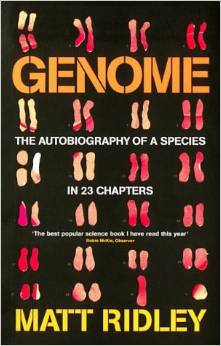
genome

“Genome” by Matt Ridley is a really interesting read.  I have read it over and over again since it was first published in 2000.  The chapters are short but the ideas contained within are important and challenging.  The 23 chapters are each devoted to a single gene on a different human chromosome but Ridley is able to draw out some deep ideas with entertaining stories, anecdotes and superb detail.  I would say this is ideal for either Y11 (D block) or Y12 (C Block) students.

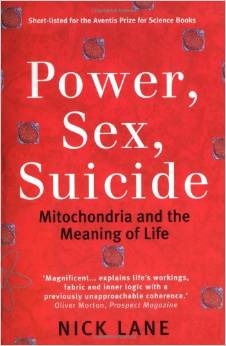
power sex suicide

Nick Lane came to Eton last year to speak to the Scientific and Banks Societies and he was about the best speaker we have had for a long time.  This book is more suitable for Y12/13 students than GCSE readers as it has direct links to the pre-U course and contains some complex ideas.   He is interested in the role mitochondria have played in the history of life and for me, Nick Lane is the best contemporary writer.  If you like this, I can also recommend his later book “Life Ascending” which is also a super read.

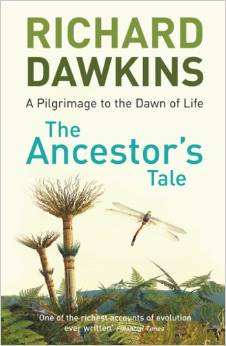
The Ancestors Tale

This is my favourite Dawkins book.  If you are interested in understanding the grand sweep of the tree of life and the history of life on our planet, there are a lot worse ways to start than reading this.  Dawkins has a superb writing style and is able to make a complex chronology of species entertaining and easy to follow.  If you do read any of these books and would like to tell me your thoughts, or indeed if you have other recommendations, please add a comment to this post so that others can see.

Happy Christmas!

2014 Public School Rackets Singles competitions at Queens

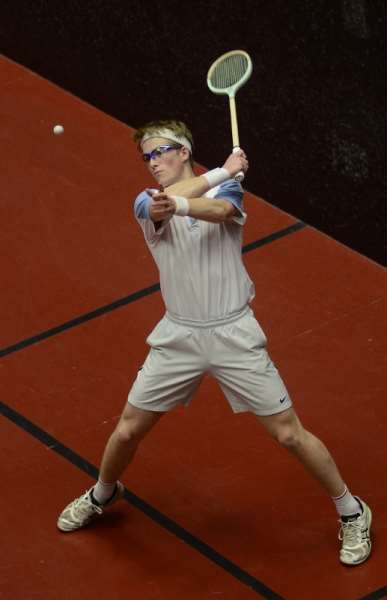
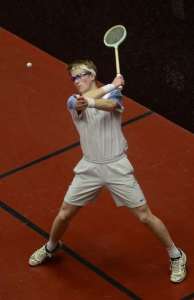
After all the controversy and adverse publicity that accompanied the previous Public Schools Doubles tournaments in March 2014, it was good to get back to Queens for the Singles events.  The Foster Cup field of sixteen featured no less than five Eton boys, including last year’s winner Toni Morales and number two seed Charlie Braham.  For this correspondent at least, it was also good to see schoolboy rackets players involved who are not lucky enough to attend one of the 14 schools with their own court. The furthest traveller this year came not from Manchester, England but from Chicago, Illinois, accompanied by his coach, Will Hopton OE.

The Jim Dear Cup is named after one of Peter Brake’s predecessors as Eton Rackets professional and is for U15 and U14 players.  The feeling at the start of the week was that this was an open tournament with several possible winners.  In the end, the top seed from Marlborough, Dom Coulson, won a close final coming from behind, showing as earlier in the competition his ability to keep his head and remain focused for every point.  Notable Eton performances in this competition included Josh Britton who reached the quarterfinal stage with three good wins.  Hugo Giddins and Bertie Duncan both put up encouraging performances when they came up against the better players and all three should be pleased with what they achieved this week.

The Incledon-Webber event for U16 players was won by Alex Engstrom (St Pauls) as he reversed the result in last year’s final overcoming Ben Cawston.  I was encouraged by Salil Navarpurkar‘s performances and as a late-comer to the sport and after just one term of practice, he showed himself one to watch for the future.  Tom Loup was never really at his best this week and went out in disappointing fashion at the quarterfinal stage against an opponent he should have beaten.  Hector Hardman played much better all week and has improved a great deal this term but lost his nerve somewhat when in a winning position in the quarterfinal against a dangerous opponent.  Often players have to go through a match like this at some stage in their rackets career and I know Hector will emerge stronger next time.  The courts at Queens put a premium on the ability of the players to move well, to not plant their feet too early and yet to keep taking the ball early and volley in rallies. Hector did all of this well in every round and indeed for the first part of his quarterfinal but as tension creeps in, it is easy for this to ebb away.  As the match descended into longer rallies, the better movement of his opponent, Cawston around the court allowed him to gain the edge.

The Renny Cup is for U18 players.  Jamie Jordache (Harrow) won the final against a good player from Cheltenham in three close games.  All the Eton boys in this event performed with credit.  Max Cooper made his debut at Queens and played well.  Sam White too showed how much he has improved in a high quality match against a good opponent from Marlborough.  And it was good to see Milo Dundas smiling after two good wins on the first day of competition.  Ed Kandel lost in a close game to the eventual winner and should be encouraged for a strong challenge at this title next year.

The main event is the Foster Cup for the sixteen best U18 players in the country.  For Eton to have five boys in this event is an impressive achievement but a strong case could be made for us having the four best players and that has never happened for any school in my time in the sport.  Ed Rowell was unlucky to draw Braham in the first round but produced a fine display of singles and pushed Braham to the limit in every game.  Rowell has worked hard on his backhand side, straightened the ball well and too a good length especially with his return of serve on the forehand side, and although he lost 0-3 to Braham, he came away from this match with tremendous credit in my eyes: an impressive performance.  George Nixon lost in the first round to the eventual semi-finalist Maxim Smith (Wellington) and perhaps wasn’t quite able to produce his best play due to a lack of preparation time because of injury.  Rory Giddins was seeded three and duly disposed of his two early opponents without really breaking sweat.  Rory’s strong serving from both sides resulted in a string of aces and although he could not challenge Morales who was on top form in the semi-final, Rory should be pleased with his week’s work.  He will be back next year for another challenge for this prestigious title but will need to maximise all aspects of his preparation to be successful.

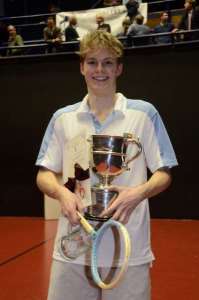
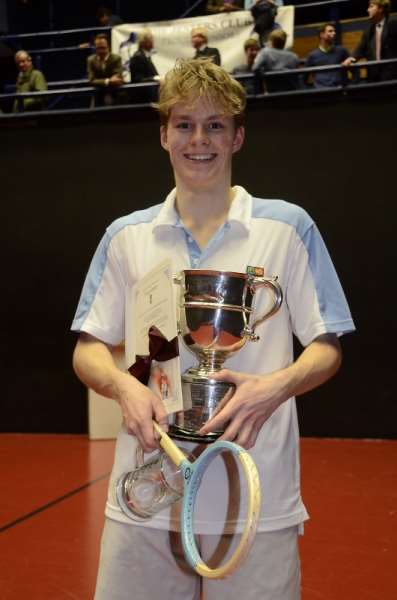
So the 2014 Foster Cup final was the match most people had been anticipating: defending champion Toni Morales against his first pair partner Charlie Braham.  Morales won the first game playing the kind of high quality rackets that had seen him overcome Giddins the day before.  He was returning serve very well indeed, killing the ball to a good length off the front wall and dominating the front of the court in rallies.  I think is fair to say that of the sixteen entrants in the event, only Morales at the moment can produce play of this quality.  He won the first game 15/5 but the question was simple: could he keep it going?  In the second game his movement was starting to look less confident and this meant he was unable to hit the ball exactly where he wanted.  Balls that in previous rounds were hitting the front wall were now just catching the side wall and so ending up in the middle of the court.  Braham was moving well, serving consistently on both sides and the longer rallies were to his advantage.  You could see the belief growing in Braham’s body language as he was able to win some crucial points.  The rallies were becoming longer as both players struggled to control the length they were hitting and balls were flying off the back wall.  Tension affects footwork, which affects the timing of contact on the ball, which causes errors, which causes tension.  Who was going to be able to break this cycle?  Braham was able to close out the second and third games 15/11, 15/11 to take a two games to one lead.  The fourth game was equally close and there were moments in it where a Morales come back looked likely.  After a period of scrappy play, Morales would suddenly produce two or three fine points.  But Braham was able to keep his belief, to keep serving well and to keep his standards high throughout.  Braham won a close fourth game 15/12 to take the Foster Cup title by three games to one.
web_PSS14-0305 (517x800)web_PSS14-0391 (530x800) web_PSS14-0374 (786x800)

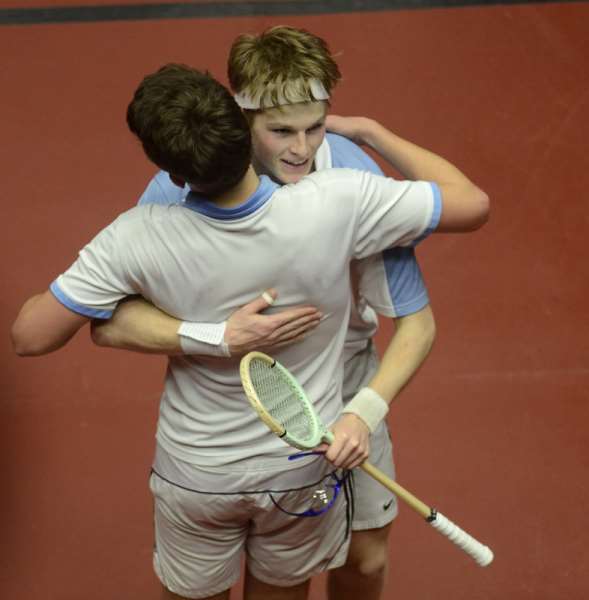
There are just one or two final things to add about this final other than to congratulate Charlie Braham on a fabulous victory.  The match was played in a great spirit of friendly competition.  You will hear plenty of sports coaches who would suggest this phrase is an oxymoron.  They will tell you that competition is never friendly as it is a substitute for some kind of life or death battle.  Well I am afraid they are wrong.  Morales wanted to defend his Foster Cup title with every ounce of will in his body.  But this did not stop him again, as last year, calling balls he had hit not up.  There are ways of winning and losing that reveal character and gain you credit and both boys come out of this final even higher in many people’s estimations.  I hope that we will see a photograph of a similar hug in March as they successfully defend their Doubles title together.

But my final comment is to draw your attention to how hard Charlie Braham has worked and some of the sacrifices he has made to reach the standard needed to beat Morales.  Charlie won the National U18 real tennis title in August this year but has hardly played since as he has been so focussed on his Rackets.  He was worked on his strength and conditioning with regular sessions through the term and hard training in between.  Perhaps the fitness he demonstrated in the final few points of the final game were the result of all this hard work, this effort over an extended period, this self-motivation…? Perhaps the difference between hitting the last ball up at the end of a 90 minute match and just catching the tin was not due to work on the rackets court but work done, alone, in a S&C suite at school at the end of a long tiring day?  My question for the younger Etonians reading this is whether they will be prepared to put this much effort into their preparation, to devote this much focus and determination to be the very best they can be.    Do you have what it takes to be the next Eton boy to win this title? I posted a tweet on the eve of the final that presumably is an advertising slogan for a sports brand.  But it does seem quite apt:  “Don’t Wish for it, Work for it”: a good catch phrase for Eton Rackets in 2015.

Happy Christmas.

Understanding Pedigrees: Grade 9 Genetics for IGCSE Biology 3.24

Sometimes genetics problems are based around a pedigree diagram.  These diagrams show the phenotypes of individuals over several generations and allow deductions to be made about certain individuals phenotypes.  Often pedigrees are used to show the inheritance of a particular disease in a family.

566Pu

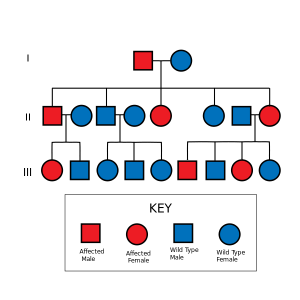
You can see that circles in the pedigree represent females, squares represent males.  If the symbol is filled in, then the person suffers from the disease.  Empty symbols represent people who do not have the disease.

Have a look at the pedigree above?  What does this tell you about the disease?

Well the first and most obvious thing is that this disease is caused by a recessive allele, h.

If you see two people who don’t have the disease producing one or more children who do, then this must be a genetic disease caused by a recessive allele.  In the top generation, parents 1 and 2 do not have the disease, but they have three children 2,3,4 one of whom has the disease.

What does this tell us about the genotype of parents 1 and 2 in generation I?  Well if neither have the disease and they have a child who does, both 1 and 2 in the top generation must be heterozygous – Hh

Anyone with the disease must be homozygous recessive hh.

Have a look at generation II in the diagram above?

The man, number 2, who is a sufferer and so genotype hh marries woman 1 who does not have the disease.  They produce 4 children, three with the disease and one without.  What must the genotype of the woman 1 be?  Well she must be heterozygous Hh.  How do we know?  What children would she produce if she were a homozygous HH woman?

AutosomalDominant

A pedigree caused by a dominant allele would look very different.  Every sufferer would have at least one parent who also suffers from the disease.  Two sufferers producing some children who do not have the disease is indicative of a disease caused by a dominant allele.  If we use the symbol P for the dominant allele that causes the disease, and p for the recessive allele that is “normal”, can you work out the genotypes of all 12 people on the diagram above?

  1. Pp
  2. Pp
  3. pp
  4. Pp
  5. PP or Pp
  6. PP or Pp
  7. pp
  8. pp
  9. Pp
  10. pp
  11. pp
  12. pp

Grade 9 GCSE Genetics: avoid a common error in understanding at IGCSE 3.19

There are one or two things which make a biology teacher’s (and indeed an exam marker’s) blood pressure rise.  Well in fact in my case there are many dozens of things, as some of you know, but let’s keep it to the things candidates write in genetics answers in exams.  This post is an attempt to encourage you to avoid the commonest “howler”.

The dominant allele does not have to be the more common one in a population.

Just because an allele is dominant, it does not mean it will be the most common in a population.  I often hear answers in which people think that in a population 3/4 of the population will have the dominant phenotype, 1/4 will be recessive.  This is utter nonsense of course.  The ratio of 3:1 only applies to the probabilities of offspring produced by mating two heterozygous individuals.

There is a gene in humans in which a mutation can cause polydactyly:  this rare condition results in babies born with an extra digit on each hand.  Anne Boleyn was a famous sufferer in the past.  But the allele of the gene that causes polydactyly is dominant – it is a P allele.  I would imagine everyone reading this post, (all 12 of you…..), will probably have the genotype pp.  The p allele that causes a normal hand to form is very very common in our population whereas the P allele is very very rare.

Don’t ever believe that just because an allele is common, it must be dominant.

How to score full marks on a genetics question in IGCSE Biology? 3.20, 3.23, 3.25

Few things in life are certain, famously just death and taxes.  Northampton Town flirting with relegation can perhaps be added to this list.  But you can be pretty certain that tucked away somewhere in your iGCSE Biology exam there will be a genetics question that asks you to draw a genetic diagram.  There are usually four or even five marks available and so learning how to ensure you get all these marks is vital in your quest for an A* grade.

GCSE candidates are terrible at doing genetic diagrams: they fill the space with messy scribbles, doodles, strange tables and lines and then confidently write 3:1 at the bottom… Not a recipe for success.  So learn how to do it, be neat, take your time and you can guarantee full marks.

If the question doesn’t do it for you, you should start by defining what the letters you will use for the alleles.  If one allele is dominant over the other, it is conventional to use the upper case letter for the dominant allele, the lower case letter for the recessive one.  It will tell you in the question which allele is dominant.

Start your genetic diagram by writing the phenotype of the parents in the cross.

e.g.          Parental Phenotype:             Tall                         Tall

Underneath the phenotype, write the genotype of the parents.

Parental Genotype:                Tt                            Tt

Then you need to think about which alleles are present in the gametes.  Gametes are haploid and so will contain one of each pair of homologous chromosomes – in this example there can only be one allele in each gamete (as we are only looking at one gene)

Gametes:           T               t                       T                   t

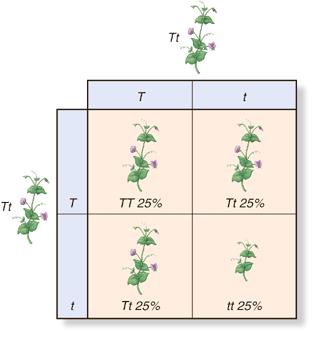
Next show random fertilisation.  I think it is much better to draw a Punnett square that has the male gametes down one side, the female gametes down the other and then carefully pair them up.  This is a stage where mistakes can be made if you rush so however simple you think this process is, take your time…..

Random Fertilisation

9.02.PunnetSquare

Finally you need to copy out the offspring genotypes from your Punnet square, like so

Offspring Genotypes:        TT            Tt              Tt             tt

And underneath each one, write the offspring phenotype

Offspring Phenotypes:       Tall           Tall            Tall           Dwarf

Finally, answer the question.  If it asks for a probability, express your answer as either a percentage or a decimal or a fraction.  So if I were asked what is the probability of a homozygous pea being produced, the answer is 50% or 0.5 or 1/2

Follow these rules and you will always score full marks – happy days……..

Genetics jargon: Grade 9 Understanding for IGCSE Biology 3.20

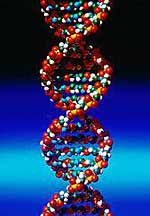
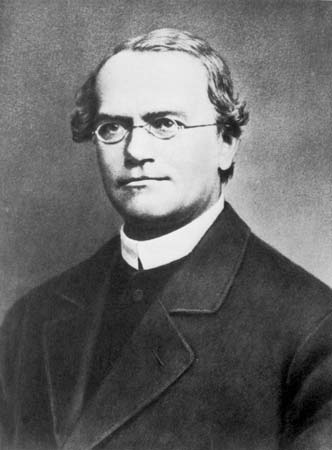
The science of genetics looks at how inherited characteristics are passed from one generation to the next.  The father of genetics was the Moravian monk, Gregor Mendel, who showed with his breeding experiments in peas that individual, discrete “particles” are passed from one generation to the next.  We now know that these “particles” are actually small sections of a DNA molecule called genes.

Mendel worked out that there were always two such “particles” in any cell which acted together to determine the feature described.  But he knew that gametes (sex cells such as pollen grains and egg cells) only contained one “particle” for each feature.  You should understand why this is.

The discrete particles that are passed from generation to generation are genes:  these are sections of a DNA molecule and are located on chromosomes.  Chromosomes in most organisms are found in pairs within the nucleus of a cell.  The word for a cell that contains pairs of homologous chromosomes is a diploid.  The gametes do not have pairs of chromosomes:  they are haploid cells that contain one member of each pair.  This ensures that at fertilisation when two gametes fuse, a diploid zygote is produced.

iGCSE candidates can find genetics a difficult topic and one reason is that there is lots of jargon.  Have a look at my definitions for these jargon words and ensure that you understand what they mean.  Genetics is not a topic in which rote learning and memorisation are helpful – the very top candidates at iGCSE will understand what is going on, and can then answer all possible questions with ease.

Gene: ” a section of a DNA molecule that codes for a single protein”

Allele: “an alternative version of a gene found at the same gene locus”

Gene locus: “the place on a chromosome where a particular gene is found”

Phenotype: “the appearance of an organism, e.g tall, short, blue eyes etc.”

Genotype: “the combination of alleles at a single gene locus that an organism possesses – e.g TT, Tt”

Homozygous: “a gene locus where the two alleles are identical is said to be homozygous – e.g. TT, tt”

Heterozygous: “a gene locus where the two alleles are different is heterozygous – e.g. Tt”

Dominant allele: “a dominant allele is the one that determines the phenotype in a heterozygous individual”

Recessive allele: ” a recessive allele can only determine the phenotype in a homozygous individual”

Codominance: “two alleles are codominant if they both contribute to the phenotype in a heterozygous individual”

Enzymes: Grade 9 Understanding for IGCSE Biology 2.10 2.11 2.13

Enzymes are biological catalysts.  This means they are able to increase the rate of a chemical reaction but are not used up in the reaction.  Without enzymes the reactions of metabolism would all happen too slowly for life to exist – enzymes can speed up the rate of reaction by many millions of times….

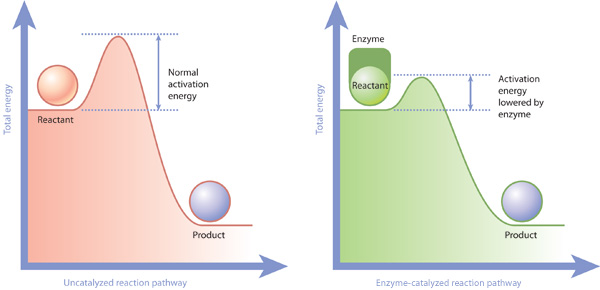
Enzymes work as catalysts by lowering the activation energy needed for the reaction to occur.  Activation energy is the term for the extra energy needed to be given to the reactants to break bonds within them to allow the product molecules to be formed.  Enzymes provide an alternate reaction pathway that has a lower activation energy.  This means that under any conditions a higher proportion of the reactant molecules will have sufficient energy to overcome the activation energy barrier and so more reactants will be turned into products.

U1CP3-3_EnzymeActivation_revised

How do enzymes lower the activation energy?

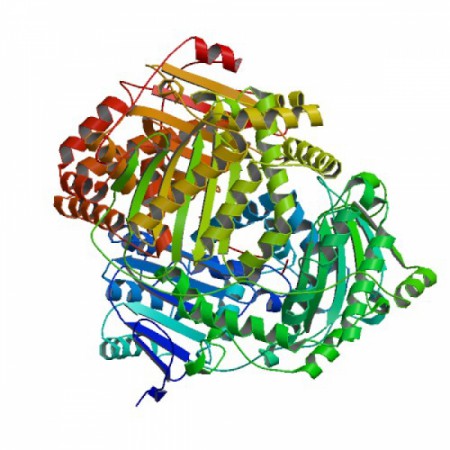
Enzymes are all large globular molecules, almost always made of protein.  They have a specific three-dimensional shape that includes a region called the active site which has a shape that allows the reactant molecules (called substrates) to bind.  When the enzyme binds to the substrate, it forms an enzyme-substrate complex.

enzyme-working-mechanism

This theory of how enzymes might work is called the Lock and Key theory.  The active site acts like a lock as it has a shape that is complementary to the shape of the substrate (the key).  Lock and Key theory explains an important property of enzymes which is that they are specific.  Each enzyme can only catalyse one reaction since only a substrate molecule with a specific shape can bind to the active site.

When the substrate is bound to the active site forming an enzyme-substrate complex, the enzyme introduces a strain on some of the bonds in the substrate, making a reaction more likely.  The active site might provide a microenvironment that is exactly the right condition for the reaction, thus lowering the activation energy.

biobook_flow_5a

Key idea:  enzymes catalyse almost all the chemical reactions that happen in organisms.  It is easy to imagine that enzymes only catalyse reactions like the one in the picture above in which a molecule is being broken down into smaller molecules.   But enzymes catalyse oxidation reactions, condensation reactions in which big molecules are built up from smaller ones, phosphorylation reactions (sticking phosphate groups onto molecules) and so on and so on.  So don’t describe enzymes as being involved in breaking things down: some do of course but the vast majority work inside cells to catalyse a whole variety of reactions in metabolism.

Rates of enzyme-catalysed reactions can be affected by Temperature

The temperature of the reaction has a significant effect on the rate of reaction.  Look at the following graphs:

tumblr_lybg7qOFFK1qdtk84 Graph

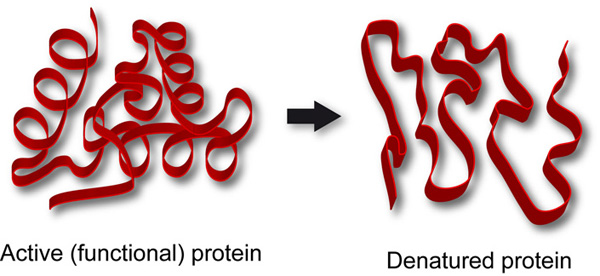
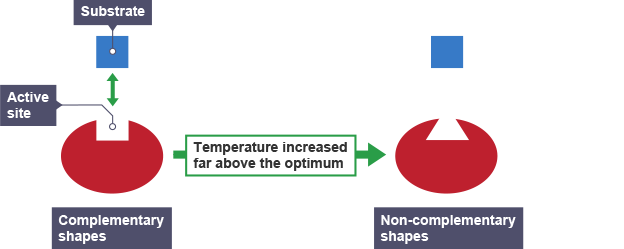
The pattern of this graph is characteristic of an enzyme catalysed reaction.  At low temperatures the rate of reaction is low.  This is because few enzyme-substrate complexes are formed per second as the enzyme and substrate molecules are moving around so slowly that they rarely collide.  At temperatures above the optimum, the enzymes and substrate molecules will be moving very fast and so will be colliding all the time.  So why is the rate so low?  Well that is because high temperatures cause enzymes to denature.  Remember enzymes are made of protein and proteins can have their 3D shape changed by high temperatures.   If an enzymes’ 3D shape changes, the active site will change shape and if this happens the substrate cannot bind.

figure12 large

Rates of enzyme-catalysed reaction are also affected by pH

Enzyme_pH

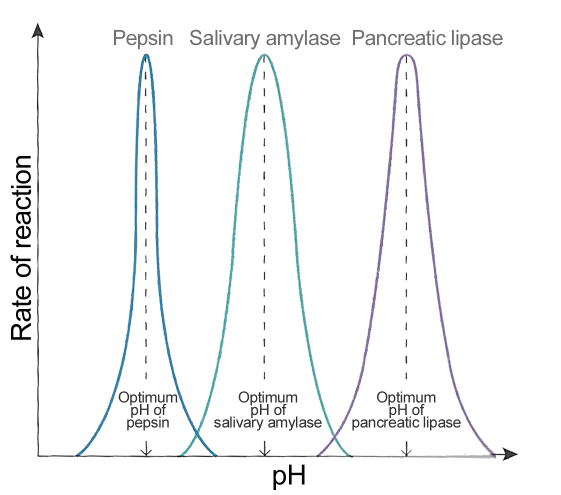
Enzymes tend to work in a very narrow band of pH values.  pH is a measure of the acidity/alkalinity of a solution and most enzymes require an optimum pH to function well.  The rate of reaction drops very rapidly on either side of the optimum pH simply because extremes of pH will denature enzymes.  The acid or alkaline environment can break the bonds that hold the enzyme in its specific 3D shape.  An enzyme with a changed shape cannot function as a catalyst if the substrate cannot bind to the active site and so the rate falls away rapidly either side of the optimum.

Factors affecting rates of Photosynthesis (part 2): Grade 9 Understanding for IGCSE Biology 2.20 2.23

In the previous post on photosynthesis, you revised how there were four environmental factors that can affect rates of photosynthesis in a plant:

  • light intensity
  • light wavelength
  • temperature
  • carbon dioxide concentration

This post will explain the results from experiments with Elodea in which one factor is altered (the independent variable) and the other three are kept exactly the same (control variables)

Light intensity

121_bitesize_intermediate2_biology_test5_2_light_intensity

The independent variable (light intensity) is on the x axis and the dependent variable (number of bubbles per minute) is on the  y axis.

How do we explain the pattern in this graph?

As the light intensity increases the rate of photosynthesis increases.  This is because a higher light intensity gives more energy to the chloroplasts and so more reactions can happen per second and the rate goes up.  But beyond the orange dot on the graph, the increases in rate slows down until at around 12 units of light, adding more light has no effect on the rate.  At these high light intensities some other factor is now the limiting factor as opposed to light intensity.  The limiting factor remember is the factor in the shortest supply.   So perhaps above 12 units of light photosynthesis is limited by the concentration of carbon dioxide.  The only way to find the limiting factor is to repeat the experiment with more carbon dioxide and see whether the rate is higher above 12 units.

Light wavelength

Although this graph is not perfect, it does show how the rate of photosynthesis varies at different light wavelength.

Spectrum of visible light and rates of photosynthesis

Rates of photosynthesis peak in the blue-violet and red parts of the visible spectrum with a much lower rate in green light.  The reason for this is that chlorophyll pigments do not absorb green light well.

Carbon Dioxide concentration

small

The pattern is similar to the light intensity relationship.  When carbon dioxide concentrations are low, it is the limiting factor for photosynthesis and so increasing the concentration will increase the rate.  As the graph levels off, some other factor is now the limiting factor – perhaps light intensity or temperature.

Temperature

Temperature is a factor that affects photosynthesis because of enzymes.  Many reactions in photosynthesis are catalysed by enzymes and enzymes all have an optimum temperature.

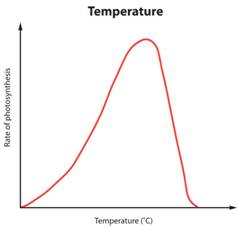
tumblr_lybg7qOFFK1qdtk84

This pattern is not explained by limiting factors.  At low temperatures the rate is low because the enzymes and the substrate molecules are moving really slowly.  This means there are few collisions between the substrate and the active site of the enzyme.  As temperature increases, the rate increases as there are more collisions and more enzyme-substrate complexes are formed per second.  But high temperatures denature enzymes:  the bonds that hold the enzyme in its precious 3-D shape are broken and the enzyme molecule unravels.  So the active site may either change shape or may be lost as a catalyst.  This slows the rate down to an extremely low rate.