Don’t waste your time studying


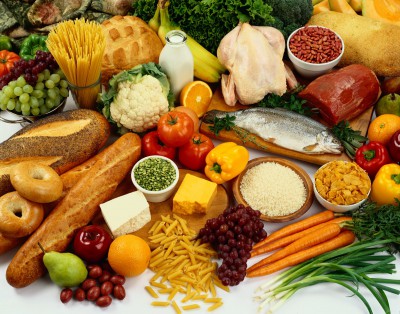
All animals are heterotrophic. This means that they cannot make their own food molecules but need to get them from some external source. Humans get a variety of different food molecules from what they eat. Diet is a term for what an animal eats (and in a biological context has no associations with any attempt to lose weight or change body shape). A balanced diet is a combination of foods that provides the correct proportions of all the various food molecules for any particular individual at any particular stage of their life.
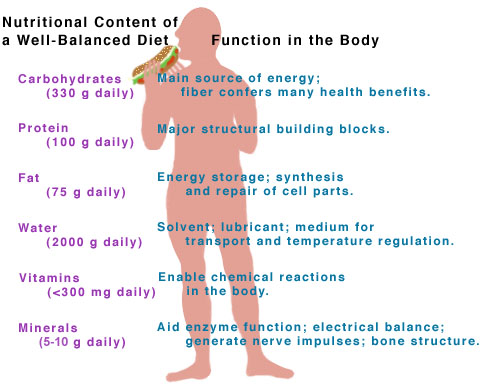
Carbohydrates are a family of molecules that includes sugars, starch and other polysaccharides. They contain C,H and O atoms only and their main function in the diet is to provide molecules that can be respired to release energy for cells. Carbohydrates are thus one of the main respiratory substrates in our diet. All sweet foods will contain sugars of course and starch-rich foods are vegetables like potatoes, pasta and rice. Starch is a polymer of glucose and so needs to be digested to glucose because it is too large a molecule to be absorbed in the small intestine.
Proteins are a family of macromolecules needed to build new cells and thus for growth. Like starch, Proteins are also polymers and thus get digested into their constituent monomers, in this case amino acids in the digestive system. Protein-rich foods include all meat and some pulses and beans. Proteins in the diet are needed to build muscle tissue, to form some components of cell membranes and to make all the enzymes that catalyse all the metabolic reactions in cells.
Lipid is a general term for all fats and oils. Despite the popular misconception that fat is “bad” in our diet, in fact lipids are essential molecules in the diet. We need lipids as a respiratory substrate, for long term energy storage in adipose tissue under the skin and for the electrical insulation of nerve cells. Foods rich in lipids are red meat, many processed foods, and food containing olive oil or other vegetable oils.
Humans need a wide variety of mineral ions in very low concentrations in our diet. The most important mineral in our diet is Calcium which is needed for making healthy teeth and bones. Iron is also needed in relatively high amounts as it is required to make the protein haemoglobin found in red blood cells. Mineral ions come from eating a wide variety of foods, but the main source of calcium is from milk and other dairy products. Iron is found in high concentrations in red meat. 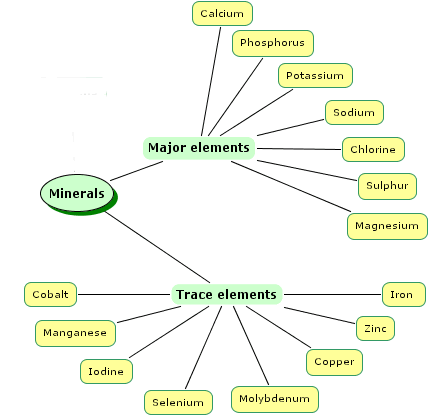
Rather like minerals, vitamins are needed in very small amounts in a diet but are absolutely crucial for the healthy functioning of the body. The diseases associated with a lack of a particular vitamin in the diet are called deficiency diseases. You need to know about three vitamins – A. C and D 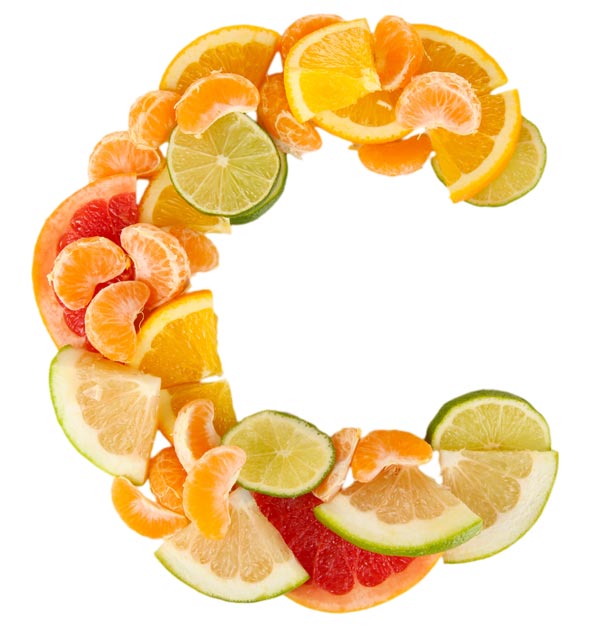 Vitamin A is a molecule called retinal found in carrots, red peppers and swede. It is needed for healthy growth and a functioning immune system. Vitamin A is also essential for normal vision since it is used to make the pigment found in rod cells in the retina. Vitamin A deficiency in the diet often causes poor vision, especially at night. Vitamin C is needed for the enzyme that produces the protein collagen in the body. It is found in all fruit especially citrus fruits. A lack of vitamin C causes the deficiency disease scurvy. Vitamin D is an unusual vitamin since it can be made in the skin using UV light. Vitamin D is needed in the small intestine to absorb mineral ions such as calcium, magnesium, etc. into the blood. A lack of vitamin D often results in a deficiency disease called rickets in which the bones malform.
Dietary Fibre is actually made up from the molecule cellulose. No mammal including humans possesses a cellulase enzyme and so when plant material passes through the intestines, dietary fibre is never digested. This means it passes into the large intestine where it helps prevent constipation. Foods rich in fibre included wholegrain bread, vegetables and some breakfast cereals.
Water is the final component of a balanced diet. It is needed to replace water lost by sweating and in urine and acts as a solvent of course for all the metabolic reactions that happen in every cell.
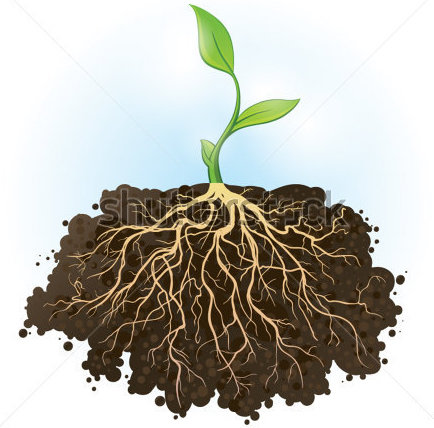
This posts addresses one of the commonest misconceptions you encounter as a biology teacher and it concerns a mistaken belief about the function of the roots of a plant.
The roots anchor the plant in the ground and so prevent it toppling over due to wind. But their main function is to do with the absorption of materials from the soil into the cells of the plant. The question is what exactly is taken up in the roots?
Well most people remember that water is absorbed in the roots by osmosis. The best candidates will remember the microscopic root hair cells in the root that massively increase the surface area for the uptake of water. This absorbed water is transported into the xylem tissue in the centre of the root and then moved up the plant to the leaves by transpiration pull.

Roots also absorb mineral ions from the soil by active transport. Active transport is the process where energy from respiration in the cell is used to pump material across the cell membrane against the concentration gradient. Mineral ions absorbed included nitrate ions (needed to make amino acids and proteins), magnesium ions (needed to make chlorophyll) and phosphate ions (needed to make DNA)

So where is the common misconception? This all seems sensible and fairly straightforward. Roots absorb water by osmosis and mineral ions by active transport.
Whenever root function is tested in exams, many candidates get in a pickle as they confuse mineral ions (nitrate, phosphate, magnesium, potassium) with food molecules. Plants do NOT absorb food molecules through their roots. There are very few food molecules such as glucose, amino acids, and lipids in soil. If there were, more animals would eat soil as a source of nutrition…… Plants do not need to absorb food molecules of course: the big idea you learn is that plants can make their own food molecules in the leaves in the process of photosynthesis.
So in your exam, if you ever find yourself writing anything that suggests that plants take in food through their roots, stop, take a deep breath, cross it all out and count yourself lucky you have prevented yourself from one horror answer at least!

All living organisms are made from cells. Indeed the cellular nature of life is one of the universal features shared by all life on earth. Some organisms are made from just one cell (unicellular organisms) while at some point around 1 billion years ago, cells starting clumping together and specialising to form multicellular organisms such as animals and plants.
All cells are surrounded by a cell membrane. The cell membrane is made from a mixture of proteins and a type of lipid called a phospholipid. The cell membrane serves many functions but perhaps the most significant is acting as a partially permeable barrier that can control which molecules can enter and leave the cell.
Inside the cell membrane there is a watery solution of chemicals called the cytoplasm. The cytoplasm is the site of many metabolic reactions in the cell because many enzymes are dissolved in the cytoplasm. The cytoplasm also contains many tiny nano machines for assembling proteins called ribosomes.
And that is about it for things all cells have in common. Prokaryote cells (bacteria) have a very different cell structure with no organelles but in this section you need to understand the simplified structure of two eukaryote cells: a typical animal (on the left below) and a typical plant cell (on the right).

Both animal and plant cells have a nucleus. This is the largest organelle and contains the DNA which is the genetic material. The DNA is found in long thread-like structures called chromosomes. The nucleus controls the division of the cell and also the various functions of the cell by regulating which proteins get made.

Animal and Plant cells both contain mitochondria which are the organelles associated with aerobic respiration. Mitochondria are recognisable in the cytoplasm of the cell as sausage-shaped organelles with a folded inner membrane (see diagram above).

1) All plant cells have a thick rigid cell wall made of the carbohydrate cellulose. The cell wall allows plant cells to become turgid since when the cell takes in water by osmosis, the rigid cell wall prevents the cell from bursting. The cell wall also acts as a transport pathway across plant tissues and can provide a barrier to some pathogens.
2) All plant cells have a large permanent central sap vacuole. This organelle is bounded by a membrane called the tonoplast and in many plant cells takes up the majority of the volume of the cell.

The sap vacuole provides a compartment in the cell into which excretory molecules can be moved to stop them poisoning the cytoplasm. It also plays a role in the water balance of plant cells since because of all the solute dissolved in it, the cell sap has a low water potential. This helps draw in water by osmosis from the cytoplasm and hence from outside the cell across the cell membrane.
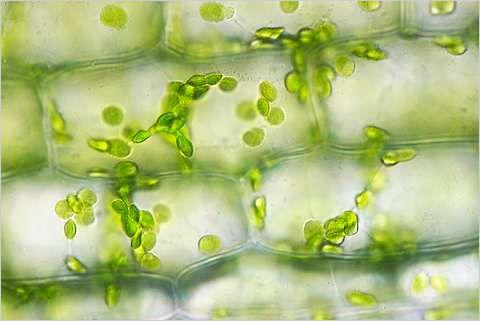
3) Many but not all plant cells contain chloroplasts. These are organelles associated with the process of photosynthesis. Chloroplasts can be recognised in a light microscope image as small, green structures in the cell. The green pigment comes from the chlorophyll molecules that trap energy from sunlight. In an electron micrograph, chloroplasts are distinguished due to their stacks of membrane discs called grana.


The Easter holiday is the most important time of year for this iGCSE Biology blog. With exams in early May, the next few weeks should be the time when students are working at their maximal rate. I intend to add one post a day such that by the middle of April, the entire EdExcel iGCSE Biology specification has been covered on this blog. This should then make it a useful resource for all GCSE Biology students to help them with their revision.
Today I will put up two posts that will look at two of the simplest topics in the specification: the first one will be Levels of Organisation and then Cell Structure (2.1, 2.2, 2.3 and 2.4)
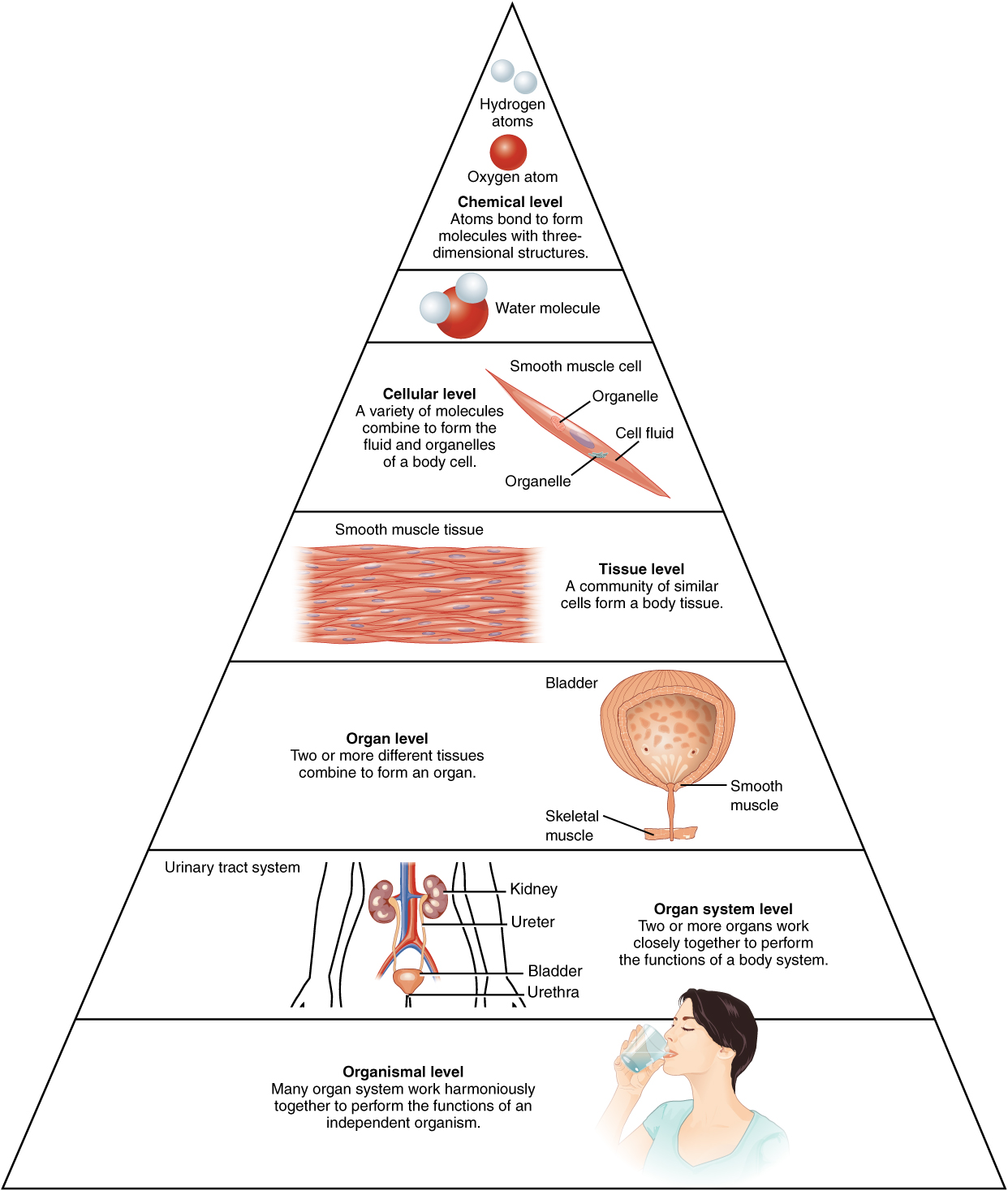
Living things (or organisms to be precise) are complex entities. Even the simplest organism will be made up of millions of different molecules arranged in an organised and complex way. Human beings are organisms made up of about 10 trillion cells of roughly 210 different cell types all put together in a organised and systematic way. It makes it much easier to study such complexity if we have a system to break the complexity down into constituent parts. This is what scientists mean by levels of organisation.
So, starting with the smallest things that might be of interest to a biologist……
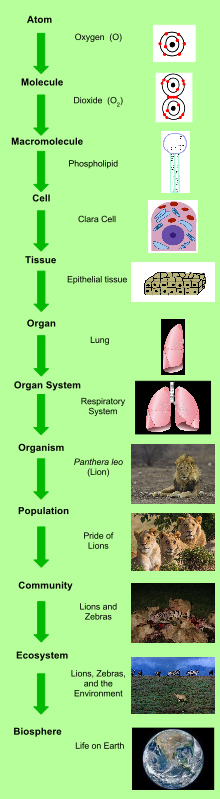 All matter on earth including the matter of living things is made of atoms (e.g. a carbon atom, an oxygen atom etc.). Atoms can combine together in a variety of ways to form molecules (a water molecule H2O, a carbon dioxide molecule CO2,) How atoms combine to form molecules is chemistry, and the levels of organisation smaller than an atom forms part of physics, so we won’t worry too much about them….
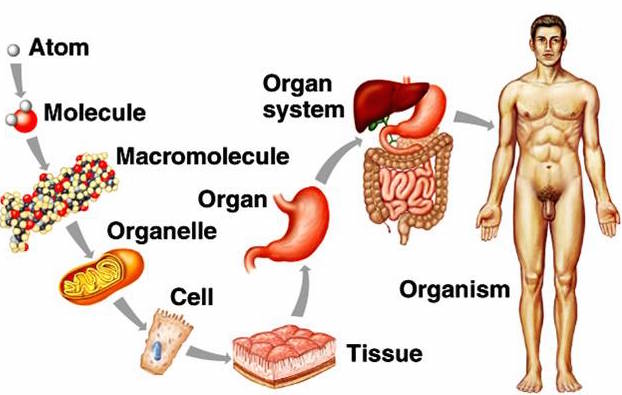
But molecules in an organism are interesting and worth studying – you learn about carbohydrates, lipids, proteins, DNA in your iGCSE course. These molecules can be grouped together to form structures inside cells called organelles. If you are being really precise with your terminology, an organelle is a membrane-bound compartment inside a eukaryotic cell (remember bacterial cells have no organelles at all). Examples of organelles are structures like the nucleus, chloroplasts, mitochondria and so on.
Cells are structures enclosed by a cell membrane that contain many different organelles. You have probably looked at a human cheek cell using a light microscope at some point in the past. In multicellular organisms, cells of the same type are often attached together to form a Tissue. A tissue is a group of similar cells often attached to each other that carry out the same function in an organism. (It is also a small disposable piece of rectangular fabric used for blowing your nose but that is something quite different….) Tissues are grouped together to form larger structures called Organs. For example, the lungs are an organ made up of a particular arrangement of epithelial tissues together with some blood and connective tissues. Organs can be grouped into Organ Systems based on their function such as the Digestive System (oesophagus, tongue, stomach, pancreas, liver, intestines etc.) An Organism such as you or I is made up of many organ systems (nervous system, cardiovascular system, digestive system, excretory system and so on….. You get the idea I’m sure!)
You can study levels of organisation bigger than the organism. This branch of biology is called Ecology – and indeed you should know the meaning of the terms population, community and ecosystem – but perhaps that is for another post……

Just confirming the playing regulations for my two iGCSE Y11 groups with Zondle. Create an account using the classcode I have given you. Play the games I set for you as many times as you like, collecting “zollars” for high scores but also for repeated attempts.
At the start of next half the student in each class with the most “zollars” will be taken out for lunch at Zero 3 on the High Street and I will pay. If you want to set your own revision quizzes on Zondle, do please have a go. You can see the other games from people in the class under the “games set by my friends” drop down list.
Enjoy – I think this will be a great way to make revision a little more interesting…..

The Easter holidays will be the critical period for all Y11 students preparing for the summer iGCSE exams. The main paper for Biology is so early in May that you need to make good use of time of the holidays. Indeed the majority of your Biology revision should be accomplished before you come back to school in April
Here are some tips in no particular order that might help.
1) Revision is not measured in hours. It is not how many hours you do that matters, it is the benefit you gain from your work. Don’t worry about people who tell you they are doing 10 hours a day – most of their effort will be wasted….
2) What do you need for revision? I suggest you make sure you have all of the following ready for Biology revision this holidays.
3) Active Revision: You all know that reading is a very poor way to revise. The more active and multi-sensory you can be in revision, the more you will learn. Make flash cards that summarise each topic. Use a dictation app to record yourself speaking about the three key ideas in a topic. Make revision videos that you can post to a YouTube channel. Do some of the Zondle revision activities I will set up during the holidays. Leave replies to my blog posts with anything that doesn’t make sense or with any questions you may have. Past papers are best used sparingly in the early stages of revision – your task this holidays is to try to learn as much of the specification as you can. We will look at many past papers and mark schemes next term.
4) Do not revise any one topic for more than 35 minutes. Take a 5-10 minute break and then start something new.
5) Have a plan. I suggest you should aim to work a maximum of 5 hours a day and I think it is best to split the day into three periods of work. 9.15am – 12pm; 2pm – 4.45pm; 7.30pm – 10.15pm. The idea is that every day you always work in the morning slot plus either the afternoon or the evening slot as you prefer.
The plan is good because you want to know that when you are not working, you can relax and enjoy yourself properly. Each revision session is divided into three or four topics, each lasting about half an hour.
Do not ever work late in the evening. Always get up at your normal time and always start work at 9.15am.
6) Do some fun things in the holidays as well as work, but put them into the plan. Exercise is good, spending time with friends is good, eating healthily is good, getting plenty of sleep (8 hours at least a night) is essential.
Basically for this one holiday, you want to trick your body and mind into sticking in “school mode”. Early to bed, early to rise, keep active each day and work hard! The summer term will fly by and you can do a great deal of sleeping and proper relaxing in the months of June, July and August.
Good luck – and keep checking the blog and/or Twitter for new posts and Zondle quizzes
Viruses appear in your syllabus in a section entitled “Variety of Living Organisms”. This is rather unfortunate because of course viruses are not classified as living organisms at all. The reason they are not alive is simple: they are not made of cells and they are incapable of carrying out any metabolic reactions. Viruses are much smaller than any cell, even very small prokaryotic cells such as bacteria.

In the diagram above you can see in the top right of the picture part of a red blood cell. Red blood cells are one of the smaller cells in the human body. The bacterial cell at the bottom of the diagram E.coli is much smaller, and all the blue viruses are much much smaller still. [The units of length on this diagram are nanometers (nm) – a nanometer is 10-9 m]
All viruses are parasitic as they have to infect a living cell in order to reproduce.
What are viruses made of?
Well remember viruses are not made of cells. The individual virus particles are called virions and are simply made up of a protein coat (called a capsid) that encloses some genetic material. The genetic material in a virion can either be DNA or a similar molecule called RNA.

Viruses can infect all different kinds of living organisms. The virus on the left in the diagram above is called a bacteriophage and it infects bacterial cells. You can see the protein coat is arranged into a head, tail and fibres and the genetic material in a bacteriophage is DNA. The virus on the right is the Influenza virus that infects mammals and birds, causing the disease influenza or “flu”. Influenza virus is an RNA virus.
Many human diseases are caused by viral pathogens. Influenza is one (see above) and the other one mentioned in the syllabus is HIV – a virus that causes the diseases AIDS. HIV is also an RNA virus. [HIV stands for Human Immunodeficiency Virus and the disease AIDS is acquired immunodeficiency syndrome.]

Some viruses infect and cause disease in plants. Tobacco Mosaic Virus infects tobacco plants causing yellow leaves as chloroplasts are not formed correctly in the leaves.
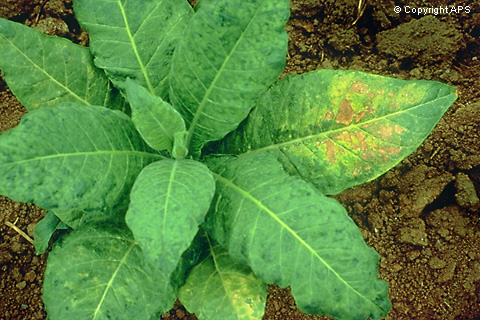
This is a diagram of a Tobacco Mosaic Virus

So to summarise:
 PMG Biology