
Chromosomes and Sex: Grade 9 Understanding for IGCSE Biology3.26 3.27
Having spent the last day or two writing material about one of the hardest topics in the IGCSE Biology specification (DNA and Protein Synthesis), I am going to write today about something much simpler. You need to understand how the sex of a human is determined at the moment of fertilisation. But this is a topic which can confuse students so I am going to try to explain it for you as best I can.
The sex of a human (whether male or female) is determined by the 23rd pair of chromosomes. Please remember that just because humans determine their sex this way, this doesn’t mean that other species have to be the same. In fact other species use a variety of ways to ensure the correct proportion of male and offspring are born.
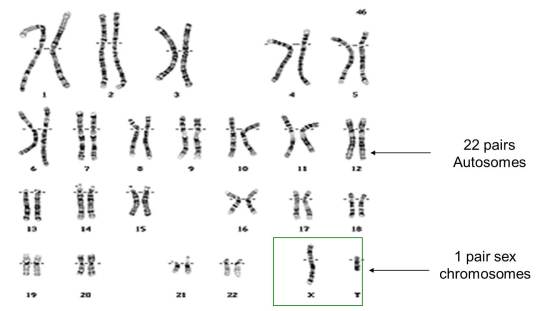
As you can see from the picture above, the 23rd pair of chromosomes in humans are called the sex chromosomes. The person whose chromosomes are shown above is male because he has one X and one Y chromosome in his 23rd pair. If we looked at a picture of a human female set of chromosomes, pairs 1 to 22 would be exactly as above, but the 23rd pair would be different. There would be two large X chromosomes rather than one large X and one tiny Y chromosome as shown above.
So a human female has XX as her 23rd pair of chromosomes, a human male has XY as his 23rd pair.
Gametes (Sperm and Egg cells) are made in a process called Meiosis. Remember that meiosis produces daughter cells that are haploid (this means they only have one member of each pair of chromosomes and so half the genetic material)
When a female cell undergoes meiosis in her ovary, the daughter cells produced (egg cells) will contain one of each of the 23 pairs of chromosomes. For the 23rd pair this will always be an X chromosome since both chromosomes in the 23rd pair are X chromosomes.
When a male cell undergoes meiosis in the testis, the daughter cells produced (sperm cells) will contain one of each of the 22 pairs of chromosomes exactly as above. But the 23 pair are different to each other and so half the sperm cells will contain an X chromosome as the 23rd chromosome and half the sperm cells will contain a Y chromosome as the 23rd chromosome.

If you understand the picture above, you understand sex determination in humans. You also need to be able to draw a genetic diagram to show this.
Phenotype: Mum Dad
23rd pair: XX XY
Gametes: X ½X ½Y
Fertilisation:

Offspring 23rd pair of chromosomes: ½ XX and ½ XY
Offspring phenotypes: ½ female and ½ male
 PMG Biology
What is the most chromosomes that someone could possible have and how would this happen?
I don’t know of any cases where a person has more than 47 chromosomes, but I guess it could happen (if you were really unlucky…)
how can it be that someone ends up with XXY chromoses? Where does the 3rd come
from?
The cause of this type of chromosomal abnormality is called non-disjunction of chromosomes, and it happens in meiosis when the gamete is being formed. In this case, the non-disjunction would occur in the formation of the egg cell and would result in both the mother’s X chromosomes finding themselves in a gamete. This egg cell would have one member of chromosomes 1 to 22, but two X chromosomes. When it is fertilised by a sperm cell from the father containing a Y chromosome, the offspring would end up XXY for the 23rd pair. Does that make sense?
Is the sex chromosome always the 23rd pair on mammals and other animals and are there differences in numbers of chromosomes from animal to animal?
There is always one pair of chromosomes in mammals that differs depending on sex. It is not always the 23rd pair (some animals will have fewer than 23 pairs, some many more) but there is always one pair of sex chromosomes in mammals. Remember that not species of animal use chromosomes to determine sex.
Why is it always the 23rd pair that determines the sex of a human, why not the 22nd for example?
The Y chromosome is the one that really determines your sex. It contains a gene for a protein called TDF (testis determining factor) and if you have a Y chromosome, and this gene, you will develop a male body. Anyone without a Y chromosome will be female.
Has there ever been a case of a diploid gamete from a human, and would a zygote form if it fertilised?
No is the answer to this question. Well there may have been diploid gametes produced, but if they were fertilised and a triploid zygote was formed, in humans this would never survive. Many plants can produce offspring that are polyploid, but never humans!
Say, if meiosis went wrong, or due to external interference, an egg cell in the ovary ended up with a full 23 pairs of chromosomes from the mother, would the egg cell be able to develop properly or maybe even implant in the womb? mother be able to birth a clone of herself? Are there any past precendents (that are not religious)?
As far as I know, there have been no recorded cases of this happening in humans…. If you did have an egg cell with a full set of chromosomes due to some catastrophic mutation during meiosis and it wasn’t fertilised, then in theory I suppose this could happen, but it never has…. Not even in Bethlehem.
Mengmeng
This is not really a question….
What mutations in chromosomes are common and why?
There are lots of possible mutations in chromosomes that do not affect the total number of chromosomes in a cell – insertions, deletions, inversions and duplications. There will be some mutations more likely than others but I can’t give any details I am afraid.
Is it possible to have someone with XXX chromosomes in their 23rd pair and if so would the extra X be from the male or female gamete?
I think this is an example of something that is theoretically possible in that you could have a sperm cell that contains an X chromosome fertilising an egg cell with a chromosome mutation in which two X cells remain. But the reality is that a cell with three X chromosomes would not survive for long: remember that the X chromosome is one of the longest chromosomes in the human and so will have lots of genes and having three copies of many genes would cause so much metabolic disruption that the embryo would not survive for long…
Using IVF, could you in theory choose the gender of the foetus through selecting a sperm cell with a certain combination of 23rd chromosomes or avoid certain recessive genes passed down in the chromosomes of a person?
Great question – you could easily select the sex of your foetus in IVF by only allowing a sperm cell with the sex chromosome you want inside (X for a girl, Y for a boy). Screening a foetus before it is implanted in IVF is theoretically possible but more tricky due to timing I believe. You are not allowed to control the sex of a human foetus in IVF but you are allowed to screen for harmful recessive alleles to prevent suffering, I believe. Good question!
If there is a 50% chance for XX and XY chromosomes why are there slightly more males in the world?
Good question. I don’t think there are slightly more males in the world, but it is true that the probability of a male child being born is just over 50% and the probability of a female child being born is just under 50%. Males have a higher mortality rate across all stages of life and women have a higher life expectancy. The reason that slightly more males are born than females must be because sperm cells containing a Y chromosome from the 23rd pair are slightly more likely to fertilise an egg than the X chromosome containing sperm cells. Perhaps it is a question of the extra weight having a negative impact on their swimming speed…? Just a suggestion so it may not be true….
What would be the differences in a person with XY chromosomes and a person with XXY chromosomes?
This is a good question. I think the simple answer is that people with XXY have a male body but are probably not able to make gametes so are infertile. Look this up and let me know in the lesson tomorrow.
How long does the process of meiosis take?
This is a good question Jessica and the answer is that it varies in humans, depending on the type of gamete being produced. Sperm cells are made by meiosis in the testis of males and the whole process takes 60-70 days in total. In females, meiosis happens in the ovaries and takes much much longer. Meiosis in an ovary begins before birth so a baby girl already has all the immature egg cells present in her ovaries. Meiosis doesn’t finish until after the egg cell has been fertilised…. So the answer for meiosis in a female is that it could take up to 50 years.
Is there a way of knowing what would happen to someone if one of each of chromosomes had one extra?
When a person has one extra chromosome, they are said to have a trisomy. Trisomy 21 means that a person has three versions of chromosome 21 and this mutation is relatively common and results in Downs Syndrome. There are other chromosomes where a trisomy is possible: Trisomy 18 (Edwards syndrome) and Trisomy 13 (Patau syndrome) but these are much rarer. Most other chromosomes cannot exist as a trisomy, as if you had three copies of other chromosomes, this would be a lethal mutation and the embryo would not survive. Good question!
When producing gametes through meiosis, if there were to be an error or incorrect separation of cells what impact would this have on the sex of the offspring e.g would it result in a higher chance of a particular sex?
Great question. The mostly likely error if the cells didn’t separate correctly would be a gamete that could not survive. If a cell were created with two nuclei, or no nucleus at all, it would not survive for very long. You do get errors in the separation of individual pairs of chromosomes in meiosis relatively frequently, and these can lead to chromosomal mutations that lead to conditions like Downs Syndrome and Kleinfelter syndrome. But I don’t think any of these conditions would lead to a higher chance of a particular sex.
Has there ever been anyone who for some reason didn’t have a 23rd pair of chromosomes? If so what happens?
Good question. The answer is no. If you didn’t have any chromosomes in the 23rd pair, you will be missing all the genes on the large X chromosome. This would mean that any cell with this chromosome mutation would be unable to survive or divide as the genetic damage of losing all these genes would be too great to be viable.