
Cell Division part I: Grade 9 Understanding for IGCSE 3.15, 3.28, 3.29
At the beginning of March each year, I get my Y11 classes to draw up a list of topics they want to go through again in revision. Cell Division is always there and it is not difficult to see why. Mitosis doesn’t make any sense unless you understand the concept of homologous pairs of chromosomes and I think you already know that very few iGCSE students do…… (Please see the various posts and videos on the blog on this topic before attempting to understand mitosis)
But there is actually very little to fear in the topic of cell division. If your teacher has told you about the various stages of mitosis that’s fine but you will not be asked to recall them in the exam, at least not if you are studying EdExcel iGCSE. So in this post I am going to try to focus on the key bits of understanding you need rather than bombarding you with unnecessary details.
1 Chromosomes come in pairs
This is the main idea you need before you start. In almost all sexually-reproducing organisms the cells are DIPLOID. This means that however many different sized chromosomes they have, in each cell there will be pairs of chromosomes (called homologous pairs)
So human cells contain 23 pairs of chromosomes (46 in total)
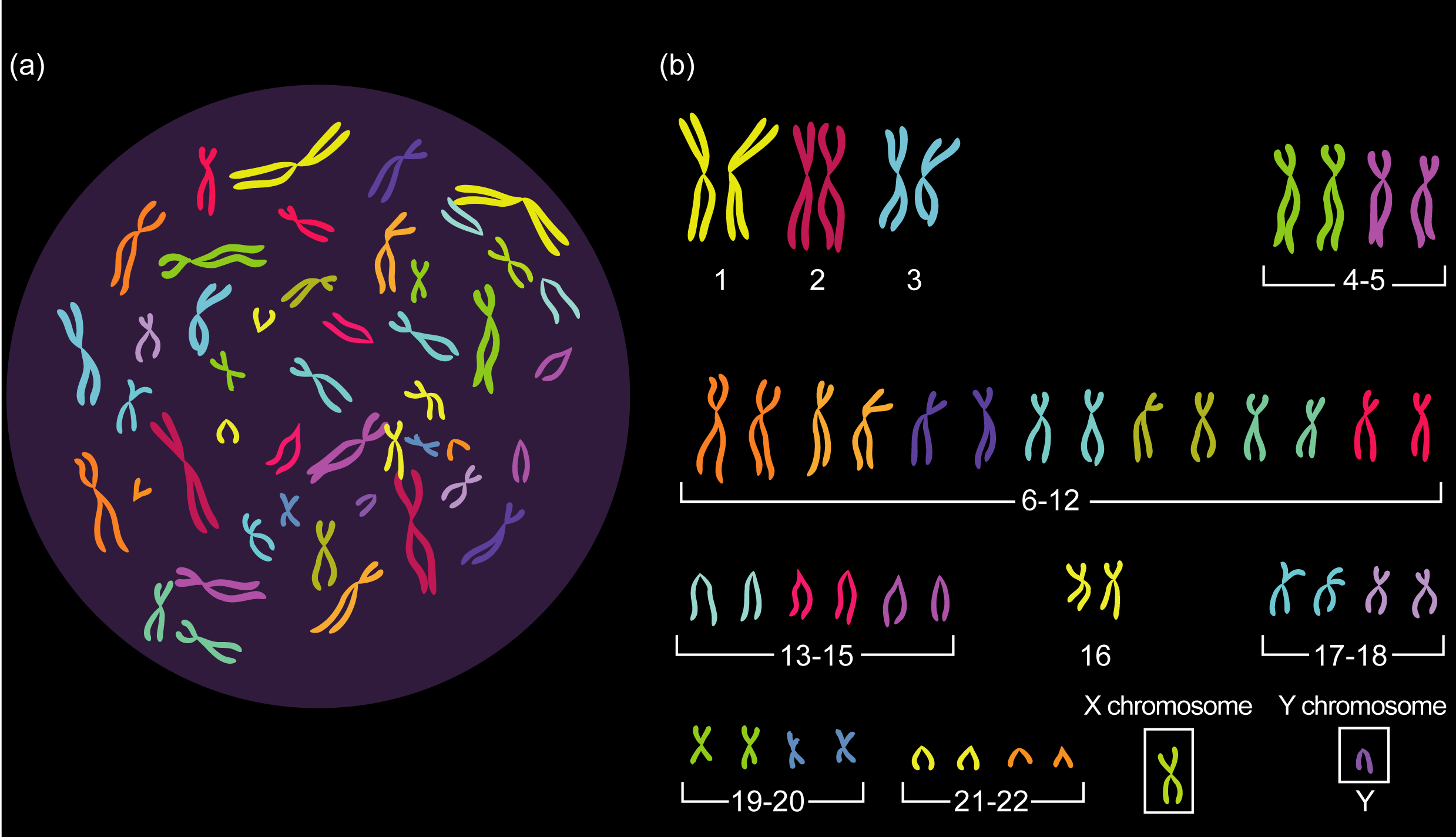
Remember that the number 46 only applies to humans. Other species have very different numbers of chromosomes in each cell (see table below)
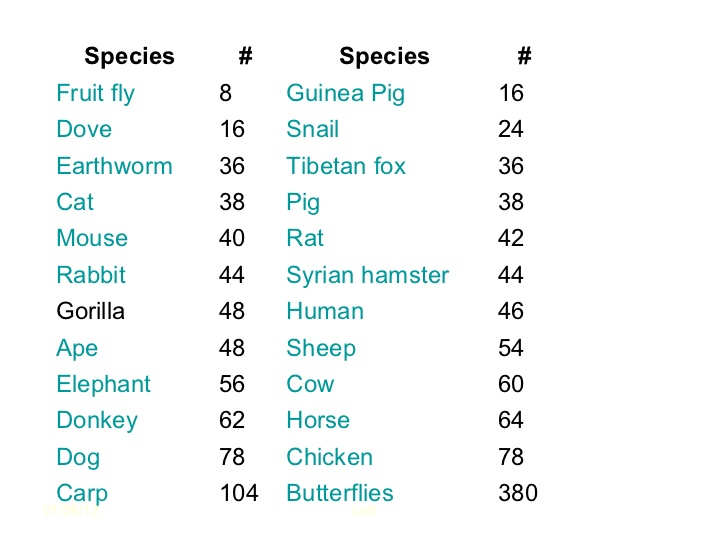
So doves have 8 pairs of chromosomes, dogs have 39 pairs of chromosomes, rats 21 pairs of chromosomes. The important point is not how many pairs each organism has but that they all have chromosomes that come in pairs!
The chromosomes any individual possesses is determined at the moment of fertilisation. Sperm and Egg cells (gametes) do not have pairs of chromosomes. They are the only cells in the body that are not diploid. Gametes only have one member of each pair of chromosomes. Cells which only have one member of each pair of chromosomes are called HAPLOID cells.
So every cell in the body is diploid and genetically identical apart from the gametes which are haploid.
2 Organisms that reproduce sexually need two different types of cell division

The fertilised egg (zygote) is a diploid cell. It has pairs of chromosomes that originate one from each parent via the gametes. Every cell division in growth and development of the embryo and foetus until birth, every cell division in growth and repair after birth always produces two genetically identical and diploid cells from the one original cell. This cell division that produces genetically identical diploid cells is called Mitosis.
Gametes (sperm and egg cells) need to be made by a different process. If gametes were diploid then there would be a doubling of the chromosome number every generation and that clearly wouldn’t do. So a different way of dividing the nucleus has evolved. It doesn’t produce genetically identical diploid cells but produces gametes that are haploid and genetically unique. This process is called Meiosis and is only used in the production of gametes.
3 Mitosis is involved in growth, repair, asexual reproduction and cloning
Any process in the body in which the outcome required is the production of genetically identical diploid cells will use mitosis. (It is not too complicated an idea to see that if you don’t need to make gametes and fuse them together in fertilisation, you can just copy cells by mitosis over and over again. All the daughter cells will be exact copies of each other and diploid.
Now I know this post is not going to satisfy everyone. I know some of you will want to read about the cell cycle, prophase, metaphase, centrioles, spindle fibres and the condensation of chromosomes, chromatids being pulled apart etc. etc.) And just for you, I will write a post later today on the details of Mitosis….. But please remember that if you are using the blog to revise for exams, none of this second post is necessary and none of it will be tested in the Edexcel iGCSE paper. If you are doing revision, focus on the key understanding ideas discussed above. And as always, please leave a reply below to ask questions, comment or leave feedback – all comments welcome!
 PMG Biology
why do different animals have different numbers of chromosomes?
Chromosome number changes during the evolutionary process. There are very rare chromosome events which lead to a change in the number of chromosomes in a gamete for example and these mutations can occasionally produce a change in chromosome number.
Mengmeng- Is there any connection between the number of chromosomes in an organism and it’s physical complexity or size? One would think that humans (46 chromosomes) would need more genetic information than butterflies(380chromosomes)? Does it stem from the difference in the length of the chromosomes in each organism?
Good question. The answer is that there is no correlation between complexity/size of organism and the number of chromosomes. Remember that in animals and plants, most of te DNA doesn’t actually code for any proteins – it is called non-coding DNA – and so having long chromosomes does not mean that there is more genetic information stored. It probably just means that this species has more non-coding DNA.
How come some species have more chromosomes than others and how does this affect them?
Good question. The chromosome number varies across species due to evolution. Closely related species will often have a similar number of chromosomes. For example humans have 23 pairs of chromosomes as you know, but our closest cousins chimpanzee have 24 pairs of chromosomes. At some point in our evolutionary history, two chimpanzee chromosomes merged together to form human chromosome 2. Evolution is cool….
can the rate of mitosis ever change? If it can, why does pregnancy always take around 9 months in humans?
Great question. Mitosis itself usually happens at roughly the same rate in lots of cell types but the life cycle of the cell (called the cell cycle) can take a varied length of time. Some cells go through their life cycle quickly, skin cells for example but other cells cannot divide at all.
Are there any sexually reproducing organisms that do not have diploid cells or the gametes are not haploid?
Brilliant question – short answer is yes and yes. There are many examples of plants that are not diploid but in fact tetraploid – this means they have four versions of each chromosome rather than the diploid two. Tetraploid plants would make gametes that are diploid by meiosis. Don’t confuse yourself with this as you don’t need to know about it (unless you choose IB HL Biology next year) but yes – many plants do not have diploid cells.
How do you know which chromosome a gamete carries? How does it determine whether it will have a X or a Y chromosome?
The answer to this is that which chromosome from each pair a gamete contains is totally random and you cannot tell by looking at it. If you consider sex chromosomes, the sperm cell containing an X chromosome will be slightly heavier than a sperm cell containing the much smaller Y chromosome. But you can’t tell by looking which chromosome is in any gamete.
Hi Paul, where did you get that first image of the human genome? I would like to use it, if possible.
I get my images from a simple Google image search. This one comes from a Pinterest page following a Google search for “chromosomes”.