Gas Exchange in Plants – Grade 9 Understanding for IGCSE 2.40B, 2.41B, 2.44B, 2.45B

The topic of gas exchange in plants is often tested in exams because it can be a good discriminator between A grade and A* grade candidates.  If you can master the understanding needed for these questions, important marks can be gained towards your top grade.

Firstly you must completely remove from your answers any indication that you think that plants photosynthesise in the day and respire at night.  Even typing this makes me feel nauseous….  Yuk?  Respiration as you all know happens in all living cells all the time and so while the first half of the statement is true (photosynthesis only happens in daytime), respiration happens at a steady rate throughout the 24 hour period.

Image

Although the equations above make it look like these two processes are mirror images of each other, this is far from the truth.

How can gas exchange in plants be measured?

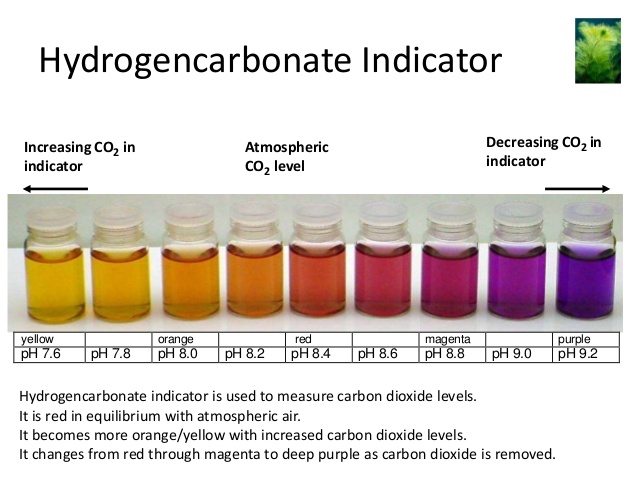
The standard set up involves using hydrogen carbonate indicator to measure changes in pH in a sealed tube.  In this experiment an aquatic plant like Elodea is put into a boiling tube containing hydrogen carbonate indicator.  The indicator changes colour depending on the pH as shown below:

  • acidic pH:  indicator goes yellow
  • neutral pH: indicator is orange
  • alkaline pH: indicator goes purple

slide-1-638

a) If the tube with the plant is kept in the dark (perhaps by wrapping silver foil round the boiling tube), what colour do you think the indicator will turn?  Explain why you think this.

b) If the tube with the plant is kept in bright light, what colour do you think the indicator will turn and why?

c) If a control tube is set up with no plant in at all but left for two days and no colour change is observed, what does this show?

In order to score all the marks on these kind of questions, there are two pieces of information/knowledge you need to demonstrate.  You need to show the examiner that you understand that carbon dioxide is an acidic gas (it reacts with water to form carbonic acid) and so the more carbon dioxide there is in a tube, the more acidic will be the pH.  As oxygen concentrations change in a solution, there will be no change to the indicator as oxygen does not alter the pH of a solution.

Secondly you need to show that you understand it is the balance between the rates of photosynthesis and respiration that alters the carbon dioxide concentration.  If rate of respiration is greater than the rate of photosynthesis, there will be a net release of carbon dioxide so the pH will fall (become more acidic).  If the rate of photosynthesis in the tube is greater than the rate of respiration, there will be a net uptake of carbon dioxide (more will be used in photosynthesis than is produced in respiration) and so the solution will become more alkaline.

So to answer the three questions above I would write:

a) The indicator will turn yellow in these conditions.  This is because there is no light so the plant cannot photosynthesise but it continues to respire.  Respiration releases carbon dioxide as a waste product so because the rate of respiration is greater than the rate of photosynthesis, there will be a net release of carbon dioxide from the plant.  Carbon dioxide is an acidic gas so the pH in the solution will fall, hence the yellow colour of the solution.

b) The indicator will turn purple in these conditions.  This is because the bright light means the plant photosynthesises at a fast rate.  Photosynthesis uses up carbon dioxide from the water.  The plant continues to respire as well and respiration releases carbon dioxide as a waste product.  As the rate of photosynthesis is greater than the rate of respiration in these conditions there will be a net uptake of carbon dioxide.  Carbon dioxide is an acidic gas so if more is taken from the solution than released into it, the pH in the solution will rise as it becomes more alkaline, hence the purple colour of the solution.

c) This shows that without a living plant in the tube there is nothing else that can alter the pH of the solution.  It provides evidence that my explanations above about the cause of the colour change is correct.
Skin – Grade 9 Understanding for IGCSE Biology 2.93

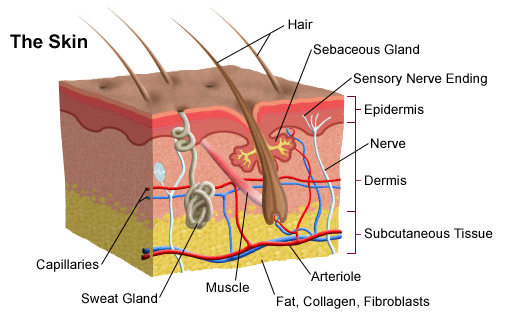
The skin as you all know is the largest organ in the human body.  It has a variety of functions including providing a water-tight barrier to minimise evaporation from the cells; it is also a habitat for billions of bacteria that live on the skin, the so-called skin flora and it contains a variety of sensory receptors that provide information about the external world to our central nervous systems.  The iGCSE specification requires you to know about the role of skin in thermoregulation.

Image

The skin is made up of an outer layer of dead cells called the epidermis that contains sensory nerve endings.  Beneath this is the dermis which is made of living cells and blood vessels, sweat glands, hair follicles and other specialised sensory receptors, e.g. for touch.  Underneath the dermis there is a subcutaneous tissue that in humans is packed full of adipose cells that store lipids.

The skin is involved in thermoregulation both as a receptor and more significantly as an effector.

The skin’s role as a receptor in thermoregulation

The brain receives information about temperature from two sets of thermoreceptors.  There are receptors in the hypothalamus that measure the temperature of the blood passing through the brain.  This provides information about core body temperature.  In the skin there are two types of thermoreceptors, called hot and cold receptors, that together monitor the external temperature.  Information from both these sets of receptors is used by thermoregulatory centres in the hypothalamus to regulate your body temperature.

The skin’s role as an effector in thermoregulation

The skin is the principle effector organ for thermoregulation.  This is because it is found at the boundary between your cells and the external environment and so heat gain and heat loss happen through it.  The skin has three ways of altering the heat gain/loss depending on nerve impulses from the CNS.

1) Sweating

Humans have sweat glands spread over almost all the surface of the skin.  These glands secrete a watery liquid, sweat that contains a solution of salts and a tiny amount of urea dissolved in large volumes of water.  Sweat is only produced when the body temperature is too high as the evaporation of sweat from the surface of the skin leads to a cooler skin.  How does this process work?

The main idea to understand is that the sweat itself is not in any way cool.  Sweat is made in sweat glands from blood plasma so if the blood is getting too hot, the sweat will be hot as well.  But it takes energy to evaporate water (to turn it from the liquid to the vapour state) and this energy (called the latent heat of vapourisation) is taken as heat energy from the skin.  So as sweat evaporates, it uses thermal energy from the skin to turn the water molecules in sweat into a vapour.  This evaporative cooling leaves the skin cooler once the sweat has evaporated than it was at the start.

2) Hairs

Hairs on the skin play an important role in thermoregulation in many mammals but not really in our species.  If the body temperature drops, the CNS causes hair erector muscles to contract and pull the hair to a more vertical position in the follicle.  If an animal’s hairs stand on end, a thicker layer of air is trapped between them and so the body is better insulated against heat loss.  Humans are relatively hairless and the only thing that really happens in us when the hair erector muscles contract is that we get “goose bumps”.

3) Shifting patterns of Blood flow in the skin

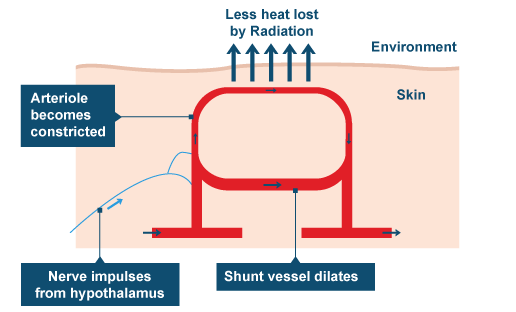
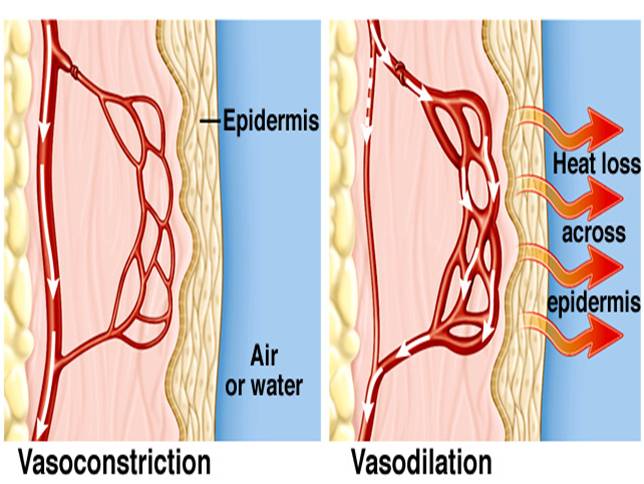
This is the main effector mechanism in human thermoregulation but it is also the one that tends to catch exam candidates out.  Please make sure you understand this process fully and can explain this section of work very well indeed.  If the body is getting too cold, the pattern of blood flow switches in the skin so less blood flows in the capillary beds near the surface of the skin and more blood is retained deeper in the skin structure.  This is achieved by narrowing the arterioles that supply the capillary beds near the surface (arterioles and arteries have plenty of muscle in their walls that can contract to narrow the lumen of the blood vessel)  This narrowing of arterioles is called vasoconstriction.

Image

The converse happens when the body is getting too warm.  The muscle in the walls of these arterioles now relaxes to widen the lumen, thus allowing more blood to flow in capillary beds near the surface.  This vasodilation allows more heat to be lost from the blood by conduction, convection and radiation and so the blood leaving the skin has lost more heat to the external environment.

Image

You will notice that at no point in these explanations of vasoconstriction and vasodilation do I mention capillaries in the skin moving deeper or nearer the surface.  For some reason every year, GCSE candidates think that the reason you look redder when you are hot is because capillaries in the skin move nearer the surface.  This cannot be true – blood vessels have a fixed position in the body for a start – but now you should understand that you look redder when you are hot because the capillaries that happen to be near the surface are having a greater volume of blood per minute flowing through them because of vasodilation.  If you find yourself in the exam writing about capillaries moving in response to a change in temperature, please stop writing, take a deep breath, count to ten and then cross it all out and start again!


Question spotting for IGCSE Biology paper 2

Trying to guess what might come up in paper 2 of public exams is a dangerous business……  But I think it is sensible for Y11 students sitting IGCSE Biology to now focus their remaining revision on topics that have yet to be tested.  You are now two thirds of the way through your exams and a final push to paper 2 might just get you across the A-A* boundary.  Every mark is vital in any exam so keep working hard!

Here are some PMG tips for topic areas that seem a better than average bet for coming up in paper 2:

  • Variety of Living Organisms (5 Kingdom Classification, Viruses)
  • Biological Molecules, especially Enzymes – (graph interpretation question?, effect of temperature and pH on rates of reaction?)
  • Photosynthesis and Respiration (perhaps a question testing bullet points 2.40 and 2.43 on gas exchange in plants over 24 hour period?)
  • Role of White Blood cells in Immunity (perhaps linked in with viruses above, vaccination, memory cells etc.?)
  • Coordination in Humans (nerves, reflex arcs, the eye, homeostasis in the skin, hormones)
  • Reproduction in Flowering Plants (asexual mechanisms plus insect/wind pollination)
  • DNA structure (including mutations), Chromosomes and Cell Division
  • Carbon, Nitrogen and Water Cycles
  • Pollution (atmospheric, water pollution and climate change)
  • Fish Farming (surely they can’t leave this out?…..)

I will post some blog entries on some or all of these topics in the week or two after half term so keep your eyes posted on Twitter or follow this blog.

I am not suggesting that these are the only topics you revise in preparation for paper 2.  That would be very foolish as the examiners can ask questions on anything at all.  I am merely suggesting that you focus your remaining revision time on the topics most likely to come up and the list above might help you to decide what best to do.

Good luck and keep working hard!  Not long to go now……


Cricket gets in the way of work – not for players but definitely for coaches

In spite of the best intentions, I have found it hard to keep posting material on my blog during term time.  In the holidays I have found it a really useful way of keeping in touch with students, particularly those doing public exams but obviously during term time, this is not quite so relevant.  But now the period of exam leave for Year 11 is approaching, I will try to put a few more posts up relating specifically to those topics likely to be tested in IGCSE Biology paper 2.  Students who want to revise using Zondle challenges should also keep an eye out for new revision resources.

The reason for the inactivity on the blog is mostly due to one of my passions – cricket.  I coach my school’s U14A team, a role in the school that is immensely rewarding both in a sporting and more importantly in a pastoral context.  Cricket is a sport that can be damaging to fragile adolescent egos (as well as fragile middle-aged ones) and time spent helping young people cope with adversity and disappointment is sometimes the most valuable work of all.

I have worked out that in a typical summer term week I spend 20 hours on cricket.  I work this out as 18 hours of coaching and umpiring, and 2 hours of emails, team planning and communicating with other coaches in my age group.  90% of this time is contact time with the players and this can be tiring as well as exciting and challenging.  Of course sometimes the weather means that time is freed up for marking, planning and even perhaps blogging but luckily the sun shines more than one might imagine.

The match we had today featured a remarkable spell of bowling from the young off spinner in the team.  We played a 20-20 match against one of the local grammar schools in Slough and one of my boys returned the remarkable figures of 3.5 overs, 1 maiden, 7 runs conceded for 9 wickets. These 9 wickets included two separate hat-tricks.  I hope the memories he has made today will last long into his adulthood:  it was a remarkable achievement.

The evening was spent taking my Year 10 tutor group out for dinner at a Moroccan restaurant in Windsor as a treat for their hard work so far this term.  The boys had been promised belly dancing by one of their housemasters but sadly the restaurant was quiet (although the food was great) and so they might have returned a little disappointed.   One of the great parts of my job is the ability to talk frequently to young people out of the classroom and tonight we had a good discussion about UKIP, the European elections, the valuation of Snapchat, Bitcoins and the viability of Chemistry teachers following the change of career shown in Breaking Bad.

How is energy lost between one trophic level and the next? Grade 9 Understanding for IGCSE Biology 4.8 4.9

Image The diagram above shows how energy moves up the food chain through feeding.  Remember that if you are asked what the arrows represent in a food chain, there is only one possible correct response.  “Arrows in a food chain show the flow of energy from one trophic level to the next”

The big idea here is that not all the energy in one trophic level can ever pass to the next.  The specification suggests that only 10% of the energy is transferred from one level to the next (but in fact the percentage varies between 0.1% to around 15%)

ImagekCal is a unit of energy and the pyramid shows that only 10% of the energy in one level is found in the next.

So there is a big question here – where does all the other 90% of the energy in one level end up?

There are a whole load of different ways energy is lost.  Consider the transfer of energy between mice and owls.

  • The mice use up energy in the process of respiration.  The glucose molecules that mice oxidise to provide the energy to move around are not available to an owl if the mouse is eaten.
  • Not all mice are eaten by owls or other predators. Many die of disease, starvation and exposure and a few might even live long enough to die peacefully in their sleep.  All these “dead mice” will have energy in their bodies that cannot pass up a food chain but instead passes to decomposers.
  • Even the mice that are eaten by owls are not eaten in their entirety.  The owl might only eat the energy-rich parts of a mouse and regurgitate out the bones and fur.  So some  energy is lost as not all the mouse is eaten and digested by the owl.
  • There will be parts of the mouse that even when swallowed and digested are not accessible.  Owl faeces will contain some molecules from the mice eaten that contain energy.   This energy is perhaps found in molecules that the owl digestive system cannot digest.  The energy present in the owl faeces is lost to the food chain and like the example above will pass to decomposers.

This energy adds up to around 90% of the energy in any trophic level.  Ultimately though where does it all go?  All the energy in all the organisms in an ecosystem has the same fate:  it ends up as heat that is dissipated into the system.  Energy can only enter an ecosystem in one way (as sunlight trapped in the process of photosynthesis in producers) and in the end, it all ends up leaving the system as heat energy.  This heat energy is a waste product of respiration.

Xylem transport – Grade 9 Understanding for IGCSE Biology 2.54, 2.55B, 2.56B

The topic of plant transport can appear quite complicated but you will see from your past paper booklets that the questions examiners tend to set on it are much more straightforward.

The key piece of understanding is to realise that there are two transport systems in plants, learn their names and what they transport.

  • Xylem vessels move water and mineral ions from the roots to the leaves.
  • Phloem sieve tubes move sugars, notably sucrose, and amino acids around the plant.  Both of these molecules are made in photosynthesis in the leaves and so can be transported from the leaves to the areas in the plant where they are needed.

Water is needed for photosynthesis of course in the leaves (remember that rain water cannot enter leaves directly because of the waxy cuticle on the surface of the leaf).  All the water that is used in photosynthesis is absorbed in the roots from the soil and moved up the plant in the xylem vessels.  Minerals such as nitrate, phosphate and magnesium ions are also required in the leaves for making amino acids, DNA and chlorophyll respectively.  These minerals are moved up the plant along with the water in the xylem.

How does water enter the roots from the soil?

Water molecules can only enter root hair cells (and indeed can only cross any cell membrane) by one mechanism and that is OSMOSIS.  If you understand the mechanism of osmosis that is great but don’t worry too much about it at this stage.  You need to know that osmosis is a net movement of water from a dilute solution to a more concentrated solution across a partially permeable membrane.

How do mineral ions enter the roots from the soil?

Minerals are pumped into the root hair cells from the soil using ACTIVE TRANSPORT.  This a process that uses energy from respiration in the cell to move ions against their concentration gradient (so from a lower concentration in the soil to a higher concentration inside the cell cytoplasm.)

What do we know about xylem vessels?

The cells that water and minerals are transported in are called xylem vessels.  They have some interesting specialisations for this function.  They are dead cells that are empty with no cytoplasm or nucleus.  The end walls of these cells break down to provide a continuous unbroken column of water all the way up the plant.  The cell walls of xylem vessels are thick and strengthened and waterproofed with a chemical called lignin.

What causes the water to move up the xylem?

Clearly it will take energy from somewhere to move water against gravity all the way up a plant from the roots to the leaves.  The key question here is what provides the energy for this movement?  There is no pumping of water up the plant and indeed the plant spends no energy at all on water movement.  The answer is that it is the heat energy from the sun that evaporates water in the leaves that provides the energy for water movement.  When you combine this with the fact that water molecules are “sticky” – they are attracted to their neighbours by a type of weak bond called a hydrogen bond – you can see that the water evaporating into the air spaces in the leaf can pull water molecules up the continuous column of water found in the xylem.  The proper adjective  for this stickiness is cohesive and you should know the name for the evaporation of water in the leaves (Transpiration)

Image

A Simple Reflex Arc: Grade 9 Understanding for IGCSE Biology 2.90

GCSE Biology students often find the reflex arc a difficult topic in the section on human coordination and response.  This is because it is the only type of response they learn about and doesn’t really fit into a sensible flow of ideas on the various types of behaviours organisms can show.  But it is not too complicated, at least if you restrict yourself to ideas that might be tested in the iGCSE exam.

Prior Knowledge (you need to understand these things before you can appreciate a reflex arc)

  • basic structure of a neurone/nerve cell
  • three different kinds of neurones – sensory, motor and relay – and where they are found in the body
  • nerve impulses are electrical events that travel at up to 100ms-1 along nerve cells but cross synapses much more slowly by diffusion of a chemical called a neurotransmitter

Reflex responses

Most human behaviours are complex and involve millions of neurones interacting in the brain.  Our ability to link stimuli (changes in the environment) with an appropriate response can develop over time, can be modified by past experience and can produce different outcomes depending on the circumstances.  For example if you see a fast moving spherical object moving towards your head, you might head it (football), catch it (cricket), hit it (cricket again), duck out of the way (cricket again) or eat it (flying Malteser)

A simple reflex response is much more straightforward:  the same stimulus always produces the same response.  It does not need to be learned but is innate (you are born with it) and in humans, reflex responses tend to be involved in protecting the body from harm or maintaining posture.  The example we look at is called a withdrawal reflex to a painful stimulus e.g. touching a hot plate on a cooker.

The response to this is that you contract muscles in your arm to move your hand away from the hot plate.  The key idea is that you will do this before you feel the heat or burn the skin.  The sequence of events is

  • touch the hot plate (pain receptors stimulated in the skin)
  • move your arm away (reflex arc)
  • feel the pain (brain receives the nerve impulses and a conscious sensation of pain is felt

The reason that you move your arm away before you feel anything is that your brain is not involved in this response.  This produces a rapid, involuntary reaction called a reflex response.  The reason the response is so rapid is that at most three neurones are involved in linking the painful stimulus to the response.  The arrangement of these three neurones is called a reflex arc.

ImageThe cell that detects the stimulus is called a sensory neurone.  One end of this cell is a pain receptor in the skin and the other end of this individual cell is found in the spinal cord (see diagram above)  Neurones can be very long cells!  The sensory neurone forms a synapse (junction) with a relay neurone found entirely in the grey matter in the centre of the spinal cord and this in turn synapses with a motor neurone.  The cell body of the motor neurone is on the spinal cord and the other end of this individual cell is a synapse with a skeletal muscle in the arm.

Synapses are the things that slow nerve impulses down and as this whole pathway only includes two synapses (sensory-relay and relay-motor) the response will be as fast as possible.  The response is involuntary as the brain is not involved.

In humans, we can modify most reflex responses using the conscious parts of our brain.  As the sensory neurone synapses with the relay neurone in the diagram, it will also synapse with other neurones carrying nerve impulses up to the brain.  This is why touching a hot plate will hurt (the feeling of pain is in the brain).  There will also be neurones from the brain that can modify the synapse between the relay and motor neurone.  If I told you that I would pay anyone who can touch a hot plate for 2 seconds $10,000 (although of course I don’t have $10,000) many of you would be able to force yourself not to pull your arm away from the hotplate when you touch it.  You could overcome the reflex response with signals from your brain which would know how much fun you could have with $10,000.


Zollar leaderboard for bD1.4

There are just a couple of days left for the boys of bD1:4 to accumulate “Zollars” for the star prize of a lunch at Zero 3 next week.  Just to remind you, I will buy lunch (whatever you want) for the boy in my division with the most zollars at the start of our first Biology lesson of the new term.

If you haven’t yet signed up to Zondle, please do so as my revision games should be useful.  It is free, you don’t need to add your real name (although please choose an id that I can tell who you are…..) and get playing.  Use the class code I emailed you so you can see exactly what I want you to do.  You get zollars for playing games but also for the scores you get and you can play each game as many times as you like.

Just for your information, there are 11 boys with zollars already on the board and four players with over a 1000 zollars to their name……

Easter holiday iGCSE revision: the final stages

I hope that many of the Y11 students reading this will have made good use of the time in the holidays to get ahead with their revision.  If you can “hit the ground running” when you return to school next week, that makes it so much easier for you to benefit fully from the revision classes to come.  (If this doesn’t apply to you, skip the next paragraph and continue on in the post.)

Your aim when school starts next week is to keep up the good work habits, the organisation and the high personal motivation levels you have shown this holiday.  Remember that you can never do as much as you can with schoolwork: there is always another past paper to work through, another time to go over your revision notes, another summary poster to make.  The important thing is to use the time you do spend working wisely and gain the most you can from the experience.  Sheikh Mohammed is a man I greatly admire for what he has achieved both in racing and as a leader: his epithet is that “in the race for excellence, there is no finishing line”.   There is more to do, you will almost certainly benefit by doing a little more, and you can do it!  Keep going…….

If you haven’t managed to achieve what you wanted in the past three weeks, don’t panic.  You won’t be alone.  There is still time for you to make a big difference to your chances in summer exams.  I think your best bet is to now team up with a mate or two for revision.  (These comments apply to students in the boarding school where I work but the idea is transferable)  Ask a friend who you know has good work habits if you can pair up with him for the first week of school for revision.  When he or she works, you work.  Ideally you work alongside each other (the housemaster’s dining room is often a good venue free of distractions)  Don’t copy exactly what they are doing as they may be at a different stage in the revision process to you, but just work with them, never alone.

You will all have more conflicting demands on your time when the term starts again.  Don’t worry about this at all.  Keep doing your sport, your music, your social activities with mates.  All are vital to success.  You will probably be set homework by teachers in these first few weeks:  that’s fine too.  Complete each task as conscientiously as you can even if you think you could be better doing something else. The key thing is to keep the positive energy, the focus and the high performance levels going.  Don’t allow yourself to ever slip into old habits (at least not until the end of June)  Momentum is key:  if you don’t yet have it, build it quick. If you do have it, keep going.  Keep working with the same focus, the same intensity and enjoy the feeling of making progress.  Just think how much better you understand topics compared to a few weeks ago!

Final idea in this post is this.  Keep looking after yourself and your mates.  Eat healthily, get to bed early, keep your room tidy and clean and help others to do the same.  Work is not something you do alone.  You and your friends are “all in it together” so look after others and to some extent they will look out for you.  Exams are important but so are many other things in life – friendship, health, family to name just three – so don’t neglect these things even when the pressures start to build.

If anyone reading this wants any help with anything to do with revision, schoolwork etc. please get in touch.  Catch me in my schoolroom if you can or get in touch via Twitter or comments on my blog.